

Advice after your nerve block for surgery
On this page…
Total hip replacement - progressive exercises
You will be advised to start the first three exercises after your 3 week phone call with your Physiotherapist.
Repeat 2-3x day
Please remember that this leaflet is intended as general information only. We aim to make the information as up to date and accurate as possible. Please therefore always check specific advice or any concerns you may have with your physiotherapist.
Contact Information
If you have any questions regarding your surgery, please call
|
Treetops |
|
|
Therapy Team Heatherwood |
If you have any questions regarding your outpatient physiotherapy appointment, please call:
Wexham Park Hospital Physiotherapy
0300 6140540 Option 2
Email address: fhft.physiooutpatientswph@nhs.net
Heatherwood Hospital Physiotherapy
0300 6140540 Option 3
Email address: fhft.
Frimley Park Hospital Physiotherapy
0300 6133396
Email address: fhft.
Fleet Community Hospital Physiotherapy
fhft.
For translation of this leaflet or for accessing this information in another format, please contact one of our physiotherapy departments.
|
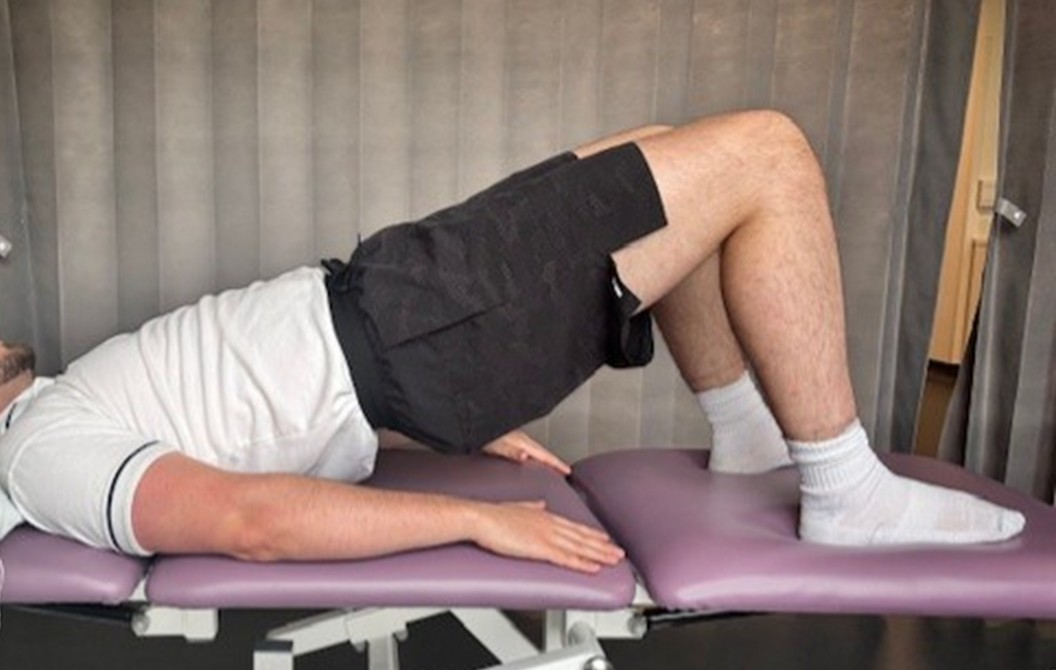
1. Shoulder bridge Lie on your back on the bed. Bend both knees and place your feet flat on the bed. Lift your buttocks from the bed. Hold for 5 seconds, then slowly lower back down on the bed. 10 reps x3 a day |
 |
|
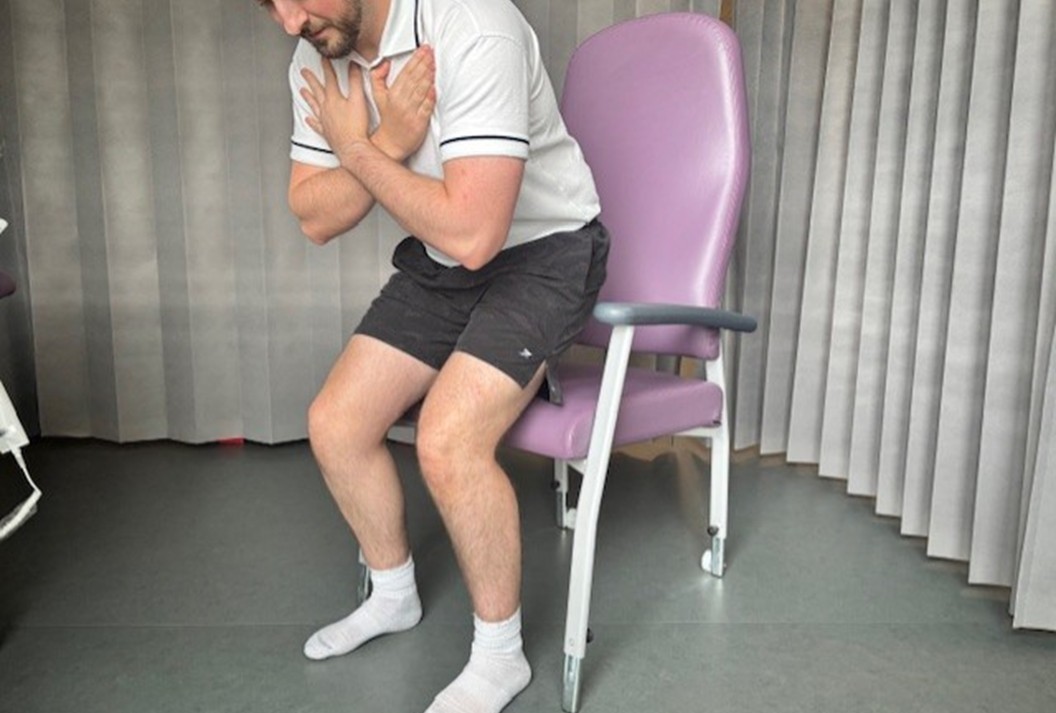
2. Sit to stand Sit in a chair with your feet flat on the floor. Crossing your arms in front of your chest, stand up slowly using your legs. Then slowly sit back down. 10 reps x3 a day |
 |
|
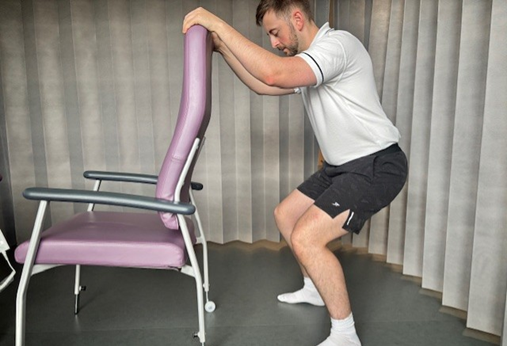
3. Mini Squats Stand holding a support. Your feet should be hips width apart. Bend your hips and knees slightly as if you’re about to sit on a stool. Ensure your knees travel directly forwards over your toes. Hold for a few seconds, then slowly push through the heels of your feet and tighten your buttock muscles to return to the upright position. 10 reps x3 a day |
 |
IF YOU HAVE BEEN TOLD YOU ARE UNDER HIP PRECAUTIONS, DO NOT START THESE NEXT 5 EXERCISES UNTIL 6 WEEKS POST SURGERY
|
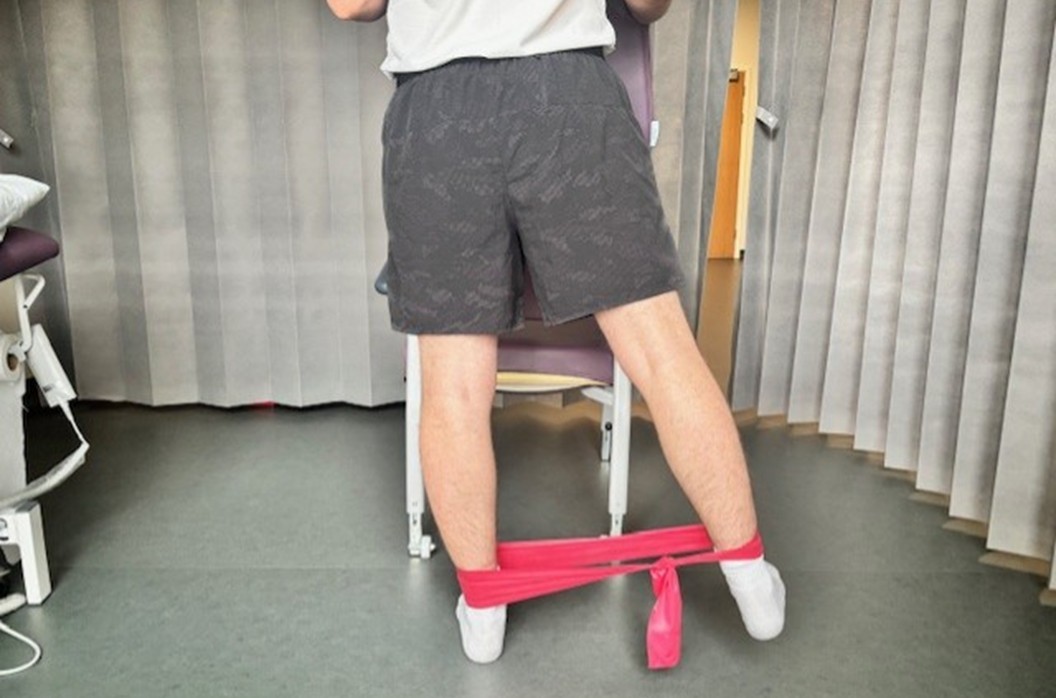
4. Resisted hip abduction Hold a support and stand up straight with a resistance band looped around both ankles. Keeping your leg straight, slowly take your affected leg out to the side. Keep your body upright, pelvis still and toes facing forwards as you move your leg. Hold for a few seconds. Control the movement as you bring your leg back to the starting position. 10 reps x3 a day |
 |
|
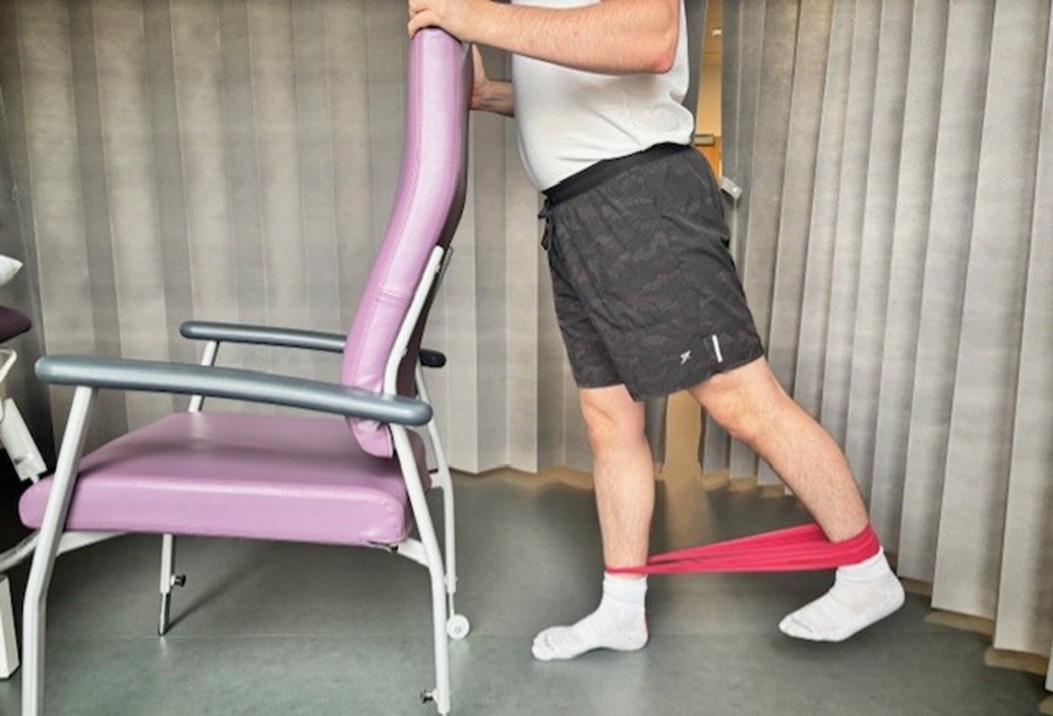
5. Resisted hip extension Hold a support and stand up straight with a resistance band looped around both ankles. Keeping your leg straight, slowly take your affected leg backwards, tightening your buttock muscles as you do this. Do not lean your body forwards as you do this movement. Hold for a few seconds. Control the movement as you bring your leg back to the starting position. 10 reps x3 a day |
 |
|
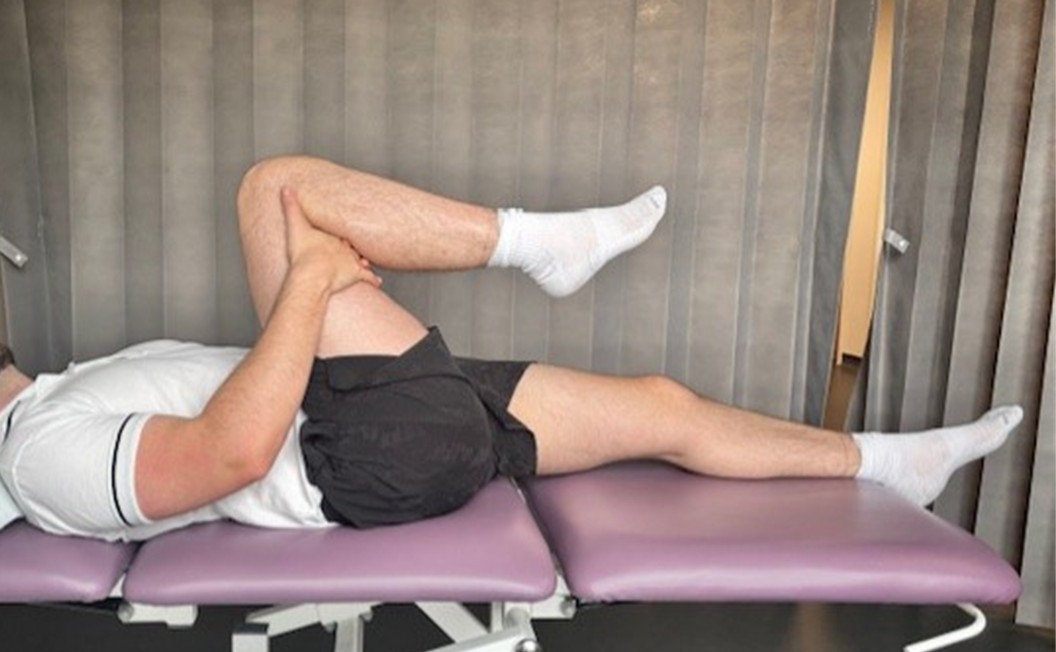
6. Hip flexion stretch Lie on your back on the bed. Reach underneath your knee on the affected leg and pull the knee in towards your chest as far as you can comfortably go. Hold this position for 20-30 seconds, then relax. 5 reps x3 a day |
 |
|
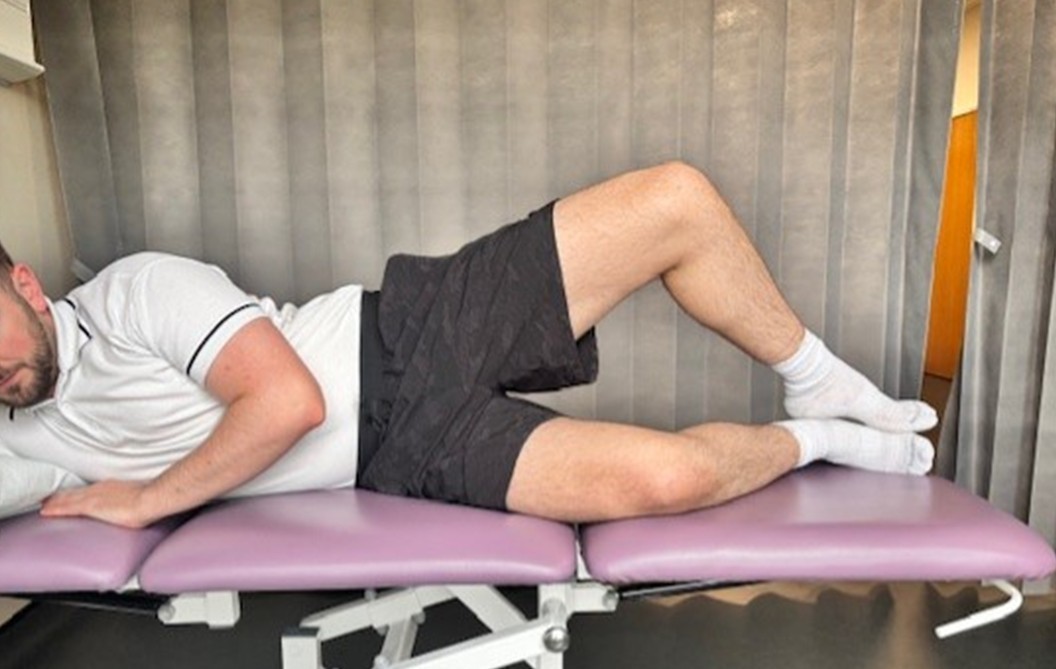
7. Clam shells Lie on your side on the bed with the affected leg upper most. Keeping your feet, ankles and knees together, bend your hips and knees a little and tighten your core stability muscles. Keeping your feet together, lift your top knee as far as comfortable without letting your pelvis roll backwards. Hold for 3 seconds, then slowly lower the knee to the starting position. 10 reps x3 a day |
 |
|
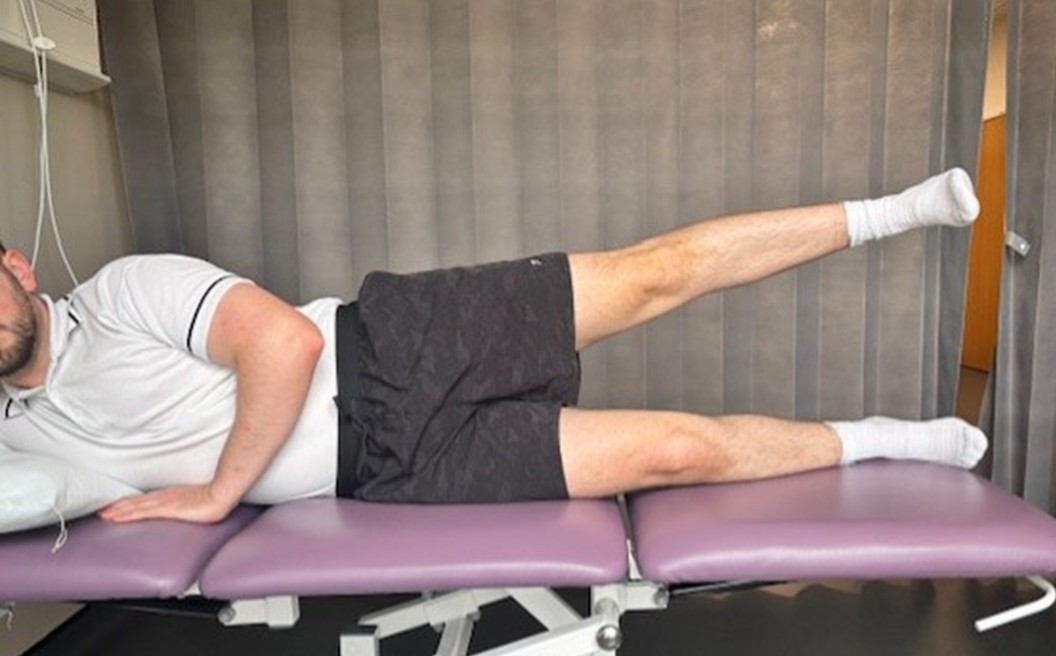
8. Hip abduction in side lying Lie on your side on the bed with the affected leg upper most. Keep your back straight and trunk still. Slowly lift your top leg upwards as far as comfortable. Ensure your leg remains straight and does not come forwards. Hold for 3 seconds, then slowly lower the leg back down. 10 reps x3 a day |
 |
Contact us
If you have any queries relating to this information, please contact the Physiotherapy service.
About this information
Service:
Physiotherapy
Reference:
BB/061
Approval date:
30 October 2026
Review date:
1 April 2029
Click ‘show accessibility tools’ at the bottom of the page

Then click ‘select language’

Alternative formats
You can use the accessibility toolbar at the bottom of your screen to:
-
Change the text size
-
Adjust the font
-
Modify the colour contrast
-
Use the translate function
If you would like this information in another format, such as Braille, audio, or easy read, please speak to a member of staff.
You can also print as well as download as PDF using the “Print this page” button at the end of the page.
Staff will print a copy for you on request
Important note
This page provides general information only. It is developed by clinical staff and is reviewed regularly every 3 years for accuracy. For personal advice about your health, or if you have any concerns, please speak to your doctor.