

Advice after your nerve block for surgery
On this page…
Introduction
Carpal tunnel is a condition where the median nerve gets compressed in the carpal tunnel of the wrist. The ‘carpal tunnel’ lies in the wrist, as you can see from the picture below. The tunnel is made up of the transverse carpal ligament and carpal bones. Through this tunnel runs the median nerve and tendons which move your wrist, fingers and thumb.
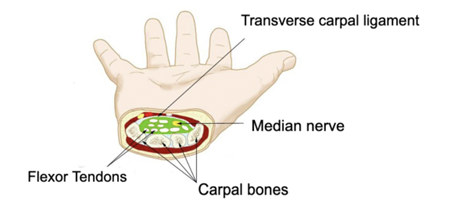
Symptoms of Carpal Tunnel Syndrome
The median nerve provides feeling to the palm side of your hand, thumb, and your index, middle and part of your ring fingers. This nerve controls some of the muscles which move the thumb. It also carries information back to the brain about feelings in your thumb, index, middle and part of the ring fingers.
Because of this, when the nerve becomes compressed, it produces pins and needs and numbness in the hands. Many people also report waking at night with numbness or pain. This happens due to the natural position people tend to sleep in, with their hands curled inwards, reducing space in the carpal tunnel. Depending on how severe the compression is, you may also experience stiffness, weakness or clumsiness in your hands.
Treatment of Carpal Tunnel Syndrome
Splinting
Your therapist may provide you with a splint to wear at night. This holds your wrist in a better position to reduce the pressure on the nerve and can help to relieve your symptoms.
Exercises
You will also be advised to start doing finger and tendon gliding exercises. These are to reduce stiffness and keep everything moving and gliding normally within your hand. These exercises can help to reduce your nerve symptoms over time.
Repeat all the exercises 2-3 times per day.
If you feel your symptoms are getting worse, please stop the exercises and contact your therapist.
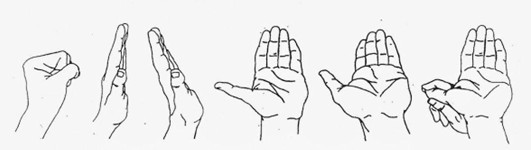
Resting up on your elbow
- First make a fist
- From there straighten your fingers
- Then stretch your wrist backwards
- Then stretch your thumb out to the side
- Then turn your arm around so you are looking at your palm.
- Then, if it is not painful, gently pull down on your thumb to increase the stretch feeling.
If your hands ache for more than 30 minutes after your exercises you should try to do less next time.
Summary
Your splint (if you have been given one) should be worn at night.
Contact details
Hand therapy departments:
0300 6133396 for Frimley
0300 6140540 then Option 2 Wexham or Option 3 for Heatherwood
Contact us
If you have any queries relating to this information, please contact the Hand therapy service.
About this information
Service:
Hand therapy
Reference:
UU/088
Approval date:
1 August 2025
Review date:
1 August 2028
Click ‘show accessibility tools’ at the bottom of the page

Then click ‘select language’

Alternative formats
You can use the accessibility toolbar at the bottom of your screen to:
-
Change the text size
-
Adjust the font
-
Modify the colour contrast
-
Use the translate function
If you would like this information in another format, such as Braille, audio, or easy read, please speak to a member of staff.
You can also print as well as download as PDF using the “Print this page” button at the end of the page.
Staff will print a copy for you on request
Important note
This page provides general information only. It is developed by clinical staff and is reviewed regularly every 3 years for accuracy. For personal advice about your health, or if you have any concerns, please speak to your doctor.