

Advice after your nerve block for surgery
On this page…
Introduction
Snoring occurs when the soft tissues or muscles in your air passages vibrate. As you fall into a deep sleep, sagging tissues narrow your airway and vibrate or flutter. The narrower your airway becomes, the greater the vibration and the louder your snoring becomes.
Snoring affects 45 per cent of the population from time to time and an estimated 25 per cent of people are habitual snorers. There are a number of reasons why you may snore:
- Age—The older you get, your throat muscles sag and vibrate.
- Weight—If you are overweight, your throat tissues are less firm and more inclined to vibrate when you breathe.
- Shape of throat—A low-set, thick soft palate, or enlarged tonsils or adenoids can narrow your airway. A longer than normal uvula can limit airflow and increase vibrations as you breathe.
- Nasal blockage—caused by allergies or a deviated septum (when the partition between your nose is crooked) can limit airflow through your nose. This forces you to breathe through your mouth where more flabby tissue is located.
- Alcohol and certain drugs— (such as sleeping tablets) affect your sleep, causing extreme relaxation of your muscles, including those in your throat.
- Position—When you sleep on your back, your tongue falls backwards into your throat which can narrow your airway and partly block.
Anatomy:
The roof of the mouth is the palate. The front of the palate has bone underneath and is called the hard palate. The back of the palate is soft and made of muscles and is called the soft palate. The free edge of the soft palate has a protrusion hanging in the midline, called the uvula. The pharynx is the side wall of the throat.
Diagram of the mouth:
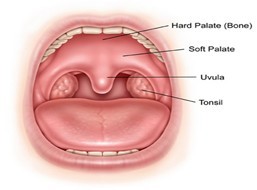
Your nose consists of a cavity, which is separated into two separate passages. The partition wall between the two is called the nasal septum. The side walls of the nasal cavities contain fleshy folds called the turbinates. The nose warms and moistens the air we breathe. Thus the nose is an air conditioner and air filter for the lungs providing moist, warm and clean air.
Sleep apnoea
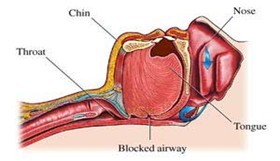
Sleep apnoea are periods when you stop breathing whilst you are sleeping. These occur when the muscles in your throat relax during sleep, and the airway narrows so much that it closes. Reduced oxygen in your body briefly wakes you up, re-opening your airways and re-starting your breathing.
This process can be repeated several times during the night. Sleep is disturbed, resulting in fatigue and a decreased quality of life. Sleep apnoea in adults can increase the risk of serious health problems such as heart failure, because it deprives the sufferer of adequate levels of oxygen, making the heart work harder than normal.
Diagram of sleep apnoea
Sleep Studies
This is sometimes necessary to exclude sleep apnoea. This is carried out at your home using equipment that monitors your sleeping patterns. If this investigation is required, it would be discussed with you by the consultant during your initial consultation.
Treatment of Snoring
Treatment of snoring involves addressing as many of the factors which contribute to snoring as possible.
This commonly involves trying to reduce weight and general measures like reducing alcohol intake. Surgery is usually the last option and may involve a combination or succession of different treatments.
Lifestyle
- Some causes of snoring (listed above) are the result of lifestyle habits. By altering these habits, you can stop—or at least minimise your snoring.
- Try to maintain a healthy diet and weight
- Regular exercise will improve muscle strength
- Fact sheets on diet and weight and exercise are available and you can talk to your doctor about your ideal target weight, and regular exercise.
General Measures
- Always try to sleep on your side, instead of your back.
- Avoid alcohol before bedtime
- Raising the head may help reduce snoring. This should be done by raising the head of the bed itself or by pillows at the correct height.
Medicines
If you have allergies or other causes of nasal congestion, see your doctor for medication. If your nasal congestion is caused by a structural problem in the nose such as a deviated septum, there are surgical techniques that can correct it.
Surgery
This is usually recommended when the above treatments fail.
Radio Frequency Technique
Radio waves—such as those used in radio transmitters—are directed onto your soft palate, and the energy that is released coagulates the inner tissue. The subsequent healing process stiffens the soft palate so that it can no longer vibrate and cause snoring.
The great advantage of this new technique is that there are no cuts, stitches or bleeding and minimal post-treatment discomfort. This also means that there is no time lost from daily activities, including work.
The treatment is performed in the outpatient clinic and takes only around 20 minutes. This is not yet available in the NHS. The success rate for control of snoring is about the same as for laser surgery.
LAUP
This uses laser to reduce and reshape the palate when excessively large or bulky. The treatment is carried out under a local anaesthetic. Rarely, if you gag easily or if this is combined with removing your tonsils, it may be done under a general anaesthetic.
The laser treatment is a similar experience to a visit to the dentist. A local anaesthetic is then applied and the procedure takes approximately 20 minutes to perform. No pain is to be expected during the operation.
Following the treatment, you go home with a variety of painkillers and anti-inflammatory. Speaking should not be affected at any time. Although it is not usually necessary to take time off work, it may be necessary if you require strong painkillers, as these may make you drowsy.
About 6—7 out of 10 people find their snoring is reduced to an acceptable level.
Tonsillectomy
The tonsils are usually removed because of recurrent tonsillitis, but if they are large, it can be a major factor in your snoring. Depending on the size and other factors, the surgeon may either recommend reducing the size with laser under a local anaesthetic, or it may involve a general anaesthetic and a one night’s stay in hospital.
Laser Turbinectomy
Snoring can be caused by the obstruction of the tissue surrounding the entrance to the nose (the turbinates in the nasal cavity).
The Laser Turbinectomy procedure involves reducing the size of the turbinates using laser. This not only reduces snoring, but improves the quality of breathing generally.
The procedure is carried out under local anaesthetic in the outpatient clinic. You sit upright in a dentist’s chair for a procedure that takes no more than 10 minutes, and you should be able to return home afterwards. There will be no pain during treatment and following this, little discomfort is expected.
Septoplasty
This is an operation to straighten the nasal septum. The stuffiness of the nose can also be reduced by electric cautery to the lining of the nose, which shrinks the lining, and this is called SMD (submucous diathermy).
UPPP
This involves trimming the uvula, soft palate and the folds enclosing the tonsils, and aim to stiffen these by scar tissue when healed.
This is sometimes combined with removing the tonsils if these are large. This is done under a general anaesthetic (fast asleep). Usually, you go home the next day. You need 2 weeks sick leave from work.
If your doctor diagnoses sleep apnoea and no surgically correctable cause is obvious, he or she may recommend wearing an oxygen mask over your face whilst you sleep, to force air through your airway so that it will not close.
This treatment is called continuous positive airway pressure (CPAP). However, this form of treatment may need to continue for months or years, and some people find wearing a mask in bed every night difficult to tolerate.
Mandibular Advancement Prosthesis (MAP)
Sometimes, snoring is caused by the tongue falling back into the throat during sleep. Mandibular Advancement Prosthesis effectively locates the tongue in a position that increases the airflow to reduce snoring.
This may be advisable, either alone or as part of a combined treatment plan if this is found to be the significant factor in your snoring. The device appears similar to a sports mouth guard. It is usually supplied by your dentist.
Whilst every effort has been made to ensure that the information given on this page is accurate, not every treatment will be suitable or effective for every person. Your own doctor will be able to advise in greater detail.
Further information can be found on the following websites:
www.
www.
Contact us
If you have any queries relating to this information, please contact the Ear or nose and throat (ENT) service.
About this information
Service:
Ear, nose and throat (ENT)
Reference:
G/041
Approval date:
23 February 2026
Review date:
1 February 2029
Click ‘show accessibility tools’ at the bottom of the page

Then click ‘select language’

Alternative formats
You can use the accessibility toolbar at the bottom of your screen to:
-
Change the text size
-
Adjust the font
-
Modify the colour contrast
-
Use the translate function
If you would like this information in another format, such as Braille, audio, or easy read, please speak to a member of staff.
You can also print as well as download as PDF using the “Print this page” button at the end of the page.
Staff will print a copy for you on request
Important note
This page provides general information only. It is developed by clinical staff and is reviewed regularly every 3 years for accuracy. For personal advice about your health, or if you have any concerns, please speak to your doctor.