

Advice after your nerve block for surgery
On this page…
What is a Central Slip Injury?
The Central Slip is the tendon which straightens the middle joint of your finger. A central Slip injury is usually caused by a sudden forceful bend of the middle joint of the finger which tears this tendon or the tendon pulls the bone away. You will be unable to fully straighten your finger and the finger maybe swollen and painful.
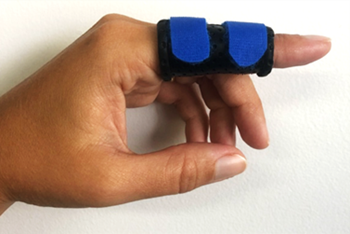
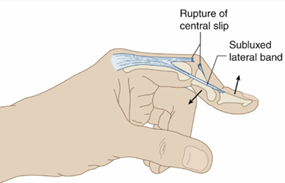
How is it treated?
The aim of treatment is to allow the tendon to heal which will allow the middle joint of your finger to straighten again. You must keep the middle joint straight for six to nine weeks, except when completing exercises provided by your therapist. These may start at week 3 or 5 dependent on the type of central slip injury you have sustained and depedendent on your healing. If the finger is bent more than advised during this time the healing bone or tendon can be damaged and the joint will need to be held straight for another six to nine weeks.
Your middle joint will be kept straight using a plastic splint or Plaster of Paris, this must be worn at all times for six to nine weeks. You may remove the plastic splint to clean your skin, the finger must remain straight and supported at all times. Your therapist will show you how to remove the splint safely. You will have a new Plaster of Paris splint made every two weeks or more frequently if necessary.
After six or nine weeks your therapist will check for signs of the finger joint straightening which is a sign of bone or tendon healing. If the finger does not fully straighten you will need to wear the splint for longer. If the finger straightens you will be shown exercises to gently bend the finger.
How to keep your finger and splint clean
You must keep your splint or Plaster of Paris dry at all times to avoid your skin becoming sore. If you have a splint you may remove the splint to clean the skin and splint; the finger must remain supported and straight at all times. Your therapist will show you how to safely remove your splint and clean your skin.
Activity and exercise
- While your finger is in the splint or Plaster of Paris it is important to avoid gripping or lifting heavy objects as this can put strain on your healing tendon.
- You should keep all other joints of your hand moving fully to stop them getting stiff, especially the end joint of the injured finger.
- We advise you check with your insurance before driving.
- Do not participate in any contact sports.
Problems you may encounter
- Swelling: the injured joint may be swollen which may increase or decrease and affect the fit of your splint or Plaster of Paris. Please arrange an appointment with the hand therapist for a splint adjustment.
- Skin irritation: water and sweat may lead to the skin becoming sore. Keep the skin dry and contact the hand therapist if skin problems persist.
- When bathing/showering, cover you splint in a plastic bag taped to your arm. Keep your arm away from the hot water as this may alter the splint shape.
- If at any time you feel the splint is causing pressure or impairing your circulation, you must contact your therapist immediately.
Avoid direct contact with heat, (e.g. radiators/hairdryers and the bath) as this may alter its shape.
Are there any complications?
Following treatment you may not be unable to fully straighten your middle joint, this is very common and doesn’t usually affect the function of the finger.
It may take several months to regain full bend of the finger, sometimes the full bend of the finger isn’t gained. There maybe swelling, tenderness and redness to the joint for many months.
Contact Details
If you have any concerns, or need to change your Hand Therapy appointment, please contact the Therapy Department on:
Frimley Park Hospital: 0300 613 3396
Heatherwood Hospital: 0300 614 0540 Option 3
Wexham Park Hospital: 0300 614 0540 Option 2
Contact us
If you have any queries relating to this information, please contact the Hand therapy service.
About this information
Service:
Hand therapy
Reference:
UU/092
Approval date:
19 February 2026
Review date:
1 February 2029
Click ‘show accessibility tools’ at the bottom of the page

Then click ‘select language’

Alternative formats
You can use the accessibility toolbar at the bottom of your screen to:
-
Change the text size
-
Adjust the font
-
Modify the colour contrast
-
Use the translate function
If you would like this information in another format, such as Braille, audio, or easy read, please speak to a member of staff.
You can also print as well as download as PDF using the “Print this page” button at the end of the page.
Staff will print a copy for you on request
Important note
This page provides general information only. It is developed by clinical staff and is reviewed regularly every 3 years for accuracy. For personal advice about your health, or if you have any concerns, please speak to your doctor.