

Advice after your nerve block for surgery
On this page…
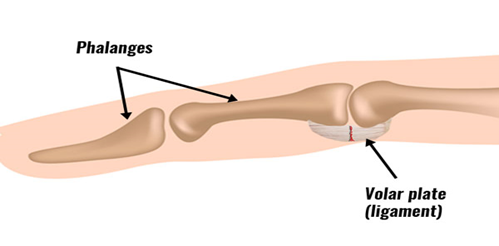
A volar plate injury is a common hand injury, often sports related. It occurs when your finger is hyper-extended (forced to bend backwards) which damages the volar plate ligament.
The injury may be a soft tissue tear or avulsion fracture where a piece of bone chips away from the middle joint of the finger.
It is common for your finger to become painful, stiff, bruised, and may result in enlargement of the joint.
Treatment
A splint (thermoplastic or Bedford support) will often be provided to protect your finger allowing it to rest and heal. For the first 3-4 weeks, the splint should be worn at all times - only being removed for hygiene and your gentle exercise programme. Early mobilisation of your finger is encouraged to maintain movement and prevent stiffness.
After 3-4 weeks, the splint may be reduced to wearing it overnight and for protection for another 2-3 weeks.
At 6 weeks post-injury you may require further splinting if you are having difficulties straightening your finger.
Contact your therapist if your splint causes any of the following problems:
- Increased swelling / pain
- If your splint feels loose when swelling reduces
- Skin irritation / soreness or splint rubbing
- If your finger turns blue, feels cold or tingles – check the straps are not too tight – remove the splint and seek medical advice if the symptoms continue.
Hygiene
It is important to keep your hand and splint clean. Avoid overusing or hyperextending your finger when the splint is removed.
The splint can be washed in cool, soapy water. Keep it away from direct heat i.e. hair dryers, radiators and hot water. Dry your skin and splint with a towel before re-applying to your finger.
Exercise plan
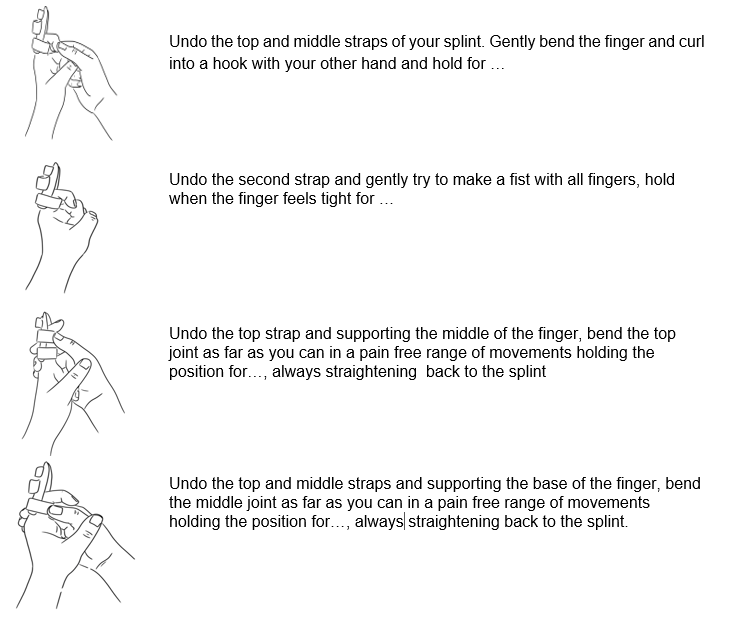
For the first 3 to 4 weeks, complete the following exercises in this order:
Activities
Avoid heavy lifting and contact sports during the initial healing process to prevent further damage to your finger. It is advised not to begin heavy lifting or contact sports until 8 weeks post injury, and to gradually build up the use of your finger.
Driving
You are not advised to drive while wearing a splint, particularly if you have significant pain or reduced grip function which prevents your ability to drive safely. Contact your car insurance company to clarify if you are insured to drive whilst wearing a splint. We cannot give you permission to drive. It is your responsibility to ensure that you are safe to drive and you are in control of the vehicle.
What outcome to expect after a volar plate injury?
- Most bony volar plate injuries heal within about 6 weeks. However, swelling, pain and discomfort may take several months to fully settle.
- Soft tissue volar plate injuries can take up to 3 months to heal completely, with normal function usually returning within that timeframe.
- If your finger is not moved enough while it heals, it may become very stiff. To prevent this, it is important to follow the exercise plan provided. Your hand may feel weaker when you start using it again and make take a few more months to rebuild your strength fully.
Complications
Most volar plate injuries heal without any complications. Associated fractures involving a joint may have a greater tendency to become stiff.
The following complications may also occur:
- Chronic swelling – extremely common
- Flexion contracture
- Joint stiffness
- Instability or recurrent dislocation
- Post traumatic arthritis
- A pain syndrome
Contact details
Hand therapy departments:
0300 6133396 for Frimley
0300 6140540 then Option 2 Wexham or Option 3 for Heatherwood
Contact us
If you have any queries relating to this information, please contact the Hand therapy service.
About this information
Service:
Hand therapy
Reference:
UU/008
Approval date:
19 February 2026
Review date:
1 February 2029
Click ‘show accessibility tools’ at the bottom of the page

Then click ‘select language’

Alternative formats
You can use the accessibility toolbar at the bottom of your screen to:
-
Change the text size
-
Adjust the font
-
Modify the colour contrast
-
Use the translate function
If you would like this information in another format, such as Braille, audio, or easy read, please speak to a member of staff.
You can also print as well as download as PDF using the “Print this page” button at the end of the page.
Staff will print a copy for you on request
Important note
This page provides general information only. It is developed by clinical staff and is reviewed regularly every 3 years for accuracy. For personal advice about your health, or if you have any concerns, please speak to your doctor.