

Advice after your nerve block for surgery
On this page…
Introduction
Dacryocystorhinostomy (DCR) is an operation to treat a blocked tear duct which is causing watering of the eye. The tears are produced by the lacrimal gland and drain along the eyelid to the inner corner.
The tears then drain into narrow channels leading to lacrimal sac (A - refer to the pic), which in turn drains into the nose via the nasolacrimal duct. The commonest site of a blockage is the nasolacrimal duct (B - refer to the pic). The eye doctor will confirm there is a blockage by flushing your tear-duct with saline in the clinic.

This operation creates a new channel from your tear duct system to the inner lining of the nose which enables your tears to drain and by-pass the blockage in the nasolacrimal duct. This involves removing a small piece of bone from the side of your nose and opening up the lacrimal sac so that it can drain directly into the nasal cavity.
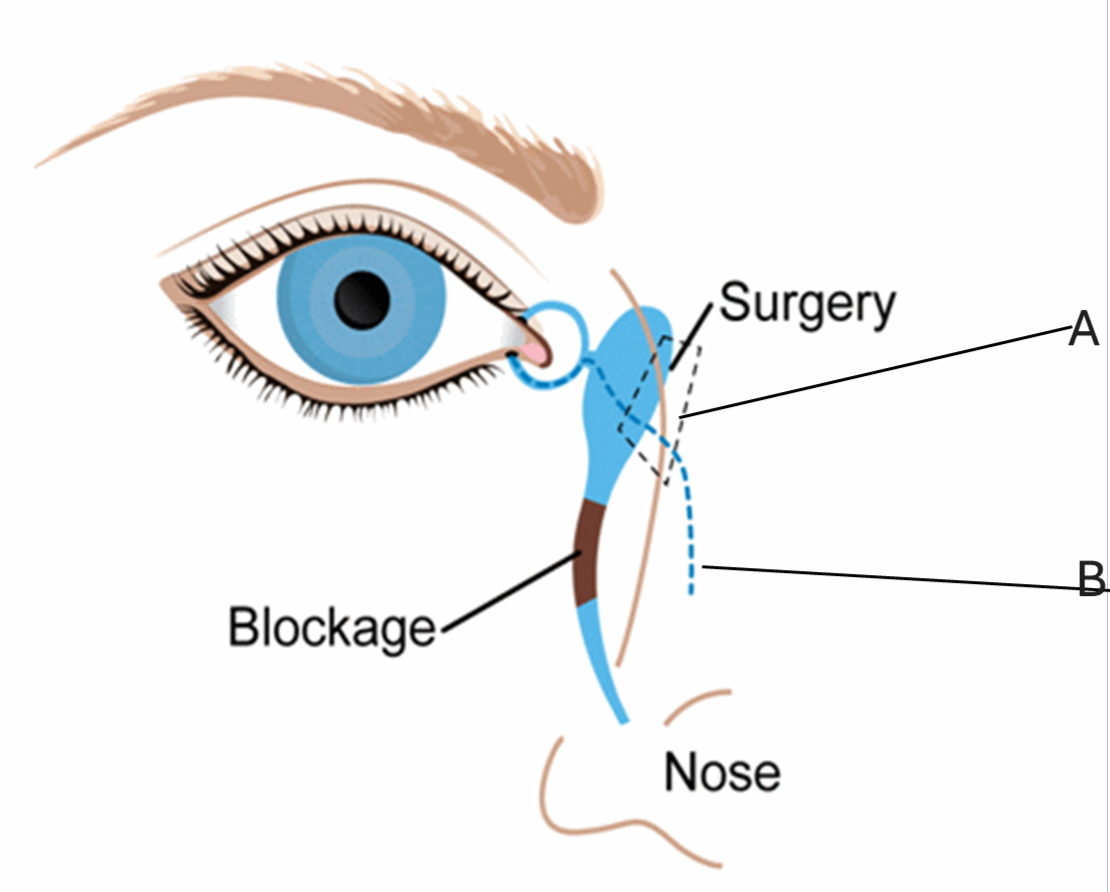
A - Lacrimal sac opened here into nasal cavity after bone is removed.
B - New drainage passage created between lacrimal sac and nasal cavity, by-passing blockage.
Types of DCR
There are two main types. The technique which will be used to treat your blocked tear duct will be discussed with you in the eye clinic.
- External DCR
- This is performed by the eye surgeon and involves making a cut on the side of your nose which will leave a scar approximately 1.5cm long. This usually fades and will not be very noticeable in a few months time.
- Endonasal DCR
- This is performed by an eye surgeon and usually an ENT (Ear Nose and Throat) surgeon. No scar will be left using this method as the operation is done up the nose internally using an endoscope. You will be seen in the ENT department for further assessment if you prefer this method.
Whichever technique is used, a clear silicone stent is normally inserted into the tear ducts which you may be able to see in the inner corner of your eye if you look very carefully. This stays in place for about 4 - 8 weeks to help keep the new channel open while you are healing after the surgery.
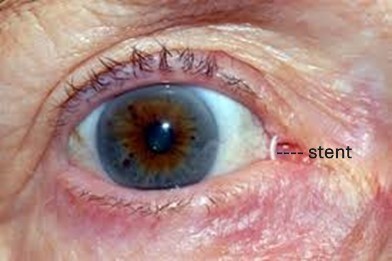
Before surgery
Certain medications predispose to excessive bleeding such as:
- Aspirin
- Ibuprofen
- Warfarin
- Clopidogrel
- Rivaroxban
- Apixaban
- Edoxaban
- Dabigatran
You will be asked to check with your GP if it is possible to stop these for a short while before surgery. This can help reduce the amount of bleeding during the surgery and the amount of bruising you can expect afterwards.
A consent form is signed after the eye doctor has explained the operation, the benefits and any risks involved. The main benefit is to stop the eye watering.
The possible risks
- Infection
- Bleeding
- Failure (it may not work)
- Recurrence of watering (the tear-duct may block up again)
On the operation day
- You cannot drive on the day of your operation. This is usually day case surgery so you should be able to go home the same day.
- The surgery will be performed under general anaesthetic (you are put to sleep).
- You will have stitches along the skin incision on the side of your nose, if you are having an external approach. These will be removed when you come back to the eye clinic for your follow-up appointment.
- Antibiotic ointment is applied to the eye and wound at the end of your operation. The eye is then padded up. You can remove this pad yourself at home the following morning.
After the surgery
- You will be given eye drops 3 times a day for 4 weeks. You may also be given a course of antibiotic tablets.
- It is best not to drive for a few days after surgery as your vision is likely to be blurred.
- If there is any pain, you may take paracetamol. You should avoid excessive physical activity for about a week. It is best to avoid travel abroad for about 2 weeks after surgery.
- You should avoid hot drinks for 2 days
- You should avoid blowing your nose for 2 weeks. After 2 weeks however, you should blow your nose as usual to keep it clear of crusts.
- Your eyelids and nose will be bruised and swollen for about 2 weeks. It takes longer than this for things to settle down completely.
Post-op appointments
A doctor or nurse practitioner will see you in the eye clinic 1 - 2 weeks later to remove your stitches if you have the external approach and to check that the wound has healed properly.
A further appointment will be made for you to be seen by the eye doctor who will remove the silicone stent from your nose. This is removed in the clinic and is usually fairly quick and painless.
If you have any concerns after your operation, or if your sight deteriorates, please contact the staff in the eye treatment centre on the following numbers:
| From 9am to 5pm Monday to Friday: | 0300 373 5884 |
| From 5pm to 9am and at weekends: | 0300 614 5000 and ask for the Eye Doctor on call |
Contact us
If you have any queries relating to this information, please contact the Ophthalmology service.
About this information
Service:
Ophthalmology
Reference:
QQ/031
Approval date:
5 August 2024
Review date:
1 July 2027
Click ‘show accessibility tools’ at the bottom of the page

Then click ‘select language’

Alternative formats
You can use the accessibility toolbar at the bottom of your screen to:
-
Change the text size
-
Adjust the font
-
Modify the colour contrast
-
Use the translate function
If you would like this information in another format, such as Braille, audio, or easy read, please speak to a member of staff.
You can also print as well as download as PDF using the “Print this page” button at the end of the page.
Staff will print a copy for you on request
Important note
This page provides general information only. It is developed by clinical staff and is reviewed regularly every 3 years for accuracy. For personal advice about your health, or if you have any concerns, please speak to your doctor.