

Advice after your nerve block for surgery
On this page…
The Alexander “Active Resting” Position
The Alexander ‘Active Resting’ position will help to restore balance and ease throughout your body. Lying in an active resting position for ten minutes each day can have very beneficial effects on tension levels in particular in the neck/shoulder area.
It is also a useful position to practice diaphragmatic breathing in. This is because, when you lie flat, your muscles relax and your diaphragm can move more easily.
What is an active resting position?
- Lie flat on your back, on a firm but comfortable surface. A thick rug or yoga mat is ideal, a bed is too soft
- Bend your knees up and place your feel flat on the floor (as long as this is comfortable for you). Ideally you should be barefoot or wearing socks
- Place your head on a book or books (roughly 1.5-3 inches in height), so that your head feels supported in line with your spine (chin not falling back or tipping forward). This encourages release in the muscles that join the back of the neck to the base of your skull
- Your hips, knees and feet should be approximately the same distance apart. Allow your knees to relax apart, don’t lock them inwards
- Place your hands on your stomach (unclasped) and your elbows resting on the floor
- Now, focus on your breathing, feeling the tummy rise and fall (see ‘posture and breathing’ leaflet for more information)
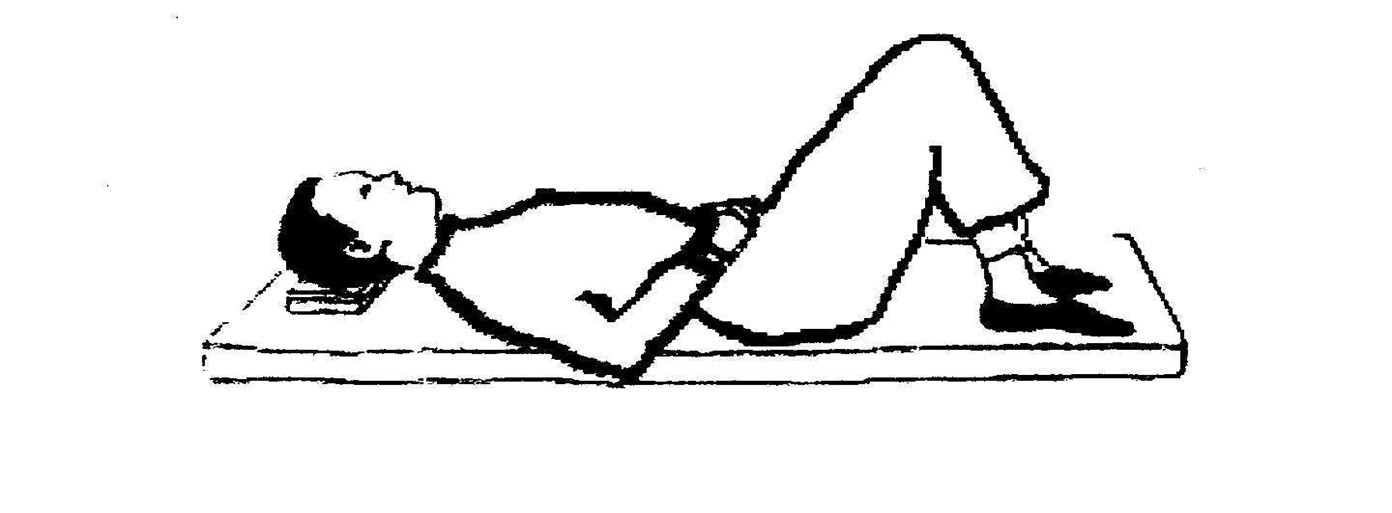
How to encourage release in the body
- Think of releasing the tension at the back of the neck, where the skull meets the spine
- Think of allowing your shoulders to release apart but do not push them. Think of expansion and space across your collar bones and chest
- Think of the elbows releasing into the floor, as if the arms are ‘dropping out’ of the shoulder joints
- Allow your body to feel heavy, as if it is sinking/spreading downwards and outwards
- With each exhalation, feel yourself relaxing and letting go
Aim to spend 5-10 minutes in the position, at least once a day.
Contact us
If you have any queries relating to this information, please contact the Speech and language therapy service.
About this information
Service:
Speech and language therapy
Reference:
VV/026
Approval date:
27 September 2024
Review date:
1 September 2027
Click ‘show accessibility tools’ at the bottom of the page

Then click ‘select language’

Alternative formats
You can use the accessibility toolbar at the bottom of your screen to:
-
Change the text size
-
Adjust the font
-
Modify the colour contrast
-
Use the translate function
If you would like this information in another format, such as Braille, audio, or easy read, please speak to a member of staff.
You can also print as well as download as PDF using the “Print this page” button at the end of the page.
Staff will print a copy for you on request
Important note
This page provides general information only. It is developed by clinical staff and is reviewed regularly every 3 years for accuracy. For personal advice about your health, or if you have any concerns, please speak to your doctor.