

Advice after your nerve block for surgery
On this page…
This leaflet explains about how to look after your PEG-J tube at home, including any problems which can occur. If you have any further questions, please contact your dietitian or nutrition specialist nurses.
General Information on PEG-J Feeding
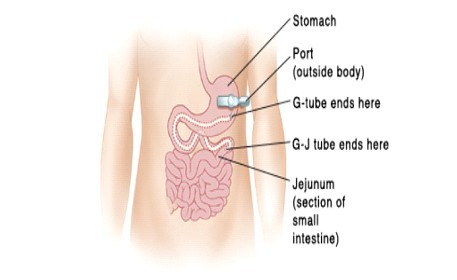
A PEG-J a type of feeding tube which allows access both to the stomach and to the jejunum (the top part of the small intestine).
PEG-J stands for Percutaneous Endoscopic Gastrostomy Tube with
a Jejunal Extension.
Why Do I Need a PEG-J Tube?
You may have had a PEG-J tube inserted because it is unsafe to have food by mouth, or because you are struggling to take enough food and therefore not getting all the nutrients you need. You may also be experiencing reflux which is where food is reverting back into the oesophagus from the stomach and it is therefore safer to feed directly into the jejunum.
Comfort and Safety
- If any sickness or breathing difficulties are experienced during feeding, stop the feed immediately
- If you are using the gastric port for feed or medication avoid lying flat during administration.
- Sit up if possible. If feeding in bed, the upper back and head should be raised on extra pillows aiming for an angle of 30-45 degrees. This helps to prevent indigestion/ regurgitation/ heartburn. Remain upright for 30-45 minutes post feed
- A feeling of ‘fullness’ during feeding may indicate that feed is being administered more quickly than recommended. Try reducing the rate by 10-20mls/hr
Care Of PEG-J Tube
-
The PEG-J tube must be ‘flushed’ or rinsed with cooled boiled water
-
before and after any feed or medication is administered through the tube
-
Every 4-6 hours while in use and during rest periods
-
Even if you rarely use the gastro-port it should be flushed daily to keep it clean
This ensures that it will not become blocked. The dietitian will advise you on how much water to use for this
-
-
The external fixation device (which holds the tube in place on the outside) should be approximately 0.5 cm to 1 cm from the skin. It should be adjusted if necessary (e.g. if weight changes) moving the tube as little as possible. Your specialist nurse will show you how to do this.
-
At least once a week, the tube should be removed from the blue clamp, advanced 2-3cm into the stomach then pulled back to the original position, this is to avoid the internal disc becoming attached to the stomach wall.
-
The tube should not be rotated. Care should be taken to ensure the jejunal extension is not displaced.
Hygiene
- Always wash your hands carefully and dry hands on a clean towel or paper towel before handling feeds or feeding tubes. The six-stage procedure described later in this booklet will help you to effectively decontaminate all areas of your hands
- Handle and store feed and equipment in accordance with recommendations
Skin care
- The area around the tube site should be kept clean and dry in order to prevent any soreness or infection
- Washing the area daily with a gentle soap and water is usually all that is needed
- Do not use talcum powder or creams on this area unless prescribed by your GP. Dressing or gauze are best avoided under normal circumstances
- Any soreness, swelling, odour or discharge should be reported to your GP or Nutricia homeward nurses in the first instance.
Medication
- If it is necessary to have medication through the tube, make sure these are prescribed in an appropriate format e.g. soluble/dispersible tablets or liquids
- Please be aware that some liquid medications can be sticky and may need diluting to avoid tube blockage—please discuss with your pharmacist
- Check with your pharmacist that your medication is suitable to be administered into this part of your digestive system
- Medication can lead to tube blockages, so your PEG-J tube must be flushed with cooled boiled water before, between and after each different medication that is given. Usually, this would entail a 50ml flush of cooled boiled water prior to giving the medication, 10ml flushes between each separate medication, followed by a final flush 50ml cooled, boiled water. The dietitian will advise you of any change to these quantities.
Mouthcare
- It is important, even when not eating or drinking, to take good care of your teeth and mouth
- Teeth and gums should be brushed as usual
- Lip salve can prevent dryness or soreness around the mouth
- It is important to visit the dentist at usual intervals
Stopping feeding
- If for any reason it is not necessary to take feed regularly via the tube, it is recommended that the tube is flushed at least twice a day with 50mls of water to prevent the tube from becoming blocked
- If you become able to take enough food and fluids by mouth to meet your nutritional requirements, then we can refer you to Enteral Nutrition CNS team for tube removal.
Care of Enteral Feed and Equipment in the Home Environment
Feeds
- All prescribable feeds have an expiry date on the pack. Check the date and never use feed if the expiry date has passed
- Before opening feed gently shake the pack
- Liquid feeds in packs are sterile until opened and therefore do not need refrigeration but should be stored at room temperature (away from heat or direct sunlight)
- In winter months it is advised not to store feed in garages or garden sheds for risk of freezing
- Rotate stock of feed, using up ‘old’ stock before using a new delivery
- Powdered feeds should be kept dry and at room temperature
- Once opened, any liquid feed which is not used immediately must be kept covered and refrigerated for up to 24 hours (feed should be given at room temperature, never given straight from the fridge, so take feed out of the fridge 30 minutes prior to using)
- Any feed not used within 24 hours of opening must be discarded
Washing Equipment
|
ITEM |
USE FOR |
CLEANING METHOD |
DISCARD AFTER |
|
Giving set |
24 hours |
Not applicable |
24 hours |
|
Feed reservoirs |
24 hours |
Not applicable |
24 hours |
|
Re-usable syringes (syringes issued on the ward are not re-usable) |
|
Immediately after use, wash and rinse following instructions below |
7 days |
|
Extension sets |
|
Immediately after use, wash and rinse following instructions below |
10 days |
- Some disposable equipment may be washed and re-used
- Items which may be re-used after cleaning should be washed well in hot water containing detergent and then rinsed thoroughly in clean water
- When washing syringes separate the chamber and plunger
- After rinsing, allow to dry by inverting syringes on a clean surface or kitchen paper. Do not use dishcloths or tea towels
- Store equipment in a clean container
- The syringes should be purple oral/enteral syringes. Syringes issued by the wards are not re-usable, but the syringes provided once you are at home, should be re-usable
- Ensure feeding pump is cleaned regularly. If feed is spilled on to the pump, clean immediately.
Water
- We use cooled boiled water for all patients at home unless advised otherwise
- Water can be boiled and kept in a covered container in the fridge for a 24-hour period and then changed daily
- Water should be given at room temperature - never give straight from the fridge
Handling Feed and Equipment
- Hand hygiene is very important. Effective hand washing will reduce the risk of infection. Prior to handling feeds or equipment hands should be thoroughly washed with soap and hot water and dried on a clean towel. Wash hands thoroughly. The six stage procedure described next will help you to effectively decontaminate all areas of your hands
- Disposable gloves are not needed by family members but should be worn by others (e.g. dietitians, district nurse) when handling feed and equipment
- Careful, clean handling of feed and equipment will reduce risk of bacterial contamination
Six stage hand washing guide
| 1. Palm to palm | 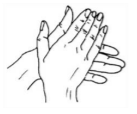 |
| 2. Palm to palm with fingers | 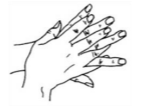 |
| 3. Palm to back with fingers interlaced | 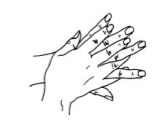 |
| 4. Fingers clasped | 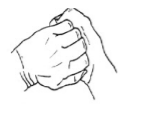 |
| 5. Rotational rubbing of both thumbs | 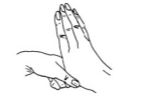 |
| 6. Tips of fingers opposite palms | 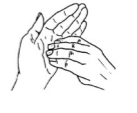 |
PEG-J feeding – Problems Which May Occur
Tube Blockage
This should not happen if the tube is always flushed as instructed.
However, should the tube become blocked:
- First draw back tube contents to remove blockage
- Try to flush the tube with warm water (not hot)
- Use the syringe plunger to apply gentle pressure to withdraw contents of the tube, try a push/pull action
- Gently squeeze/roll blocked section of tube between finger and thumb to help disperse the blockage
If no success:
- Try to flush the tube with soda water or one teaspoon of bicarbonate of soda mixed with 50ml warm water and leave in the tube for approximately 20 minutes
- Please note – never try to force water into the PEG as this may split the tube
- The tube may not clear on the first attempt. Repeated attempts may be necessary
If still no success:
- If you are using the tube to administer fluid or medication as well as feed, it is possible that you may become dehydrated, or suffer from symptoms that your medications usually control
- Contact the Nutrition nurses at the hospital where your tube was placed
- If it is outside of working hours, please contact the out of hours GP service who may refer you to your local A & E
Can the tube fall out?
It is unlikely that the tube will become completely dislodged; however, displacement of the jejunal lumen may occur. If this happens, you may experience symptoms such as reflux or vomiting.
If you experience any unusual symptoms
- If you are using the tube to administer fluid or medication as well as feed, it is possible that you may become dehydrated, or suffer from symptoms that your medications usually control
- Please contact the Enteral nutrition CNS at your local Hospital as soon as possible
- If it is outside of working hours, please contact the out of hours GP service who may refer you to your local A & E
Dehydration
- This is when the body needs more water. It can be caused by a variety of reasons such as fever, not taking enough water or hot weather
- If you feel thirsty, have dry lips, feel weak and are not passing very much urine, then you may be dehydrated
- Overcome this by flushing the tube with extra cooled, boiled water prior to and at the end of feeding
Fullness or Discomfort During Feeding
- Check that feed is not being given more quickly than is recommended by your dietitian
- Contact the dietitian for advice if the problem persists
Nausea or Vomiting
- Stop the feed in the case of any vomiting
- Check the feed is not being given more quickly than is recommended by your dietitian
- Check that the feeding position is correct (i.e. not lying flat), aim for 30–45-degree angle
- If feeds are not tolerated, please contact your dietitian in the first instance for advice.
- As vomiting may either displace the jejunal tube or indicate displacement of the jejunal lumen, tube position may need to be confirmed before restarting feeds following an episode of vomiting.
- If the issue persists, contact the Enteral Nutrition CNS team at your local hospital during working hours, or attend A&E if urgent assessment is required outside of these hours.
Further Information
Additional information on feeding can be obtained from PINNT (Patients on Intravenous and Nasogastric Nutrition Therapy).
This is a support group for patients receiving nutrition via their veins or through a feeding tube.
Telephone or fax on 020 3004 6193, between the hours of 09.30am and 16.30pm. You may also log on to their website www.
|
Important Information |
Future Contact
Once you are at home, the dietitian will telephone or visit you at regular intervals to review your progress and make any necessary changes to your feeds.
Please contact the dietitians between appointments if you have any queries or problems relating to:
- Your feeding plan
- Your feeding tube or other equipment
- Any problems during feeding (e.g. discomfort, nausea, vomiting, diarrhoea)
Nutricia Homeward nurses in community or Enteral Nutrition CNS at your local hospital may also be able to assist you with queries regarding your feeding tube.
If there are any problems with the delivery of feeds or giving sets, please contact Nutricia Helpline.
CONTACT INFORMATION:
|
DIETITIANS: For any questions regarding your feeding regime, including tolerance, timings or potential side effects, the Dietitians may be contacted during office hours 8.30am to 4.00pm, Monday – Friday. Tel: 0300 6153232 HOSPITAL NUTRITION NURSES: For tube related issues, the Hospital Nutrition Nurses may be contacted during office hours 8.30am to 4.00pm, Monday – Friday. If feeding tube was placed at Frimley Park Hospital: Nutrition Nurses at Frimley Park Hospital: TEL: 0300 613 9087 - 07393 240680 If feeding tube was placed at Wexham Park Hospital: Nutrition Nurses at Wexham Park Hospital: Krishna Patel 07775008920, Cristina Andrei - 07393265825 NUTRICIA HOMEWARD: Nutricia Homeward nurses can be contacted during working hours Monday to Friday for advice and support. Outside office hours, contact the Nutricia advice line, who will put you in touch with the on call nurse who may be able to advise you over the telephone. Nutricia Homeward: TEL: 0800 093 3672 EMERGENCY: In case of an emergency, if the dietitian or nutrition nurse cannot be contacted, please contact your GP. If you are unable to administer your feed for any length of time, your body may become dangerously short of fluid. If this happens outside of working hours, please contact the out-of-hours GP service which may refer you to your local A&E department |
Contact us
If you have any queries relating to this information, please contact the Dietetics service.
About this information
Service:
Dietetics
Reference:
DT/043
Approval date:
1 April 2026
Review date:
1 April 2029
Click ‘show accessibility tools’ at the bottom of the page

Then click ‘select language’

Alternative formats
You can use the accessibility toolbar at the bottom of your screen to:
-
Change the text size
-
Adjust the font
-
Modify the colour contrast
-
Use the translate function
If you would like this information in another format, such as Braille, audio, or easy read, please speak to a member of staff.
You can also print as well as download as PDF using the “Print this page” button at the end of the page.
Staff will print a copy for you on request
Important note
This page provides general information only. It is developed by clinical staff and is reviewed regularly every 3 years for accuracy. For personal advice about your health, or if you have any concerns, please speak to your doctor.