

Advice after your nerve block for surgery
On this page…
A Patient guide
This information leaflet aims to give you some helpful advice preparing yourself and your home environment for your discharge from hospital following emergency surgery/ planned surgery.
You will be seen by a physiotherapist after surgery to discuss your exercises and post-operative restrictions advised by your consultant. The time you will be under restrictions and wearing a poly-sling varies, but is usually between 2 and 6 weeks. You will not be able to put weight through your operated arm when carrying out activities of daily living.
Activities of Daily living
You will be one handed for a period of time whilst wearing the poly-sling, the following advice gives some tips on how to manage.
Washing and Dressing
Your occupational therapist will discuss your personal care activities with you. You will need to wash and dress your body using your un-operated arm.
Depending on your restrictions you may be provided with a sling for showering. Your wound dressing is water resistant therefore showering with a non-slip mat in place is advisable to taking a bath. This is to protect the wound and to avoid weight bearing on your operated arm.
Please be advised that your balance may be affected while wearing a sling and therefore consider safety aspects when stepping in/out of the bath/shower or on uneven ground. Always support your arm in your sling, on your lap or on a surface in front of you.
Always dress your operated arm first and undress it last. You will require loose clothes that preferably button down the front. Avoid clothing with small buttons, hooks and zips. Ladies may find a bra uncomfortable and may prefer to wear a strapless or front-fastening bra. Consider slip-on, easy fitting shoes.
Dressing Procedure in a Sling
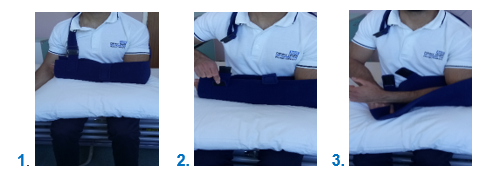
- Sit on the bed and place a pillow(s) under your arm so it is rested in the sling position.
- Undo the buckle and Velcro fastenings at the elbow and wrist. This will release the shoulder strap. You may need assistance.
- Gently slide out the sling from underneath your forearm by pushing down into the pillows. Keep the operated shoulder as still as possible.
- Thread the sleeve onto your operated arm and take the garment as far up to the shoulder as possible. Keep the operated shoulder as still as possible. You will then be able to put your non operated arm into the sleeve, bringing the garment up and around your shoulders to do the clothing up.
- Replace the sling by gently sliding it under your forearm. Replace the buckle and Velcro fastenings. You may need assistance.
- To fit sling reverse steps 3 to 1.
Sleeping
Lying on your back may be the most comfortable position with a pillow placed behind the operated arm.
Standing from Chairs, Toilets and Beds
It can be quite difficult to stand from low furniture. If you feel that you will struggle with this post operatively it is advisable to raise the height. e.g. extra cushion, raised toilet seat, chair or bed blocks.
Domestic Tasks
It is advisable to cook extra meals and stock up with freezer food. Use ready prepared meals or items that need little preparation e.g. pre-chopped vegetables. There is equipment available which can help with food preparation, for example easy grip jar openers, pizza cutters. We suggest you prepare food in small dishes that are easy to hold and carry in one hand. If you use a walking aid we suggest you sit in your kitchen to eat and drink.
You should avoid heavy household duties that may put undue stress on your shoulder until approximately 12 weeks post op or when advised by your physiotherapist.
If you live alone it is advisable to stay with someone, or arrange for someone to come in and help you with household tasks, shopping and looking after pets.
Social services will not provide support with domestic tasks.
Driving
You must not drive until your consultant advises you it is safe to do so, approximately six-eight weeks. If your ability to drive has been affected you are required by law to contact the DVLA and you may need to inform your insurance company of your operation as your insurance may be invalid.
Returning to leisure activities
Prior to restarting any leisure activities it is advised you discuss them at your post-operative clinic review or with your outpatient therapist. The ability to return to leisure activities will depend on pain, range of movement, strength and the procedure undertaken.
When can I return to work?
You will probably be off work approximately 6–8 weeks, depending on the type of job you have. Please discuss any queries with the therapists or hospital doctor.
Discharge
It is your responsibility to set up your home environment and organise the support you will need post operatively, do not assume we will provide any help at home.
Equipment
Living made easy http:/
Complete Care Shop http:/
Contact us
If you have any queries relating to this information, please contact the Occupational therapy service.
About this information
Service:
Occupational therapy
Reference:
UU/022
Approval date:
23 June 2025
Review date:
23 June 2028
Click ‘show accessibility tools’ at the bottom of the page

Then click ‘select language’

Alternative formats
You can use the accessibility toolbar at the bottom of your screen to:
-
Change the text size
-
Adjust the font
-
Modify the colour contrast
-
Use the translate function
If you would like this information in another format, such as Braille, audio, or easy read, please speak to a member of staff.
You can also print as well as download as PDF using the “Print this page” button at the end of the page.
Staff will print a copy for you on request
Important note
This page provides general information only. It is developed by clinical staff and is reviewed regularly every 3 years for accuracy. For personal advice about your health, or if you have any concerns, please speak to your doctor.