

Advice after your nerve block for surgery
On this page…
This information explains the risks of developing blood clots and administration of Fragmin® injections. This medicine is used to help prevent and treat blood clots that can occur in your limbs or chest.
What is Deep Vein Thrombosis (DVT)?
Blood clotting is natural mechanism to stop you bleeding from a cut. It is triggered by the body when you have a cut to stop you from bleeding too much. A Deep Vein Thrombosis (DVT) is a blood clot that forms within a deep leg vein. This blocks the normal flow of blood through the leg veins.
Why does a blood clot form in leg veins?
Normally blood flows freely through veins. It does not usually clot or form a plug within a vein. Three factors may trigger a clot to form in a vein:
1. A reduced blood flow (e.g., immobility, surgery or long-distance travel);
2. Changes to the blood’s clotting mechanism or;
3. Changes to the smooth lining of the blood vessel wall (e.g., trauma, fracture or inflammation).
Who is most at risk?
There are several factors which increase your chance of developing a DVT. Some of the risk factors for DVT include:
- Previous DVT or pulmonary embolism (PE). A PE is a blood clot in the lung (see full explanation later in this leaflet).
- Major Orthopaedic operations.
- Trauma.
- Paralysis or immobilisation of lower limbs.
- Family history of DVT or PE.
- Faulty blood clotting.
- Active cancer.
- Recent medical illness (e.g., heart or lung disease, kidney disease/failure or recent heart attack).
- Smoking.
- Obesity/overweight (e.g., BMI>30kg/m2).
- Pregnancy.
- Age over 40 years.
- The contraceptive pill or HRT which contain oestrogen.
- Very large varicose veins (not operated on).
What are the symptoms of DVT?
Typical symptoms include pain, calf tenderness and swelling in the whole leg compared to unaffected leg. The calf may be warm and red. Sometimes there are no symptoms in the leg and the DVT is only diagnosed if a complication occurs in the form of a PE. This can cause a serious problem. Sometimes it is difficult for a doctor to be sure of the diagnosis as there are other causes of a painful and swollen calf especially when you have injured your leg. You will normally be seen urgently at hospital if you have a suspected DVT. Tests may be done to confirm the diagnosis.
Is DVT a serious condition?
Blood clot in the leg (DVT) itself is not a serious condition if the clot remains stuck to the vein wall. Blood clots can dislodge from the vein wall and travel along to the lung which is called Pulmonary Embolism (PE).
This can be a serious problem depending on the size of the embolus. This can present with shortness of breath, rapid heartbeat and chest pain. PE is not common but can be life threatening and requires urgent medical attention.
DVT can cause inflammation and obstruction in the deep venous system (deep veins of the leg). This complication can produce pain, swelling, discolouration and ulceration of the leg. This is called post-thrombotic syndrome, which is a long-term problem.
Self-administration of Fragmin (Dalteparin) injections
It is the decision of the Consultant managing you care as to whether you are required to have Fragmin injections after your operation and/or lower limb injury to thin the blood to try to prevent DVT.
The drug we use is called Fragmin® (Dalteparin) and the commonest dose is 5000 units once a day, for as long as your Consultant feels you need it and, if this applies, for as long as the plaster is on your leg. You will be given your first injection on the ward, in A&E or during your Fracture Clinic appointment. and shown how to self-administer your own injections. If you really don’t feel able to give the injection we can teach a relative to give it to you or we may be able to arrange a District Nurse to visit daily to administer the drug.
You may be given a prescription for the whole course, or you may only be given a prescription for two weeks. If you require a further prescription to complete the course, you may need to contact your Consultant as some GPs will not prescribe more for you. If attending the Fracture Clinic for a post operation outpatient appointment – please remind the doctor to give you a new prescription.
How to give a Fragmin injection
You should read the Patient Information Leaflet included in the Fragmin® pack before administering the medicine. Fragmin® is given by a small injection under the skin. You should take the dose of Fragmin® at the time recommended by your doctor. This leaflet explains how you should go about injecting Fragmin® yourself. Please follow the steps explained below.
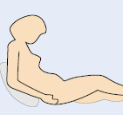
Firstly, remove the single dose Fragmin® syringe from the box.
Then wash and dry your hands.The injection site should be cleaned. (Please note that if a carer is doing the injecting then it is recommended that they wear gloves to perform the injection)
|
Step 1 |
|
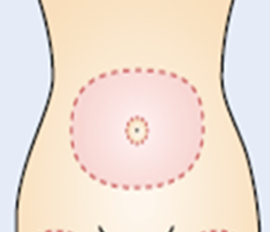
| Step 2 Your tummy (see shaded area) is usually best as the injection site. For comfort and to reduce the risks of complications (eg, injection lumps; scarring) it is important that you change the injection site each time. This can be done by rotating around the belly button. |
|
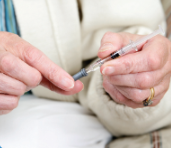
| Step 3 Pick up the syringe and take off the grey rubber cover by pulling it straight off. You will notice an air bubble in the syringe, which is supposed to be there and you can just ignore it. It is important not to press the plunger yet as some medicine may be lost. |
|
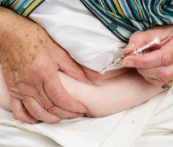
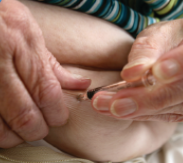
| Step 4 Hold the syringe in one hand and with the other hand, gently pinch a fold of skin with its fatty tissue between your thumb and index finger (as demonstrated in the picture). This will be the injection site. |
|
| Step 5 Hold the syringe like a dart, keeping the needle at a right angle. Insert the needle into the skin until the needle is fully inserted. |
|
| Step 6 Keep pinching the fold of skin whilst pressing the plunger and inject the Fragmin® slowly until all of the medicine has been injected. Then release the fold of skin and pull the needle out. |
If there is any oozing of blood at the injection site, apply gentle pressure, however, do not rub the injection site as this may encourage bruising.
Immediately dispose of the syringe in the safe container, ideally a yellow sharps bin which can be purchased from most pharmacies. The container must be stored safely and away from children at all times. After you have finished the course of Fragmin® injections, contact your local Council to arrange for collection of your used sharps.
Side-effects
People who take Fragmin® may experience side effects. This is a short description of the more common side effects you could have. Contact your Consultant or GP if you have any worries or concerns, or if you notice anything unusual.
The most common side effect of Fragmin® is bleeding, therefore it is more likely that you would bleed or bruise easily should you injure yourself whilst on the course of injections. Some bleeding events can be serious.
You might even get a bruise ranging from the size of a pinprick to the size of a two pound coin. If you notice a lump at the injection site, don't worry as it is just fluid which will soon be absorbed into your body.
Allergic reactions with Fragmin® are not common. But, tell your doctor before you start treatment if you have had a reaction to medicines in the past.
Some less common side effects that you may notice when taking Fragmin® are:
• Bleeding of gums
• Coughing up blood
• Difficulty in breathing or swallowing
• Dizziness
• Headache
• Increased menstrual flow or vaginal bleeding
• Nosebleeds
• Paralysis
• Prolonged bleeding from cuts
• Red or dark brown urine
• Red or black, tarry stools
• Shortness of breath
• Unexplained pain, swelling, or discomfort, especially in the chest, abdomen, joints, or muscles
• Unusual bruising
• Vomiting of blood or coffee ground-like material
• Weakness
If you notice any of these side effects, contact your doctor immediately.
What should I do if I get a painful swollen calf after I have gone home?
Some amount of swelling is expected over the initial period following surgery or injury to your lower limb. If you notice increasing swelling in your leg and pain in your calf which is not alleviated by painkillers and elevation of the limb, you should seek medical attention to rule out the possibility of a DVT.
If I get DVT, can it be treated?
DVT is a treatable condition. If you have a proven DVT you will be given a stronger dose of the anticoagulation treatment. The aim of treatment is to prevent the clot spreading up the vein and also to prevent the serious complication of a PE.
Please contact the Fracture Clinic/Plaster Room at Frimley Park Hospital for advice on 0300 613 4339 Opening hours, Monday to Friday, 9am – 5pm.
(Outside of these hours please contact or visit the Emergency Department)
Contact us
If you have any queries relating to this information, please contact the Plaster room service.
About this information
Service:
Plaster room
Reference:
N/062
Approval date:
24 May 2023
Review date:
1 May 2026
Click ‘show accessibility tools’ at the bottom of the page

Then click ‘select language’

Alternative formats
You can use the accessibility toolbar at the bottom of your screen to:
-
Change the text size
-
Adjust the font
-
Modify the colour contrast
-
Use the translate function
If you would like this information in another format, such as Braille, audio, or easy read, please speak to a member of staff.
You can also print as well as download as PDF using the “Print this page” button at the end of the page.
Staff will print a copy for you on request
Important note
This page provides general information only. It is developed by clinical staff and is reviewed regularly every 3 years for accuracy. For personal advice about your health, or if you have any concerns, please speak to your doctor.