

Advice after your nerve block for surgery
On this page…
Total hip replacement exercises
|
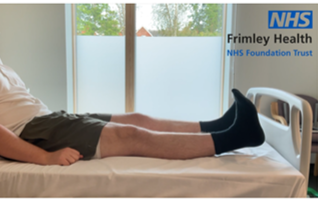
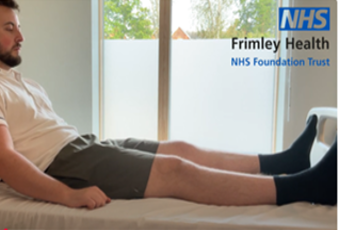
1. Quad set in bed Lie on your bed. Straighten your leg and press the back of your knee down into the bed. You should feel your thigh muscle tighten. Hold for 5 seconds, then relax. 10 reps x3 a day |
 |
|
2. Glute squeezes Lie on your back or reclined. Tighten your buttocks by squeezing them together firmly, then relax. 10 reps x3 a day |
 |
|
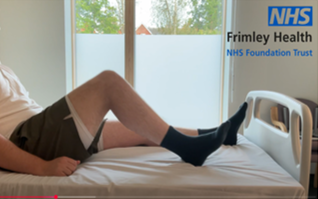
3. Hip bends in bed Lie on your back with your legs straight. Slide your foot up the bed to bend your hip and knee, then slide it back down to straighten. Important: If you have hip precautions, don’t bend your hip past 90 degrees. A plastic bag or slide sheet under your foot can help. 10 reps x3 a day |
 |
|
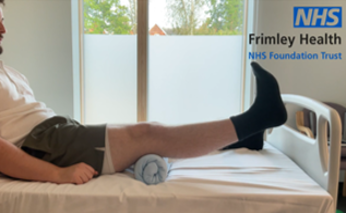
4. Supported knee straightening Lie on your back with a rolled towel under your knee (affected leg). Pull your toes up and lift your heel to straighten your knee, keeping the back of your knee pressed into the towel. Hold briefly, then lower and relax. 10 reps x3 a day |
 |
|
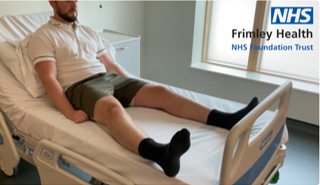
5. Leg out to the side lying Lie flat on your back. Gently slide your affected leg out to the side, then return it to the centre. A plastic bag or slide sheet under your foot can help. 10 reps x3 a day |
 |
|
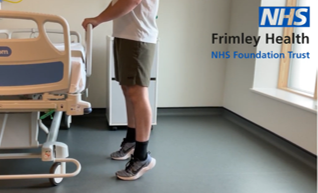
6. Heel raises (standing) Stand tall with your feet hip-width apart and hold on to a support. Rise up onto your toes, keeping knees straight, hold briefly, then lower slowly. 10 reps x3 a day |
 |
|
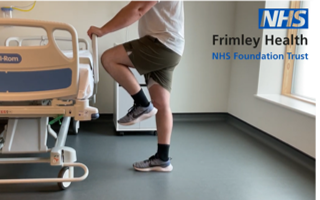
7. Hip march (standing) Hold onto a stable support. Lift your affected leg forward, bending the hip and knee. Important: Don’t lift the hip past 90 degrees if under precautions. Hold briefly, then lower slowly. 10 reps x3 a day |
 |
|
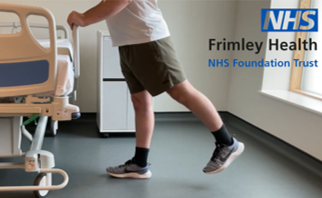
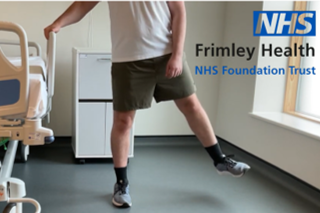
8. Leg out to the side (standing) Hold onto a support. Keep your leg straight and lift your affected leg out to the side. Keep your body upright, pelvis still, and toes facing forward. Hold briefly, then lower slowly. 10 reps x3 a day |
 |
|
9. Leg out behind (standing) Hold a support and stand tall. Keeping your leg straight, move your affected leg backwards behind you. Keep your body upright and avoid leaning forward. Return to starting position. 10 reps x3 a day |
|
|
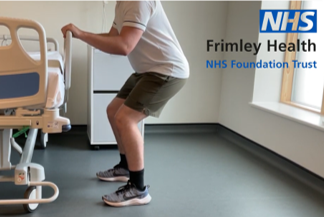
10. Mini squats (standing) Stand holding a support. Bend your hips and knees slightly as if you're about to sit on a stool. Keep your back straight and heels down. Don’t let your knees twist in or out. Hold briefly, then return to standing. 10 reps x3 a day |
 |
|
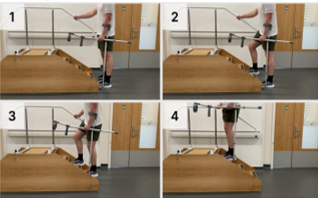
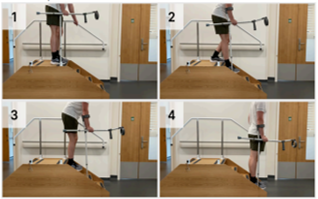
Going up and down the stairs x1 rail If there is a rail, hold onto it with one hand. Give your spare crutch to someone, or you may hold it in a ‘T’ shape on the outside of the crutch you are holding. If there is no rail, you can use two crutches Walking up the stairs: Stand at the bottom of the stairs. Push through the crutch and rail and step your unaffected leg on to the first step. Then bring your affected leg onto the same step. Finally, lift the crutch up to the same step. Repeat the pattern until you get to the top. You may also find this mnemonic helpful: A - able B - bad C - crutch Stand at the top of the stairs. Take your crutch down to the first step. Step your affected leg down to the same step. Finally, bring your unaffected leg down onto the same step Repeat this pattern until you get to the bottom. You may also find this mnemonic helpful: C - crutch B - bad A - able |
|
Contact us
If you have any queries relating to this information, please contact the Physiotherapy service.
About this information
Service:
Physiotherapy
Reference:
BB/062
Approval date:
30 April 2026
Review date:
1 April 2029
Click ‘show accessibility tools’ at the bottom of the page

Then click ‘select language’

Alternative formats
You can use the accessibility toolbar at the bottom of your screen to:
-
Change the text size
-
Adjust the font
-
Modify the colour contrast
-
Use the translate function
If you would like this information in another format, such as Braille, audio, or easy read, please speak to a member of staff.
You can also print as well as download as PDF using the “Print this page” button at the end of the page.
Staff will print a copy for you on request
Important note
This page provides general information only. It is developed by clinical staff and is reviewed regularly every 3 years for accuracy. For personal advice about your health, or if you have any concerns, please speak to your doctor.