

Advice after your nerve block for surgery
On this page…
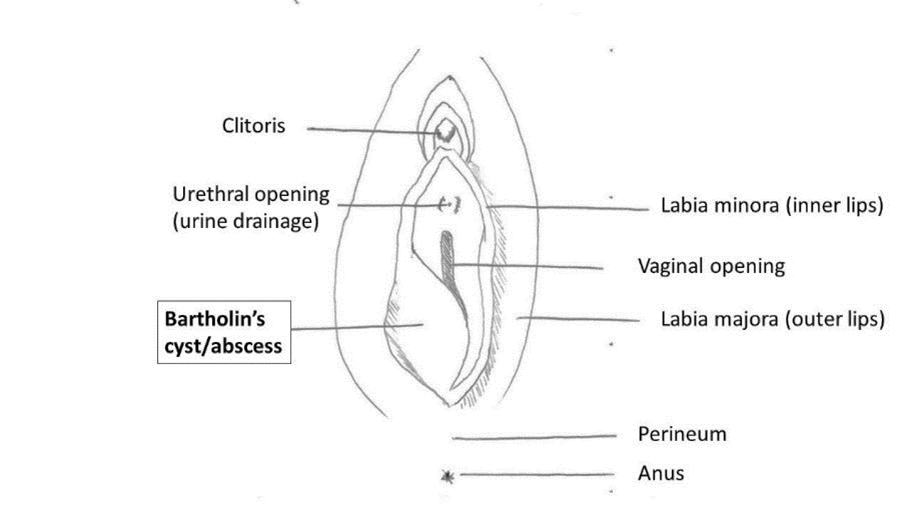
Bartholin's glands lie at the entrance to the vagina and secrete mucus to keep the vagina moist. They are normally pea-sized and can occasionally cause problems due to blockage.
How it is formed?
Bartholin’s cyst
When the ducts to these glands become blocked, the fluid collects, causing a swelling called a cyst. This usually affects sexually active women between 30-40 years old. The reason why the ducts get blocked is not clear.
Bartholin’s abscess
An abscess develops from a Bartholin's cyst that becomes infected.
Signs and Symptoms
Pain, discomfort on intercourse, difficulty in sitting and walking, fever, feeling unwell. When examining, it may be red, hot, and very tender.
Will I need tests?
No test is required. The diagnosis is made when a doctor looks at it, due to its typical appearance. Sometimes a swab test may be taken of the fluid inside. This helps guide treatment with antibiotics, if needed.
Can Bartholin cyst/ abscess be prevented?
Not usually.
Treatment Options
- Conservative: Not all cysts need treatment, and they can settle by themselves if small and only mildly symptomatic.
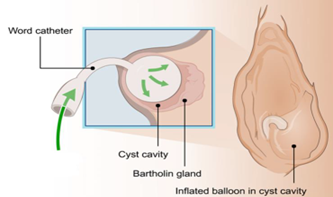
- Word catheter: This procedure can be done under local anaesthetic and takes 10-15 minutes. It involves draining the fluid/pus and inserting a small catheter into the hole created (see image). This stays in place for 4-6 weeks to allow full healing and minimize recurrence, so a follow-up appointment is made to remove it. If the catheter falls out before the follow-up appointment, no further treatment is needed and you can cancel the appointment if you want and are healing.
- Marsupialisation: This procedure is normally performed when asleep (under general anaesthetic). It involves draining the cyst / abscess and leaving the cavity open with absorbable stitches.
This table explains the key differences between Options 2 & 3:
| Word catheter | Marsupialisation |
| Done under local anaesthetic (small injection into the skin) | Done under general anaesthetic (asleep) |
| Can be done on the same day | May need to return for surgery a few days after booking |
| Do not need to fast | Requires fasting for 6 hours beforehand |
| Can resume normal activities immediately, including driving | Requires an adult at home for 24 hours after the procedure |
| Requires follow up in 4-6 weeks | May resume normal activities after 24-48 hours |
| No further follow up needed |
Care while healing
Whatever treatment you choose, you will find some things helps with the healing. Salt water baths (“Sitz baths”) may help soothe the area. Medications such as Paracetamol and/or Ibuprofen may help with pain and swelling.
While the catheter or stitches are in place, you should avoid using menstrual cups or tampons, and penetrative intercourse. We would also recommend using unscented soaps for intimate cleansing and patting the area dry after bathing, rather than wiping. You usually do not need any special creams, solutions, or dressings.
Complications after surgery
Infection, recurrence, pain passing urine, or pain during intercourse until the wound is healed.
Will it happen again?
In majority of cases, it does not happen again. For the small number of people who keep having blockages, further treatment may be discussed; but you should have at least tried all the options above first.
Contact Details
If you have any query, please contact your GP or the Urgent Gynaecology Care Centres at either of our sites:
- Frimley Park Hospital, based in Outpatients 4 - 0300 613 6418
- Wexham Park Hospital, based on Ward 20 - 0300 615 4429
Contact us
If you have any queries relating to this information, please contact the Gynaecology service.
About this information
Service:
Gynaecology
Reference:
L/025
Approval date:
4 October 2013
Review date:
1 May 2026
Click ‘show accessibility tools’ at the bottom of the page

Then click ‘select language’

Alternative formats
You can use the accessibility toolbar at the bottom of your screen to:
-
Change the text size
-
Adjust the font
-
Modify the colour contrast
-
Use the translate function
If you would like this information in another format, such as Braille, audio, or easy read, please speak to a member of staff.
You can also print as well as download as PDF using the “Print this page” button at the end of the page.
Staff will print a copy for you on request
Important note
This page provides general information only. It is developed by clinical staff and is reviewed regularly every 3 years for accuracy. For personal advice about your health, or if you have any concerns, please speak to your doctor.