

Advice after your nerve block for surgery
On this page…
The importance of breath
Breath is the power of the voice. Once lower breathing has been established, we need to ‘connect’ this to voice production. This is known as ‘breath support’. Good breath support means breathing low, and using this low breath when voicing. This helps the larynx to stay relaxed not strain. It is the opposite of speaking on a shallow breath and ‘pushing’ the voice out from the throat.
Lower breathing, and breath support, is created by utilizing the diaphragm and abdominal muscles. As we breathe in the diaphragm lowers, pushing the stomach outwards, which makes the chest cavity longer and larger. As we breathe out the diaphragm relaxes upwards and the abdominal muscles engage to ‘squeeze’ out the air.
Tips for achieving breath support
- Ensure you have good posture, whether you are sitting or standing
- Think of your breath travelling down through your throat and upper chest into your lower lungs and tummy
- Imagine the diaphragm and tummy, not the throat, as being the source of the breath and sound
- Breath support should be used to ‘kick-start’ speech and emphasise words. It should not be used for every word though – this is not natural!
- Ensure your shoulders do not collapse forward. Lengthen up through the spine and gently widen across the collar bones.
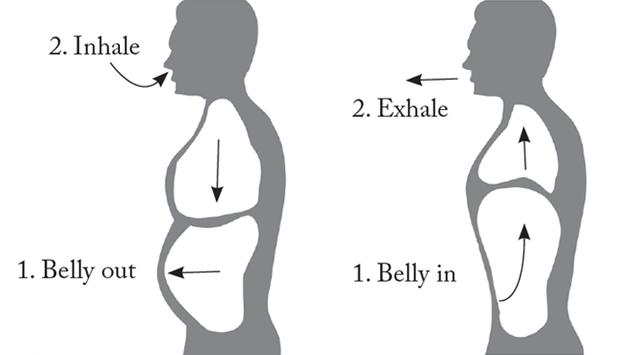
The following exercises are based on the principles of ‘Accent Method’.
Breath Support Exercises
Only do the exercises your therapist has advised.
- Blowing out candles – imagine you are blowing out candles on a birthday cake quickly, one at a time. Feel your tummy ‘kick’ inwards with each puff of air.
- Engaging breath support – feel the way your tummy gently squeezes as you make the following sounds: s------- sh-------- z------- zh------- v------ Make sure you are only using the tummy, and not squeezing from the throat.
- ‘Sh’ pulses – make a long ‘sh’ sound, this time with rhythmic ‘pulses’ inwards with your tummy. Notice the way the sound become more intense when you squeeze the tummy. The sound should be continuous with no breaks. Try this on ‘s’ as well.
- 'Z’ pulses – do the same pulses on a long ‘z’ sound. Try this on ‘zh’ and ‘v’ as well.
- Vowel sequences¬ – ‘eyeyey…’ Starting on one pitch, use the tummy to emphasise alternate syllables. Play around with different rhythms. Then, add in speech-like intonation with ups and downs, emphasising syllables with the tummy.
- Laughing (real or fake!) should naturally trigger the right movement in the tummy – feel it with your hand.
- Simple speech – using your tummy to create a strong ‘h’ sound, say the following: ‘uh huh’, ‘hi’, ‘hey’, ‘how’, ‘who’, ‘hello’. Don’t push too loud or strain from the throat – keep the sound relaxed.
- Nursery rhymes – now try using breath support on longer speech, such as nursery rhymes:
- Humpty Dumpty sat on a wall.
- Humpty Dumpty had a great fall.
- All the king’s horses and all the king’s men,
- Couldn’t put Humpty together again.
- Simple speech – count from 1-10, emphasising different numbers e.g. ‘1 2 3 4 5 6 7 8 9’. Use a natural flowing speech rate. Do the same with the days of the week or months of the year.
- Advanced practise – practise using breath support on short phrases and sentences, reading aloud (with poetry or a paragraph in a newspaper), monologue every day activities, and then in conversation.
Contact us
If you have any queries relating to this information, please contact the Speech and language therapy service.
About this information
Service:
Speech and language therapy
Reference:
VV/028
Approval date:
27 September 2024
Review date:
1 September 2027
Click ‘show accessibility tools’ at the bottom of the page

Then click ‘select language’

Alternative formats
You can use the accessibility toolbar at the bottom of your screen to:
-
Change the text size
-
Adjust the font
-
Modify the colour contrast
-
Use the translate function
If you would like this information in another format, such as Braille, audio, or easy read, please speak to a member of staff.
You can also print as well as download as PDF using the “Print this page” button at the end of the page.
Staff will print a copy for you on request
Important note
This page provides general information only. It is developed by clinical staff and is reviewed regularly every 3 years for accuracy. For personal advice about your health, or if you have any concerns, please speak to your doctor.