

Advice after your nerve block for surgery
On this page…
What is a PIPJ replacement?
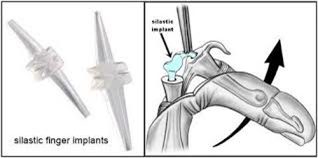
You have undergone surgery to replace the middle joint in your finger (PIPJ) with a new silastic implant, which is known as an arthroplasty. This may have been due to pain, limited movement, or damage to your joint. You will need to undergo a hand therapy programme following this surgery to optimize your recovery.
What might I expect following surgery?
After surgery you will be placed in a partial plaster cast which will be held in place by a bandage. It is important that you keep your dressing dry to avoid problems with your wound.
You will be seen in plastics dressing clinic at around 2 weeks post- surgery for a wound check and removal of stitches (if not dissolvable).
You will then be sent to Hand Therapy to be seen by a therapist.
Splint
You will be provided with a custom-made thermoplastic splint which will hold your finger straight. It will be held in place with Velcro straps. You will need to wear your splint all the time, removing for exercises only and careful hand washing and then for a further 2 weeks at night and protection as discussed with your therapist.
- You can wash your splint by taking off the soft Velcro straps and wash the plastic in cool soapy water or wipe down with damp cloth/wipes.
- Do not let your splint get hot or leave it in a hot place, i.e., near a radiator or direct sunlight above 60 degrees.
- Please bring your splint with you to every appointment.
Swelling
Your hand and fingers may be swollen after your surgery. It is important to get your swelling down as quickly as possible.
You will be given advice on how to manage swelling in your finger. This may include elevating your hand above your heart level or compression (tape or sleeve).
Scar
Once your wound is healed you need to massage your scar. Massage helps the scar to move freely and prevent adhesions(sticking) to underlying tissue/tendon. Use a thick unscented cream like E45, Nivea, Aqueous, or Bio oil. Massage needs to be firm (not like putting on sun cream), in a circular kneading motion, moving your skin side to side and gently lifting skin.
Exercises
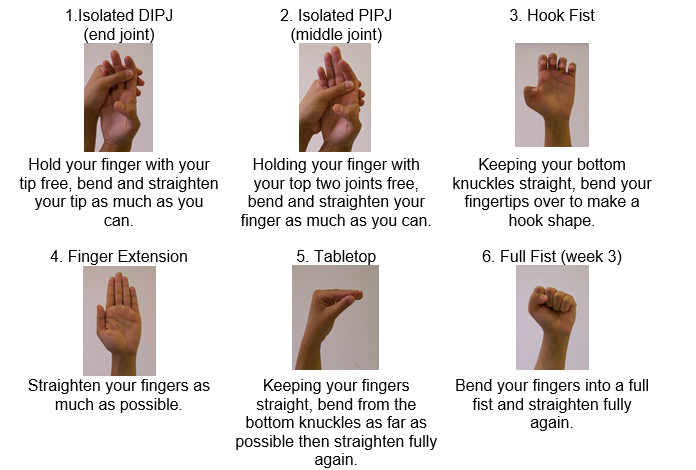
Exercises are important to help restore the movement and function of your hand. They help with preventing adhesions to the scar tissue and reduce swelling. You need to remove your splint to do exercises and perform them on a regular basis throughout the day.
Activities
You can use your hand for light activities, but you will need to wear your splint for the first 2 weeks. Do not do any medium/heavy activities. After 2 weeks, you can start to use your hand for light activities. You will be guided to increase your activities gradually over the next 4-12 weeks.
DO
- Keep your arm/hand elevated to minimize swelling, particularly soon after surgery.
- Wear your splint as prescribed.
- Follow the therapist recommendations.
- Keep all your uninjured joints moving, including your shoulder and elbow.
- Massage your scar (once healed) with moisturizer as demonstrated by your therapist.
DON’T
- Don’t leave your finger out of the splint until instructed to do so.
- Don’t force your finger to bend with your other hand until 6 weeks after surgery.
- Don’t drive until you have discussed this with your therapist.
- Don’t put any load through your joint during the first 6 weeks as you will risk damaging your finger and your replaced joint.
Contact details
Hand therapy departments:
0300 6133396 for Frimley
0300 6140540 then Option 2 Wexham or Option 3 for Heatherwood
Plastic Dressing Clinic - 0300 6153031
Contact us
If you have any queries relating to this information, please contact the Hand therapy service.
About this information
Service:
Hand therapy
Reference:
UU/082
Approval date:
19 February 2026
Review date:
1 February 2029
Click ‘show accessibility tools’ at the bottom of the page

Then click ‘select language’

Alternative formats
You can use the accessibility toolbar at the bottom of your screen to:
-
Change the text size
-
Adjust the font
-
Modify the colour contrast
-
Use the translate function
If you would like this information in another format, such as Braille, audio, or easy read, please speak to a member of staff.
You can also print as well as download as PDF using the “Print this page” button at the end of the page.
Staff will print a copy for you on request
Important note
This page provides general information only. It is developed by clinical staff and is reviewed regularly every 3 years for accuracy. For personal advice about your health, or if you have any concerns, please speak to your doctor.