

Advice after your nerve block for surgery
On this page…
Introduction
Your doctor has recommended that you have an Endoscopic Ultrasound (EUS) and a Fine Needle Aspiration (FNA) to investigate your medical condition. This test can be used to help make a diagnosis. If you prefer not to be investigated, we advise you to discuss the implications of not having the test with your doctor. You may have already had several tests to investigate your problem. EUS and FNA is another way of getting more information.
This page provides information about the examination and what to expect. If you have any questions or concerns after reading it, please call us on our direct line: 0300 613 6647 (Frimley Park).
Appointments for an endoscopy are in high demand. If you are unable to attend your appointment, please contact the Endoscopy team on 0300 613 6647 (Frimley Park) or fhft.endoscopyadminfph@
What is an EUS and FNA
EUS is a test which allows the doctor to look directly at the gastrointestinal tract (gut) using a long flexible tube (an endoscope), about the thickness of your index finger, with a bright light at its tip. Ultrasound waves are used to look through the gut wall and internal organs such as the gall bladder and pancreas. The endoscope is carefully passed through your mouth and down your oesophagus (food pipe) into your stomach and the beginning of the small bowels (duodenum) as shown in the illustration below.
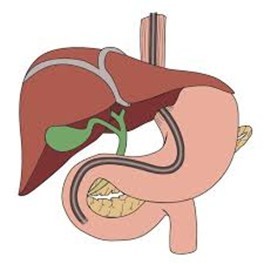
The doctor has the ultrasound machine turned on which produces sound waves that create images of your gastrointestinal tract and surrounding organs that are transmitted to a monitor, so that the doctor can look for any abnormalities. If an abnormal area is identified within the internal organs, the consultant can take a sample using a very fine needle. The FNA/B needle is passed through the scope. It is a painless procedure and is called fine needle aspiration (FNA).
What preparation will I need for my EUS and FNA/B procedure?
To allow the consultant to see clearly, your stomach must be empty. It is important that you have nothing to eat for 6 hours before the test. However if you are diabetic, you should have nothing to eat for 12 hours before the test. You may need to adjust your diabetic medication; your pre-assessment nurse will advise you on this. Unless you have been told otherwise, you may drink water but nothing else up to 3 hours before the test and nothing until after the procedure.
What about taking my medication before the procedure?
It is important to continue taking the following medication unless you are advised to stop by the nurse during your telephone pre-assessment.
- Esomeprazole (Nexium),
- omeprazole (Losec),
- lansoprazole (Zoton),
- pantoprazole (Protium),
- ranitidine (Zantac),
- cimetidine (Tagamet).
If you are on Anticoagulants (such as warfarin, tinzaparin or clopidrogrel), diabetic or have an artificial heart valve you will be given instructions by the nurse during your telephone pre-assessment.
The nurse will also advise you which medication you can take on the day of your procedure. If you feel unable to carry out any of the instructions, please contact the Endoscopy department at Frimley Park on 0300 613 6045 between 8am-1pm.
What should I bring on the day?
If you are diabetic, please bring your insulin or tablets with you. If you use a machine to help with sleep apnoea, please bring this with you. If you use reading glasses, please bring them with you so that you can read the consent form and any other paperwork. You are welcome to bring a book or other reading material. Please do not bring any valuables with you.
When you arrive
When you arrive at the hospital, please check in at the Endoscopy Department reception. If you need wheelchair access, enter through the main entrance. The Endoscopy Department is located on the first floor, please follow signposts to the Endoscopy department. After admission and consent, a staff member will escort you to the Radiology Department for your procedure.
Please note that a pre-procedure investigation, including blood tests and ECG are usually required before your appointment. The timing of your procedure will depend on when we receive your blood test results.
A nurse will guide you through the admission process, after which a doctor will explain the procedure and obtain your consent. This is the opportunity for you to ask questions and to talk about your procedure before you sign the consent form. It is important that you understand what is going to happen.
Your escort/relative can wait in the reception area or have refreshments from the cafés in and around the hospital. During your admission to the endoscopy department, a nurse will ask you several questions about your health and what medication you are taking. The nurse will also take your observations: blood pressure, pulse, oxygen saturation level and temperature. You will also be asked to change into a gown.
Your EUS and FNA procedure
You will be admitted, recovered, and discharged in the Endoscopy Department, but your procedure will be carried out in the Radiology Department. The procedure may be performed either under sedation or with propofol, a general anaesthetic (GA) medication.
To reduce your gag reflex and minimize discomfort while passing the tube, a local anaesthetic throat spray may be administered although this is only given to a minority of patients. Sedation will be given before the procedure to help you feel sleepy and relaxed. You will be made comfortable on a trolley, lying on your left-hand side.
To keep your mouth slightly open, a plastic mouthpiece will be put gently between your teeth. The sedation or propofol medication is given through a small needle placed into a vein on your hand or arm.
You will be given oxygen during the procedure, usually through nasal prongs that fit just inside your nostrils. The anaesthetic/endoscopy team will stay with you throughout the test, monitoring your blood pressure, pulse and oxygen level in your blood.
The doctor will carefully pass the endoscope through your mouth and into your stomach. This should not cause you any discomfort, nor will it interfere with your breathing at any time. During this time some air and then water will be passed down the tube to expand your stomach and allow the doctor a clearer view. If you get a lot of saliva in your mouth, the nurse will clear it using a small suction tube.
During the procedure the doctor may take samples (biopsies), photographs or video of your gastrointestinal tract, even if it all looks normal. It may take up to 60 minutes to carefully examine all areas of your gastrointestinal tract.
What are the benefits and risks?
The procedure will help us to investigate your symptoms and it may help us to treat you. EUS and FNA is generally safe, but all procedures have some risks, which you should discuss with your doctor.
These are the more common risks:
- A sore throat which should wear off within 24 hours.
- Inflammation of the pancreas (pancreatitis) can occur following a FNA. You may find that you have abdominal pain a few hours after the procedure which lasts a few days. Sometimes you may need to be admitted to hospital to treat the pancreatitis; and, in a minority of cases, the pancreatitis can be severe. Pancreatitis can occur in < 1 in 100 cases.
- Complications such as bleeding or damaging the gastrointestinal tract are very rare. This risk is increased if biopsies are taken when infection and inflammation may also occur. Bleeding can occur (< 1 in 100 cases) following a FNA or from minor damage caused by the endoscope. It usually stops on its own.
- Aspiration (inhalation of food or fluids into the lungs) can lead to pneumonia, but this risk is minimal in those who have been had no food or drink for the 6 hours before the procedure.
- An operation is likely to be needed for perforation (tearing) and this is likely to be on the same day. Please speak to your consultant or Clinical Nurse Specialist (CNS) if you would like further information Perforation (a hole) can be made in the wall of the oesophagus, stomach or duodenum. The risk of this is slightly higher if there is an abnormal narrowing, but is generally < 1 in 100 cases.
- Other rare complications include inflammation of the lungs (aspiration pneumonia) and a reaction to the intravenous sedative drugs or local anaesthetic spray.
- Upper gastrointestinal endoscopies may involve a slight risk to crowned teeth or dental bridgework.
- There is no known risk associated with the ultrasound part of the procedure.
- If an anaesthetic is required for your particular procedure, the anaesthetist will discuss the associated risks with you. The anaesthetist may consider additional investigations before the procedure can be performed.
- An incomplete or inadequate procedure can occur due to technical difficulties, complications or blockages. Sometimes biopsy samples are inadequate and the procedure may need to be repeated
What happens afterwards?
As you have received sedation or propofol general anaesthesia, you will need to rest in the recovery area until you are fully awake, which usually takes about 30 minutes to an hour. Recovery nurses will monitor you in the Radiology Department recovery area immediately after the procedure. Once you are stable, you will be transferred to the Endoscopy Department for further monitoring before your discharge.
Your blood pressure and pulse will be monitored. The nurse looking after you will judge when it is safe for you to go home.
An adult must be available to escort you home and provide support for the first 24 hours, as the sedation impairs your reflexes and judgement.
We will give you a drink of water and other refreshments when you are fully awake.
Your stay in the hospital will usually be between 4 to 5 hours. Very occasionally some patients will be asked to stay in overnight for observation.
When will I know the results?
Your doctor or nurse will be able to tell you the results of the test as soon as you are awake. As you will have had sedation it is a good idea to ask for your escort or relative to be present when the doctor or nurse speaks to you because the sedation may lead you to forget what is discussed. We will give you a copy of your endoscopy report before you leave the endoscopy department, and another copy will be sent to your GP or the specialist who referred you. However, if a biopsy was taken for examination under the microscope, these results may take seven to ten days to process. A copy of the biopsy results will be sent to your GP or the specialist who referred you.
Going home after the procedure
As you will have sedation, it is essential for an escort to accompany you home and stay with you until the next day. Please note: your procedure will be cancelled if you do not have an escort as we cannot arrange for an escort to take you home. Sedation causes drowsiness, and even if you feel that you are wide awake, your reactions could still be affected. You may find it difficult to concentrate on what you are doing and you may forget things that you have been told. For at least 24 hours after your procedure, we advise you not to:
• Drive
• Operate potentially dangerous machinery
• Use potentially dangerous appliances such as a cooker or kettle
• Have a bath unsupervised
• Look after dependants on your own
• Go to work
• Sign any legal documents
• Drink any alcohol
• Take sleeping tablets or recreational drugs
Food and Drink
You may resume eating and drinking as normal.
Medications
You may resume normal medications immediately after your EUS. Please ask if you are not sure if your medication will be safe to take with the sedation.
Complications
You should seek medical help immediately if you develop any of the following symptoms:
• Chest or shoulder pain
• If bowel motions turn black
• Persistent vomiting
• Shortness of breath
• Severe abdominal pain
• Worsening abdominal swelling
• Fever (above 38°C) and/or chills
When to seek help after the test
Please do not hesitate to contact us if you are worried about any symptoms you experience after this test.
If you are concerned or distressed by the symptoms, the priority will be to return to hospital to be seen in the Emergency Department. However, if there is time and you or a family member are able, please also consider the following options:
Within office hours, telephone the unit in which your procedure was done:
Frimley Park Hospital: Endoscopy dept on 0300 613 6045
For out of hours:
Frimley Park Hospital: Surgical Emergency Unit on 07990 528061
• Or please contact your GP, 111 or go to your nearest Emergency Department (A&E).
Contact us
If you have any queries relating to this information, please contact the Endoscopy service.
About this information
Service:
Endoscopy
Reference:
H/070
Approval date:
15 July 2025
Review date:
1 June 2028
Click ‘show accessibility tools’ at the bottom of the page

Then click ‘select language’

Alternative formats
You can use the accessibility toolbar at the bottom of your screen to:
-
Change the text size
-
Adjust the font
-
Modify the colour contrast
-
Use the translate function
If you would like this information in another format, such as Braille, audio, or easy read, please speak to a member of staff.
You can also print as well as download as PDF using the “Print this page” button at the end of the page.
Staff will print a copy for you on request
Important note
This page provides general information only. It is developed by clinical staff and is reviewed regularly every 3 years for accuracy. For personal advice about your health, or if you have any concerns, please speak to your doctor.