

Advice after your nerve block for surgery
On this page…
Categories:
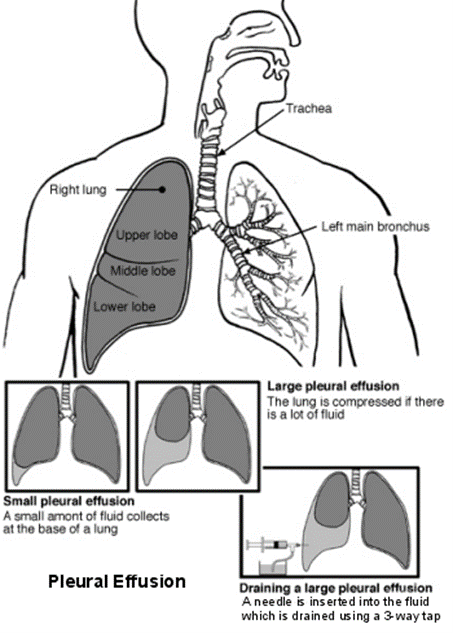
This page is for people who have been found to have had a pleural effusion (fluid around the outside of the lungs). We perform these assessments in an outpatient clinic in OPD5 on the green corridor (indicated by the star in the map below) so that you do not need to be admitted to hospital, although sometimes admission to hospital is unavoidable.
What are the Symptoms of a Pleural Effusion?
A pleural effusion is fluid around the outside of the lungs. You may feel some chest discomfort but a pleural effusion is often painless. The amount of fluid varies. As the effusion becomes larger, it presses on the lung (as in the diagram above), which cannot expand fully. You may then become breathless. You may also have symptoms of the condition that is causing the effusion.
As a whole range of conditions can cause a pleural effusion, there is a large range of other symptoms that may occur, depending on the underlying cause.
Some of the underlying causes include cancer, infection, blood clots, inflammatory diseases and heart failure.
What will happen at the Pleural Clinic?
At the pleural clinic you will usually have an ultrasound scan of the chest to see how much fluid there is and whether any further tests are needed. Sometimes it is necessary to take a small sample of the fluid after applying a local anaesthetic to the skin to reduce any discomfort. If there is a lot of fluid a small tube may be inserted under anaesthetic to drain the fluid off.
It is important that the blood is not too thin to cause a risk of bleeding. Therefore we ask that if you are taking anything that thins the blood such as clopidogrel (Plavix), warfarin, apixaban, rivaroxaban, dabigatran or injections of heparin or dalteparin that you let us know so we can discuss if and when to stop these before clinic. Please do not stop these without discussion. Aspirin does not need to be stopped.
What Treatment is There?
Treatment can vary greatly, depending on the cause of the effusion. If the underlying cause can be successfully treated then there is a good chance that the pleural effusion will go away for good. If the underlying cause cannot be treated, or can only be partially treated, the effusion may return if it is cleared (drained). Small effusions that cause no symptoms, or only mild symptoms, may just be left and 'observed'. Treatment is usually only needed if the effusion causes symptoms.
Post Discharge Advice
If it is identified that you need a follow up, it will usually be booked during the appointment. Depending on treatment plans, we may leave the follow up to be patient initiated. This means that you would contact the pleural nurses to book an appointment (07500 064438) when you feel your breathing getting worse. We try to book an appointment as soon as possible, but please bear in mind if you are on any blood thinners this will delay the appointment.
After your appointment you may suffer with pain, we encourage the use of simple analgesia like paracetamol to manage this for the first 24 hours. If the pain continues or your breathing has any significant changes please get in contact with the pleural team on 07500 064438
Useful Websites
Patient UK www.
British lung foundation www.
Contact us
If you have any queries relating to this information, please contact the Respiratory medicine service.
About this information
Service:
Respiratory medicine
Reference:
W/049
Approval date:
29 October 2024
Review date:
1 October 2026
Click ‘show accessibility tools’ at the bottom of the page

Then click ‘select language’

Alternative formats
You can use the accessibility toolbar at the bottom of your screen to:
-
Change the text size
-
Adjust the font
-
Modify the colour contrast
-
Use the translate function
If you would like this information in another format, such as Braille, audio, or easy read, please speak to a member of staff.
You can also print as well as download as PDF using the “Print this page” button at the end of the page.
Staff will print a copy for you on request
Important note
This page provides general information only. It is developed by clinical staff and is reviewed regularly every 3 years for accuracy. For personal advice about your health, or if you have any concerns, please speak to your doctor.