

Advice after your nerve block for surgery
On this page…
Introduction
Getting back to a healthy weight means you will need to eat more. This is going to be difficult at first but will get easier in time.
There are no ‘good’ or ‘bad’ foods. It is a combination of what we eat and drink that forms an unhealthy or healthy diet. The word ‘diet’ means everything we eat and drink, so we are all on a diet!
Choosing a balanced food intake from all food groups is recommended to avoid diseases in later life and to make sure you grow and develop normally.
We should all try and eat five portions of fruit and vegetables a day as well as protein, fat and carbohydrate foods. We hear that a low-fat diet is good for us, but low fat does not mean no fat. Fats contain fat soluble vitamins A, D, E and K which are essential for us.
While you are recovering it is important to eat regularly by keeping to the meal plan. Accept help from your family and friends to do this. If you have been starving yourself, you may not be able to think clearly or concentrate properly. This will get better as your weight improves.
Recovery is a process - not an event.
Eating for Good Health
Healthy eating means getting the right mixture of foods in the correct amounts to keep your body healthy now and for the future. It also means eating in a way that you enjoy and feel comfortable with, that meets your personal food likes and dislikes and allows you to join in happily with eating socially.
The Eatwell Guide on the opposite page can help you to get your eating right. It divides foods into 5 groups, but you need to eat more from some groups than others.
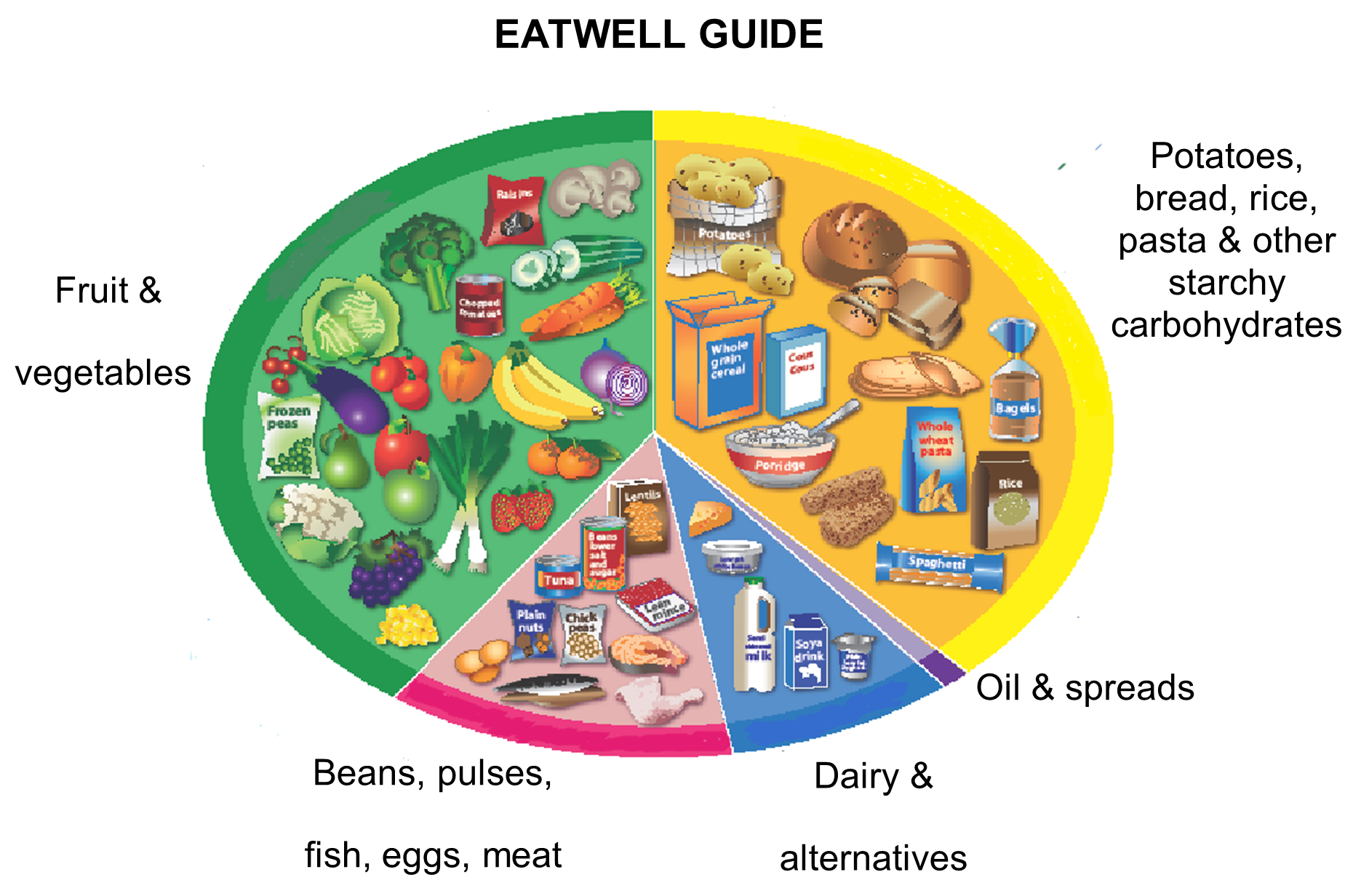
Your meal plan will show you how to balance your intake to provide you with a healthy diet.
Amounts to Eat
You may not be sure about normal serving sizes for some of these foods, so the meal plan has been worked out to provide guidelines in household measures.
How Your Meal Plan is Made Up
Each day’s meal plan is based on 3 meals and 3 snacks:
- Breakfast
- Mid-morning snack
- Lunch
- Mid-afternoon snack
- Main meal
- Bedtime snack
How to Build a Meal
Meals are made up by starting with:
A starchy food e.g. bread, breakfast cereal, potato, rice or pasta.
Add to this:
Some protein for growth e.g. milk, fish, meat, pulses.
Then you need to add:
Some fruit, vegetables or salad for vitamins and minerals.
Plus:
A little fat which is needed as an emergency supply of Energy and to keep warm.
Drinks
Remember it is important to drink enough fluid to stay well. You should drink the milk included in your meal plan as it provides an excellent source of calcium for building bones.
Breakfast
Build your meal by choosing 1 food from each of the 3 groups below:
Step 1 - start with a starchy food
- 6 tablespoons cereal e.g. rice Krispies, cornflakes, shreddies etc
- 1½ Weetabix
- 4 heaped dessertspoons (40g) of instant oat cereal with 150mls of milk
- 1 heaped tablespoon sweetened muesli (or 2 heaped tablespoons of unsweetened)
- 1½ slices bread and 1½ teaspoons butter/margarine (full fat)
- Plus jam/marmalade or marmite if liked
Step 2 - now add some protein
- 150mls full cream milk
- 2 tablespoons yoghurt (not low-fat)
- 1 small pot fromage frais
Step 3 - and some fruit
- 150mls fruit juice
- 1 tablespoon raisins
- 1 portion fruit e.g. 1 medium banana or 1 small apple
- and a drink water, squash or fruit juice (150mls).
Lunch
Step 1 - start with a starchy food
- 2 slices bread/3" French bread
- 1 bread roll
- 4 crackers or crisp breads
- 2 mini or pitta bread
- Jacket potato (small 100g)
- Rice (100g cooked weight)
- Pasta (100g cooked weight
Step 2 - now add some protein
- Tuna 1 tablespoon (60g)
- Cheese (40g) or 2 Babybels or 2 Dairy Lea Triangles
- Ham 4 thick slices
- Baked beans/spaghetti ⅓ large tin or 1 small tin
- 1 egg either scrambled or poached or hard boiled
Step 3 - and add some fat
- 1 teaspoon margarine, butter or oil
- 1 dessertspoon mayonnaise/salad cream
Step 4 - include some vegetables or fruit
- Cucumber/cherry tomatoes/lettuce/carrot or celery sticks
- 1 portion fruit
Step 5 - after, some pudding
- Full fat fromage frais (60g pot)
- Full fat yoghurt (125g pot)
- Full cream milk 200mls
- and a drink water, squash or fruit juice (150mls) - how about combining Step 4 and Step 5 and having a fruit smoothie?
Cooked Meal
Step 1 - start with a starchy food
- Rice (120g cooked weight)
- Pasta (120g cooked weight)
- Potato (150g cooked weight)
- Bread 2 slices
Step 2 - now add some protein
- Fish 120g/4 fish fingers
- Chicken 90g.
- Red meat 100g/2 small or 1 large sausage
- Eggs 2/quiche 50g
- Bacon 2 rashers
- Cheese 50g
- Vegetarian sausages x 2
Step 3 - and add some fat
- 1 teaspoons margarine, butter or oil
- 1 dessertspoons mayonnaise/salad cream
Step 4 - now some vegetables or salad
- 1 cereal bowl of mixed salad
- 1 heaped tablespoon of vegetables e.g. peas, carrots, sweetcorn or mixed vegetables
Step 5 - after, some pudding
1 portion fruit plus:
- Custard 1 teacupful/¼ can
- Rice pudding 1 teacupful/¼ can
- Angel Delight ¼ can/sachet
- Full cream milk 200mls
Don’t forget to drink 150mls squash, water or fruit juice.
Mid-morning and Mid-afternoon Snacks
Choose one option from group A and one from group B.
Group A
- Dried fruit 1 tablespoon e.g. raisins, apricots
- Dried fruit e.g. 20 banana chips
- Grapes 15 - 20
- Banana (medium) 100g
- Apple/pear/orange (medium) 100g
- Kiwis/satsumas – 2
- ¼ large can of tinned fruit
Group B
- Biscuits e.g. Hob Nob, digestive - 3
- Cereal bar, flapjack - 1
- Jaffa cakes - 4-5
- Malt loaf (medium slice) - (~45g)
- 1 scone or a currant bun with spread
- Crisps /Tortilla chips/Mini Cheddars/Twiglets - 25g bag
- Nuts (35g) - 1 handful
- Crackers and cheese spread - 30g cheese
Don’t forget a glass of squash, water, milk or fruit juice.
Bedtime
200mls full cream milk plus any choice from list B.
Contact us
If you have any queries relating to this information, please contact the Dietetics service.
About this information
Service:
Dietetics
Reference:
DT/081
Approval date:
22 May 2026
Review date:
1 May 2029
Click ‘show accessibility tools’ at the bottom of the page

Then click ‘select language’

Alternative formats
You can use the accessibility toolbar at the bottom of your screen to:
-
Change the text size
-
Adjust the font
-
Modify the colour contrast
-
Use the translate function
If you would like this information in another format, such as Braille, audio, or easy read, please speak to a member of staff.
You can also print as well as download as PDF using the “Print this page” button at the end of the page.
Staff will print a copy for you on request
Important note
This page provides general information only. It is developed by clinical staff and is reviewed regularly every 3 years for accuracy. For personal advice about your health, or if you have any concerns, please speak to your doctor.