

Advice after your nerve block for surgery
On this page…
The specialist Dupuytren’s hand clinic that you are attending today is unique in that it offers patients a one stop option to treat Dupuytren’s contracture using a minimally invasive technique under local anaesthetic.
Dupuytren’s disease is a thickening of the tissue (or fascia) just below the skin of the palm. As this tissue contracts and thickens, it forms tight cords which pull on the fingers causing them to bend down. Needle Aponeurotomy involves using a needle and local anaesthetic to cut these tight cords to allow the finger to straighten out. This procedure is also known as percutaneous needle fasciotomy.
The Consultation
We will ask you specific questions about the tightness in your fingers as well as your past medical history including medications. You will also have your contractures and grip strength measured and asked to fill in a short questionnaire.
We will then discuss the nature of this condition with you and this particular treatment. We will also inform you about other treatment options that are available to you. If you decide to proceed with the needle treatment, we will perform it in the same clinic.
Benefit of Needle Aponeurotomy
• It is a quick procedure and works well at straightening fingers (particularly when the contracture is mainly at the knuckle).
Risks of Needle Aponeurotomy
These are very rare, and similar risks also apply to other forms of treatment you may be offered.
• Pain, bruising and infection
• May not be able to fully straighten the affected finger and there is a chance of recurrence
• Small skin tears
• Damage to nerves, blood vessels and tendons
The Procedure
You will lie down and your hand will be cleaned with an antiseptic solution. A needle with local anaesthetic and steroid is then used to numb the skin at points in the hand over the tight cords. The sharp end of the needle is then used to cut the cords.
During the procedure we will continue to ensure that you are comfortable. If you are not, we can inject more local anaesthetic. We will also ask you about any pain, tingling or numbness in your finger tips as well as checking for possible tendon damage.
After the procedure the needle puncture sites will be covered by plasters and your hand will be dressed in a sticky bandage.
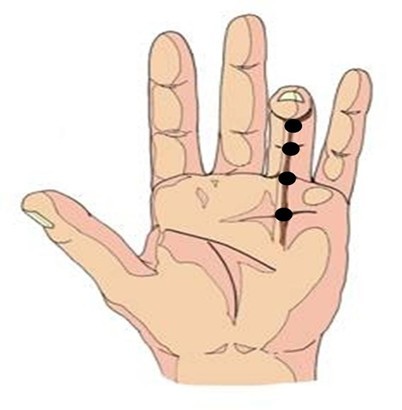 |
Sites of Injections |
- You will then see the hand therapist straight after your appointment. They will provide you with a special splint to wear on the treated finger
- You will need to wear the bandage for 3 days following the procedure (try not to get it wet)
- Take the bandage off after 3 days and start wearing the splint on the treated finger at night for 6 weeks.
- It is very important to avoid manual work for 2 weeks following the procedure (heavy household work, handyman chores, gardening)
- Follow up as discussed with your surgeon
If you have any worries or concerns regarding the procedure or subsequent recovery, please contact:
• The Hand Office at Frimley Park on 0300 613 1119
• Frimley Park Fracture Clinic on 0300 613 4339
Contact us
If you have any queries relating to this information, please contact the Plaster room service.
About this information
Service:
Plaster room
Reference:
N/059
Approval date:
1 November 2025
Review date:
1 November 2028
Click ‘show accessibility tools’ at the bottom of the page

Then click ‘select language’

Alternative formats
You can use the accessibility toolbar at the bottom of your screen to:
-
Change the text size
-
Adjust the font
-
Modify the colour contrast
-
Use the translate function
If you would like this information in another format, such as Braille, audio, or easy read, please speak to a member of staff.
You can also print as well as download as PDF using the “Print this page” button at the end of the page.
Staff will print a copy for you on request
Important note
This page provides general information only. It is developed by clinical staff and is reviewed regularly every 3 years for accuracy. For personal advice about your health, or if you have any concerns, please speak to your doctor.