

Advice after your nerve block for surgery
On this page…
Posture and Alignment
Healthy posture aids relaxation, breathing and consequently the voice. It also reduces muscle tension in whole body, especially the back and neck.
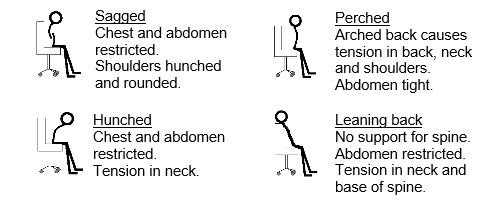
The head is heavy! When your shoulders are rounded your neck has to ‘hold up’ your head which causes strain, tension and often pain and headaches.
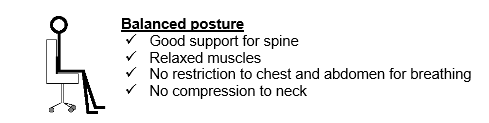
Achieving good posture in sitting
- Sit in an upright chair, with your bottom to the back of the chair, and let the backrest support you. Place your hands on your lap, unclasped.
- Place your feet flat on the floor, directly underneath your knees. Allow your knees to release apart from each other.
- Think of your spine rising straight up, with each vertebra stacked one on top of the other.
- Think of your neck rising up as an extension of this. Release the ‘nodding joint’ at the top of your neck, allowing the chin to drop slightly.
Breathing
Breath is the fuel, or power, for the voice. If there is not sufficient breath support behind the voice, it is easily strained or ‘pushed out’ from the throat.
Most people tend to ‘shallow’ breathe into the upper part of the chest, particularly if there is poor posture or when under stress. This is an inefficient way to breath, as the whole of the lungs aren’t being utilised. It also encourages tension in the neck and shoulders.
Lower breathing, also known as diaphragmatic or abdominal breathing, uses the lower part of the lungs as well as the upper part. This gives better breath support for speech, as well as encouraging both physical and mental relaxation.
Achieving lower breathing
- It is often easiest to first achieve this breathing when lying down. If appropriate, your therapist will talk you through this in ‘semi-supine’ position.
- To start with, place one hand on your stomach, just above your belly-button. Breathe through your nose. Closing your eyes may help.
- As you breathe in, imagine the air travelling all the way down to your hand. You should feel your stomach expand. Like a balloon or bagpipe filling with air.
- As you breathe out, your stomach will gently move back in as the ‘balloon’ empties.
- Try and reduce the amount of movement in your upper chest and shoulders. If your upper chest fills this ‘blocks off’ the lower part.
- Try to minimise the movement in your upper chest and shoulders – they may want to rise as you breathe in.
- Think of the breath being low, gentle and relaxed, it is not a ‘big’ breath or gasp. The lungs should not be filling to capacity.
- Allow the breath to flow naturally in and out, gently slowing the breath down – try not to hold your breath at any point.
Regularly ‘tune in’ with how you are breathing through the day, and aim for ‘low and slow’ breathing. It is particularly beneficial if you are feeling stressed, to help relax the mind and body.
Contact us
If you have any queries relating to this information, please contact the Speech and language therapy service.
About this information
Service:
Speech and language therapy
Reference:
VV/036
Approval date:
27 September 2024
Review date:
1 September 2027
Click ‘show accessibility tools’ at the bottom of the page

Then click ‘select language’

Alternative formats
You can use the accessibility toolbar at the bottom of your screen to:
-
Change the text size
-
Adjust the font
-
Modify the colour contrast
-
Use the translate function
If you would like this information in another format, such as Braille, audio, or easy read, please speak to a member of staff.
You can also print as well as download as PDF using the “Print this page” button at the end of the page.
Staff will print a copy for you on request
Important note
This page provides general information only. It is developed by clinical staff and is reviewed regularly every 3 years for accuracy. For personal advice about your health, or if you have any concerns, please speak to your doctor.