

Advice after your nerve block for surgery
On this page…
You have been fitted with an Aspen Thoraco-Lumbo-Sacral Orthosis (TLSO) to protect and restrict the movement of your spine following injury.
You will have been provided with specific guidance on how long you require the brace, which position to apply/remove the brace and how many people are required to help you fit the brace. It is important you follow these instructions for the required duration.
A healthcare professional will have guided you through how to fit and remove the TLSO brace. The brace will have been adjusted for your body type.
Applying the TLSO brace
|
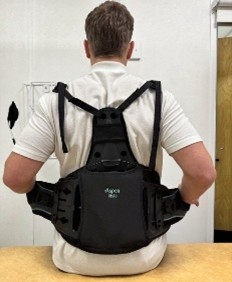
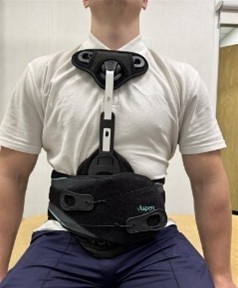
This can be done sitting on the edge of the bed, unless you have been told otherwise. To sit on the edge of the bed safely and to protect your spine: roll onto your side, swing your legs over the edge of the bed. Whilst doing this, push up with your arms. Once sitting, position the brace in the center of your back, level with the top of the buttocks. |
 |
|
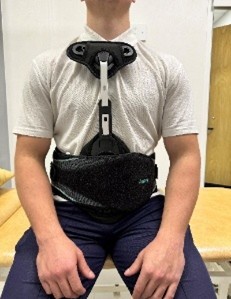
| Bring the front panel across your body and attach the Velcro to the front of the brace, like a corset. The breastplate should be in the centre of the breastbone. | 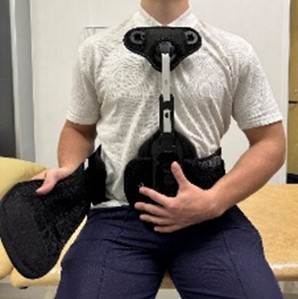 |
 |
|
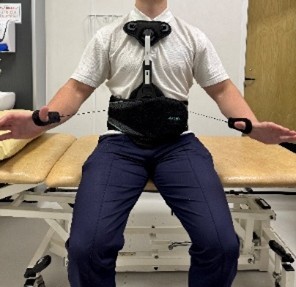
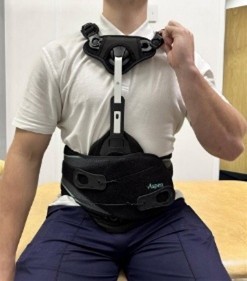
Hold each of the corset drawstrings and pull them forward, then around the front to fasten the brace. Stick the loops onto the Velcro section of the front panel, crossing them over the middle if required. Ensure the brace is not too slack; you should be able to pass no more than a finger underneath the corset of the brace. Check that you can take a deep breath comfortably. |
 |
 |
|
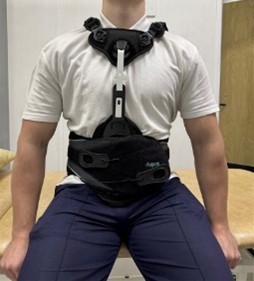
Fasten the shoulder straps on the left and right to the clips on either side of the breastplate. These can be tightened via the adjustable strap. You should be able to pass no more than a finger underneath each strap. |
 |
 |
| Now the brace is on, you can mobilise as directed by your physiotherapist. | 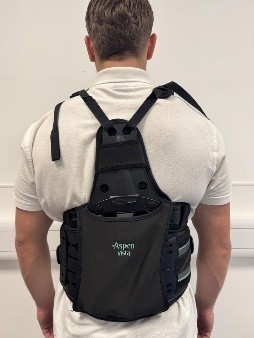 |
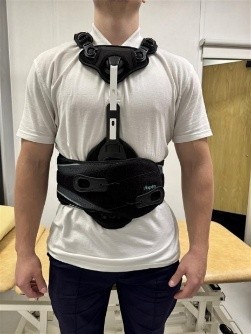 |
Removing the TLSO brace
- Sit on the edge of the bed to remove the brace.
- Undo the clip(s) at the shoulder straps.
- Undo the corset strings on either side of the brace and stick onto the respective side of the brace.
- Undo the front panel and remove the brace to the side.
- Place the brace in an accessible place for when you next need to mobilise.
- Return to lying in bed.
Skin care
The brace should be worn close to the skin, however, please ensure you have a thin vest or t-shirt between your skin and the brace.
You should monitor the skin on your back, stomach, under your arms and the tops of your shoulders for any signs of redness that does not fade shortly after the TLSO brace has been removed.
Please consult with your GP if your skin is breaking down or you are aware of any sore areas where the brace has been rubbing.
Washing and dressing
Any undergarments and thin vest or t-shirts can be applied in lying or sitting (with care) before putting on the TLSO.
Once sitting and the TLSO is fitted, you can complete the rest of your wash (upper and lower body) and dress yourself in bulkier clothes for the day, over the top of your TLSO brace.
You will be advised if you are allowed to take your TLSO brace off at all during the day.
If you are allowed to take the brace off for showering, it is important that you have everything set up in the shower prior to removing your brace. You must maintain an upright sitting posture and avoid any bending or twisting. You may find it easier to ask someone to assist you in the shower.
Cleaning the brace
The brace can be wiped with a clean cloth but must not be washed. The brace does not come with spare padding.
Driving
You are not allowed to drive whilst wearing a TLSO brace.
You can travel as a passenger in a car if you can sit comfortably for the length of the journey. If you are going to be on a long journey, it is advisable to have regular stops.
When travelling in a car, ensure that the seat is as far back as possible when you get in. This will increase the space in the passenger footwell and make it easier to get in and out. You can recline the back of the seat as required for comfort.
You need to liaise with your consultant as to when you can resume driving when your TLSO brace is no longer required. When your consultant has allowed you to drive, it may be worth contacting your insurer to advise them.
Lifting and carrying
You are wearing the brace as you have sustained a spinal injury which needs protection whilst it heals. It is important to follow the advice below to avoid putting too much strain on your back:
- Avoid lifting until advised otherwise by your consultant or physiotherapist.
- Spread the load equally of anything you are carrying – do not carrying everything in one hand.
- Try to do things little and often with regular rest.
- Prioritise your tasks and activities – know your limitations and delegate to others appropriately.
- Build up activity levels slowly.
Points to remember
- Do not loosen the TLSO when wearing it, it needs to be tight to maintain the stability of your spine.
- Discomfort is normal.
- Continue to wear your TLSO as instructed by the doctors and physiotherapists on the ward, until advised otherwise by your consultant
- If you develop any new, significant back pain, lower limb pins and needles and numbness, you should attend your nearest emergency department immediately.
- In the unlikely event of the TLSO breaking, please contact the ward physiotherapist as soon as possible for further advice.
- It is normal for the brace to ride up slightly when you sit, however if the chest bar is too high, it will affect breathing and eating. If this is the case, ensure the brace is in the correct position and try and sit on something higher and this will reduce the amount of “ride up”.
Contact details
Frimley Orthopaedic Physiotherapy – 0300 613 4625 / 07570 974390
Frimley Orthopaedic Helpline – 0300 613 2638
Frimley Ward F4 – 0300 613 4245
Frimley Ward F5 – 0300 613 4173
Frimley Ward F6 – 0300 613 4388
Frimley Ward S2 – 0300 613 3783
Wexham Ward 1 - 0300 615 3010 / 0300 615 3012
Wexham Outpatient Physiotherapy - 0300 615 3501 / 0300 613 3500
Wexham Physiotherapy - 07717 199851
Heatherwood Physiotherapy - 0300 614 4178
Contact us
If you have any queries relating to this information, please contact the Orthopaedics service.
About this information
Service:
Orthopaedics
Reference:
N/061
Approval date:
11 March 2026
Review date:
1 March 2029
Click ‘show accessibility tools’ at the bottom of the page

Then click ‘select language’

Alternative formats
You can use the accessibility toolbar at the bottom of your screen to:
-
Change the text size
-
Adjust the font
-
Modify the colour contrast
-
Use the translate function
If you would like this information in another format, such as Braille, audio, or easy read, please speak to a member of staff.
You can also print as well as download as PDF using the “Print this page” button at the end of the page.
Staff will print a copy for you on request
Important note
This page provides general information only. It is developed by clinical staff and is reviewed regularly every 3 years for accuracy. For personal advice about your health, or if you have any concerns, please speak to your doctor.