

Advice after your nerve block for surgery
On this page…
Advice on Adapting To Your Hearing Aids
When you are first fitted with a hearing aid it may take several weeks or months to adapt to the sound and wear them comfortably all day. Here are some useful tips:
Week 1
• Start wearing the hearing aid/s at home in quiet situations first.
• Start with 5 hours per day and gradually increase the time by 1 hour per day.
• By the end of week 1 you should be wearing the aid all day at home (in quiet situations).
Week 2
• Start wearing the hearing aid/s when you are out, in noisier situations.
• Start with 2 hours per outing and gradually increase the time by 1 hour per outing.
• By the end of week 2-3 you should be wearing the aid all day everywhere.
Week 3
• Only in week 3 start wearing the aid/s when you are on transport eg. car, bus, etc.
• (These are recommendations for the minimum length required for hearing aid use. Hearing aids can be worn for longer periods if it is comfortable to do so.)
PLEASE NOTE:
The hearing aid/s need to be worn CONSISTENTLY to enable the adaptation process. If they are not worn consistently, the brain does not have sufficient information to enable optimal processing of speech information.
Your Hearing Aid Instructions
You may receive a hearing aid which is fitted with a custom-made ear mould or a thin tube which we call a Corda. The decision for which type of fitting is chosen is based on your level of hearing loss and dexterity as the Corda type of fitting mainly suitable for mild losses and those with more nimble fingers.
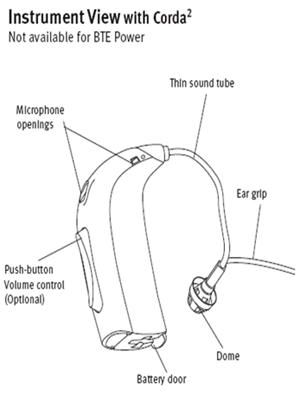 |
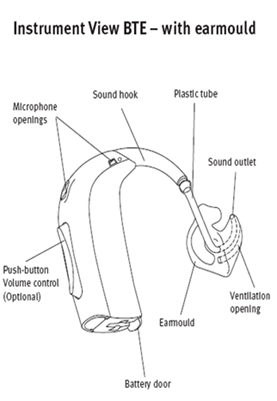 |
Changing Batteries
When the battery power is low, you will hear two beeps. This pre-warning will repeat at moderate intervals. The descending tune will play when the battery runs out and the instrument will turn off.
|
To replace the battery open the battery drawer completely by pushing the raised edge on the bottom. Ensure the flat side of the new battery faces upwards when inserted. Turning your Hearing Aid On or OFF |
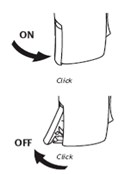 |
Left/Right Marking
Hearing aids are fitted uniquely to each individual ear, so it is important to distinguish between the left and right. In order to easily identify whether it is the left or right aid, a coloured marker may be applied inside the battery drawer.
A blue dot marks the LEFT instrument.
A red dot marks the RIGHT instrument.
|
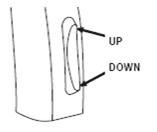
Push Button Your hearing instrument has a push button designed for volume adjustment and switching between different programmes. You can push the top end for up, or the bottom end for down. The button can be programmed to one of three functionalities: |
 |
Programmes
Your hearing aid can have up to four different programmes. When switching between the programmes, your instrument will beep. The number of beeps indicate which program you are using. E.g. One beep for program one, two for program two, and so on.
Press the upper part of the button to go forwards in the programme cycle (e.g. from P1–P2).
Press the lower part of the button to go backwards (e.g. from P3-P2).
Please see your individual management plan for a description of the programmes in your hearing instrument
Volume Control
A volume control may be activated.
When the aid is turned on, it starts at the volume level set during your fitting appointment.
To increase the volume, shortly press the upper part of the button.
To decrease the volume, shortly press the lower part of the button.
You will hear a click noise when you adjust the volume. When adjusting the volume back to your preferred level, you will hear two short beeps.
Inserting the Ear Mould:
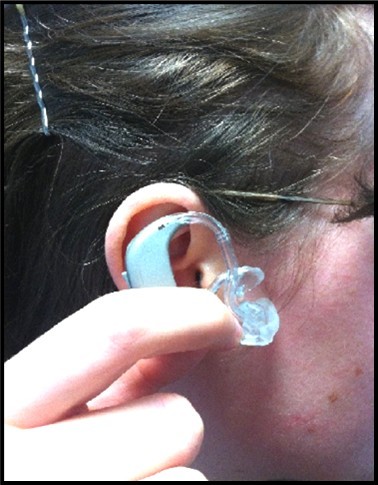 |
Hold your ear mould at the back by your finger and thumb. |
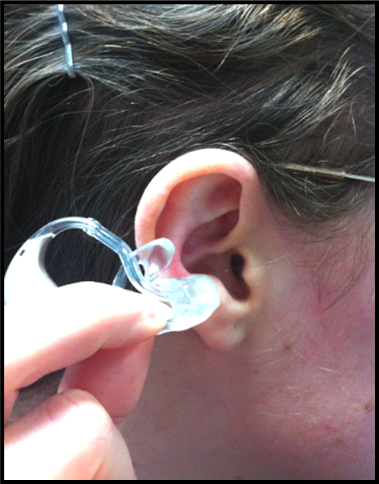 |
Pull the ear mould back past your ear. |
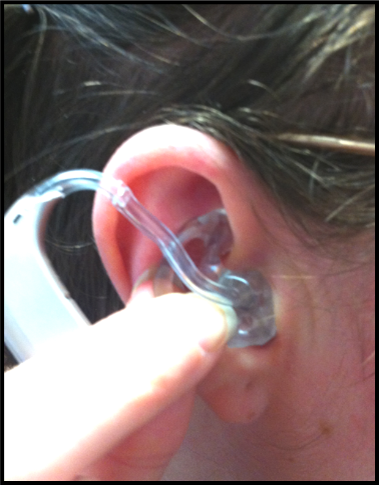 |
Ensure you put the top part of your ear mould into the top crease of your ear and the bottom part of the ear mould into the ear canal. |
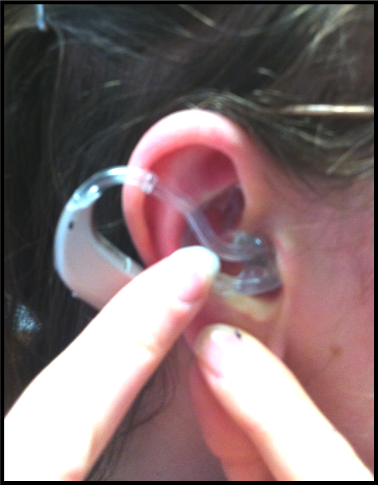 |
You may need to pull down on the ear lobe or sometimes pull the ear outwards to be able to place the mould properly into your ear. |
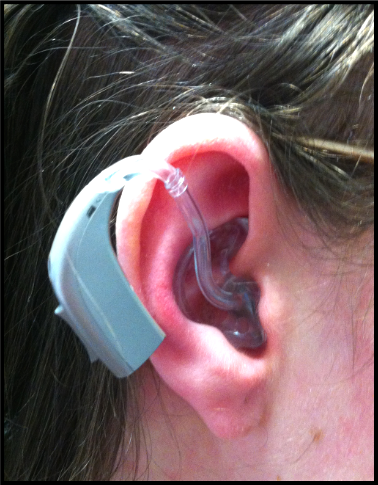 |
When the mould is in correctly it should look similar to this. Please note: If the mould is NOT fitted correctly it can cause the ear to become sore or the hearing aid to whistle or the hearing aid to easily fall out of the ear. |
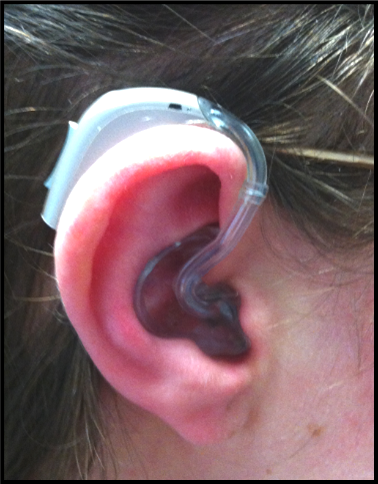 |
Finally, lift the hearing aid over the top of your ear. Well done! You have fitted your hearing aid! |
Replacing the tubing in your ear mould: Every 5-6 months the tubing in the mould needs replacement:
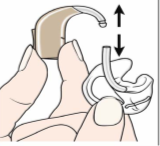 |
1. Remove the old existing tubing either with your hand or pliers. Please keep this old piece of tubing as a size reference. |
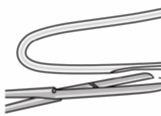 |
2. Ask Audiology for a piece of tubing. Using a pair of scissors taper the edge of one side of the length of replacement tubing. Do not cut too close to the bend. |
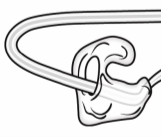 |
3. Thread the tube into your ear mould from the outside, through to the part that fits inside your ear. If there are two holes in you ear mould, please thread the tubing through the top hole. |
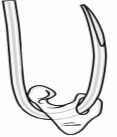 |
4. Next pull the tubing through the ear mould so that the remaining tubing is facing upwards at approximately a 50 degree angle. A small pair of pliers are sometimes helpful to pull the tubing carefully through the hole in the ear mould. |
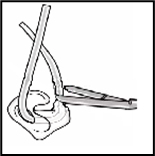 |
5. Using a pair of scissors carefully cut the tapered tubing as close to the end of the ear mould as possible. |
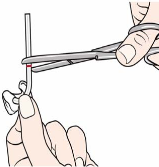 |
6. Use the old piece of tubing that you have initially removed as a guide, mark the length and cut the tubing the same length. |
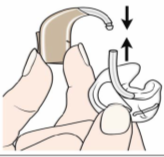 |
7. Finally, connect the ear mould and tubing together. It is now ready for use. |
How to change the Corda Tube
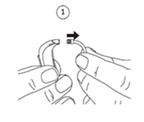 |
Pull the tubing out of the hearing aid |
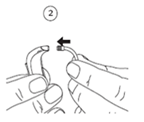 |
Push the new tube back into the hearing aid |
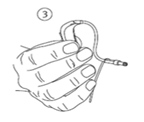 |
Appearance when tube inserted |
How to use the Cleaning wire
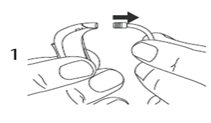 |
Pull the tube off the hearing aid |
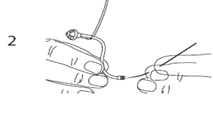 |
Insert the cleaning wire into the corda tube through the end that was attached to the hearing aid |
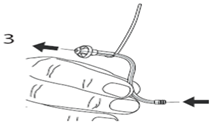 |
Remove the cleaning wire through the other end of the tube (at the dome) |
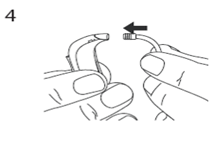 |
Push the tube back on to the hearing aid |
General Maintenance (Corda):
Thin Corda tubing needs changing every 3 months and can be collected from the Audiology Reception Desk at Frimley Park or the Main Reception Desk at Farnham Hospital, Fleet Hospital and Aldershot Centre for Health during office hours.
Inserting Corda hearing aids
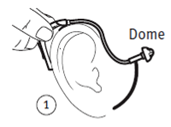 |
Place the hearing aid over the top of your ear. Hold the bend of the tube between your finger and thumb. The dome should point towards your ear canal. |
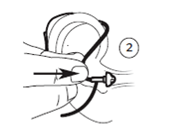 |
Guide the dome into the ear canal until the tube is sitting flush against the side of your head. Position the ear grip used to support the hearing aid into the concha using your fingers to guide this in place. |
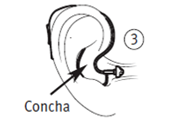 |
You can check the ear piece is in correctly by having a look in a mirror. If the tubing looks like it is sticking out then the dome should be pushed further into your ear. If the ear grip is visibly sticking out then this means it has not been fully placed into the concha. |
To remove the hearing aid, use the tube to gently ease the dome out of the ear and then unhook the hearing aid from the top of your ear.
Your Individual Management Plan (IMP) for your Hearing Aid
Following your hearing assessment we devised some agreed needs and planned actions. Today we have seen you again to fit your hearing aid/s:
Outcome
We have given you a questionnaire to fill in and return to us in 3 months time. We have not arranged another appointment for you. If you have any questions or concerns do not hesitate to contact us. If your hearing aid becomes faulty or your hearing aid is due for re-tubing (due every 4-6 months) you can phone us for a booked repair appointment on the number on page 16-17 of this booklet.
Review appointment: We will send you an appointment letter in the post which will be no sooner than 2 months after your hearing aid fitting.
What Should You Expect from Your Hearing Aids?
Your hearing aids should make the sounds you find difficult to hear louder. They cannot give you back perfect hearing but they should help you to hear speech and everyday sounds.
The hearing aids are able to reduce certain kinds of background noise such as traffic or noises from appliances. When you are in the presence of general chatter at a party or restaurant you may still struggle to pick out one voice from others as hearing aids cannot cut out background noise completely.
The level and type of hearing loss that you have will also affect the benefit you receive from the hearing aids and this can be spoken about with your Audiologist.
Wearing hearing aids should not make sounds uncomfortably loud or make your hearing worse. If you feel this is the case, please contact the Audiology department to make a Repair Appointment and you will speak to an Audiologist who can advise further.
Good Communication Skills when talking to someone who wears hearing aids
- Even if someone is wearing hearing aids, always ask if they need to lip-read you.
- Make sure you have the person’s attention before you start speaking.
- Speak clearly, not too slowly, and use normal lip movements. Use natural facial expressions and gestures.
- If you’re talking to a person who is deaf and a person who is hearing, focus on both of them.
- If someone doesn’t understand what you’ve said, try saying it in a different way. Rephrase your sentence.
- Keep your voice at a normal level. It can be uncomfortable for a hearing aid user if you shout and it looks aggressive.
- Find a suitable place to talk, with good lighting, away from noise and distractions.
- Remember to turn your face towards a person who has a hearing loss.
- Check that the person you’re talking to can follow you.
- Use plain language and don’t waffle.
Lost or Damaged Hearing Aids
Your hearing aids remain the property of the NHS. If your hearing aid is lost or damaged through negligence or neglect you may liable to a charge.
Hearing Aid Batteries
At Frimley Park: Batteries are supplied at the Audiology Reception Desk during office hours and from the Hospital Main Reception Desk after hours.
At Farnham Hospital: Batteries are supplied at the Main Reception Desk during office hours only.
At Fleet Hospital: Batteries are supplied at the Main Reception Desk during office hours only.
Aldershot Centre for Health: Batteries are supplied at the Main Reception Desk during office hours only.
Please note that we can only supply one packet of batteries per hearing aid.
Postal Battery Provision
To save you a trip in to the Audiology Department we can now POST your batteries to you.
Please send your Brown ‘Hearing Aid and Battery Issuing Record Book’ and an enclosed stamped self-addressed envelope to:
Battery Provision, Audiology Department, Frimley Park Hospital
Portsmouth Road, Frimley, Surrey
GU16 7UJ
You will need
ONE 1st Class Stamp OR TWO 2nd Class Stamps on BOTH envelopes.
You can also request ear mould tubing and Corda (thin) tubing.
PLEASE DO NOT SEND YOUR LOOSE BATTERIES BACK TO THE AUDIOLOGY DEPARTMENT.
ROYAL MAIL PROHIBIT THE MAILING OF LOOSE BATTERIES
Hearing Aid Repair and Adjust Clinics
- Appointment ONLY clinics.
- Repair clinic appointments to see an Audiologist can be booked up to 2 weeks in advance by phoning Monday to Friday during office hours.
- Should you ONLY require re-tubing, please request to see a volunteer. Re-tubing appointments can be booked up to 6 months in advance at Frimley Park and Farnham Hospital.
All Frimley Park, Aldershot Centre for Health and Fleet Repair Clinic appointments are booked on: (01276) 526998 Monday-Friday during Office Hours.
Repair Times For Frimley Park Hospital:
| Monday: Audiologist and Volunteers | 9am to 12pm |
| Tuesday: Audiologist | 9am to 12pm |
| Wednesday: Audiologist | 1pm to 4pm |
| Thursday: Audiologist and Volunteers | 1pm to 4pm |
| Friday: Audiologist | 1pm to 4pm |
Repair Times for Fleet Hospital:
| Wednesday: Audiologist | 9am to 12pm |
| Friday: Audiologist | 1pm to 1.45pm |
Repair Times for Aldershot Centre for Health:
| Tuesday: Audiologist | 9am to 12pm |
Repair Times for Farnham Hospital: Farnham Repair Clinic appointments are booked on: (01483) 782016 / (01483) 782224
Monday– Friday during Office Hours.
| Monday: Audiologist | 9am to 12pm |
| Wednesday: Audiologist and Volunteers | 1pm to 4pm |
| Thursday: Audiologist | 1pm to 4pm |
E-mail Address
If you find it difficult to use the telephone or prefer to contact the Audiology Department by e-mail to book an appointment then please reach us on this address: audiologyrepairs@
Drop-off Hearing Aid Repairs
Patients can leave their hearing aids at the Audiology Reception Desk at Frimley Park Hospital and Farnham Hospital for repair. Only broken hearing aids and hearing aids for re-tubing can be dropped off. For any adjustments, please attend the Repair Clinic. We endeavour to repair dropped-off hearing aids within 1-2 working days and will call the patient when it is ready for collection. There is no drop-off service at Fleet Hospital or Aldershot Centre for Health.
What happens when you feel your hearing has deteriorated?
Hearing tends to deteriorate very slowly and may take a few years before there is evidence of any change on a hearing test. If you do feel your hearing has deteriorated then please ring the repair clinic. You WILL NOT receive an appointment for a hearing test, instead, the administrative team will organise a 15 minute appointment for you with an audiologist. The audiologist will assess your hearing aids and have a look in your ears. If the audiologist feels that a hearing test would be appropriate then they will make a referral for a new hearing test.
Useful Websites and Information
Action On Hearing Loss www.actiononhearingloss.org.uk
The British Tinnitus Association www.
Lipreading www.
Deafplus www.
Hearing Link www.
Contact details:
Frimley Park hospital
Generic ENT Secretaries Frimley: 0300 614 5000
fhft.ENTClinicalAdminFPH@
Wexham Park Hospital
Generic ENT Secretaries Wexham
Email: fhft.entclinicaladminhwph@
Contact us
If you have any queries relating to this information, please contact the Ear or nose and throat (ENT) service.
About this information
Service:
Ear, nose and throat (ENT)
Reference:
G/004
Approval date:
23 February 2026
Review date:
1 February 2029
Click ‘show accessibility tools’ at the bottom of the page

Then click ‘select language’

Alternative formats
You can use the accessibility toolbar at the bottom of your screen to:
-
Change the text size
-
Adjust the font
-
Modify the colour contrast
-
Use the translate function
If you would like this information in another format, such as Braille, audio, or easy read, please speak to a member of staff.
You can also print as well as download as PDF using the “Print this page” button at the end of the page.
Staff will print a copy for you on request
Important note
This page provides general information only. It is developed by clinical staff and is reviewed regularly every 3 years for accuracy. For personal advice about your health, or if you have any concerns, please speak to your doctor.