

Advice after your nerve block for surgery
On this page…
Introduction
A cataract is a clouding of the natural lens of the eye causing hazy or blurred vision and is most usually due to advancing age. Genetic factors or family history may make you more prone to cataract. Cataract surgery is usually successful at restoring vision. Having a cataract does not necessarily mean you need surgery: that depends on how much of a problem your cataract(s) are giving you in day-to-day life.
Diagnosis and first appointment
A cataract is most often diagnosed by your optometrist and referred to our specialist cataract clinic at Heatherwood Hospital. Sometimes it is diagnosed at your clinic appointment at Frimley Park.
At Heatherwood Hospital your first appointment will include a pre-operative assessment by a specialist ophthalmic clinician and a further ophthalmic assessment by an ophthalmologist. Your pupils will be dilated, and you will not be able to drive afterwards.
At Frimley Park Hospital and Wexham Park Hospital you may have a separate preoperative assessment by a clinician at a later date when your pupils will not be dilated and you may drive if you wish. Before you come to a first cataract appointment you may receive a telephone call from our automated AI assistant Dora, to ask you some questions about your cataract(s) and your general health.
Pre-operative assessment
This visit is to ensure you are fit and prepared for surgery if you need it. Please remember to bring a list of all your usual tablets and eye drops with you. Please also bring your current reading and distance spectacles, and your most recent spectacle prescription. Your blood pressure will be checked and if you have diabetes, a blood sample will be needed to check your sugar levels. If either of these are found to be too high, surgery may have to be postponed and your GP informed.
Both your eyes are measured to calculate the power of the lens implant required. This measurement is called biometry. Biometry is carried out by shining an infrared laser light on the eye to take very precise measurements of the curvature of the cornea, the depth of the anterior chamber, the lens thickness and the length of the eye.
An ophthalmologist uses a formula to convert these measurements into the power of the lens implant required. During surgery we always put a new lens in to replace the cataract. This is calculated to give you distance vision without glasses. Occasionally short-sighted patients who can read without glasses choose to remain like this. In this case we would put a lens for reading vision inside the eye, and glasses would then be needed for distance vision. If this is the case, please tell your surgeon before the surgery. The measuring procedure is not painful, and your eye will feel normal afterwards.
If your biometry has revealed corneal astigmatism, we may try to correct this at the time of surgery. We can do this by using to some extent with corneal incisions as part of the cataract operation, or by using a toric intraocular lens. Whilst not all NHS units use toric lenses, we do for higher levels of astigmatism. Correcting astigmatism means better vision afterwards without glasses. If you would like to know more about the precise plan for you, please ask before any planned surgery.
Contact lens wearers
Contact lenses temporarily change the shape of your cornea and need to be removed before measurements to ensure accuracy. If you wear soft contact lenses you should not wear them at all for 1 week before your biometry. If you wear gas-permeable lenses you should not wear them for ideally 4 weeks and minimum 2 weeks before biometry.
You may wear them again after biometry and before your surgery except the day of surgery itself. If your first appointment is at Heatherwood Hospital, please remember to remove your lenses in good time as above as your measurements will be done on the same day.
Previous laser refractive surgery for short or long sight
This affects the biometry measurements. If you have had laser surgery (LASIK , LASEK, PRK) it is imperative that you make every effort to supply us with the pre- and post- operative eye and optician readings that were taken at the time of the surgery. Please bring printed copies on the day of your biometry. Our lens predictions for your eye are more accurate if we have these old readings.
When will I have my surgery?
The Heatherwood Hospital waiting list is usually short. At Frimley Park we operate on more complex cataracts and the waiting list is a little longer. We don’t yet perform cataract surgery at Wexham Park Hospital. The final operating list running orders are not decided until 2 to 6 weeks before surgery. You will be telephoned by our booking team before your operation to give you a suitable date, and you will then receive confirmation in the post.
Eyelash cleaning at home before surgery
Eyelashes can accumulate bacteria. We ask that you clean your eyelashes once a day with a cotton bud or a cotton pad for a week before surgery. You can use hot tap water, to which you can add a pinch of bicarbonate or a few drops of baby shampoo if you prefer. Try to clean the roots of the eyelashes quite firmly - this is where most debris can accumulate. This reduces the risk of infection, and the risk of us cancelling your operation on the day.
The day of your operation
- Eat and drink as usual
- Take your medications as usual including eye drops
- Wear clothes that aren’t tight around your neck
- Bring a spare top if you wish: sometimes tops can get wet during surgery
Please remember you should not:
- Wear any make-up
- Wear any jewellery
The time you are given to come in is not the time of your operation. Your operation will may start an hour or more after your arrival, as your pupil needs to dilate fully.
At Frimley Park we have two operating theatres, so don't worry if someone who arrives after you is called for surgery before you.
When you arrive on the eye ward, eye drops and sometimes a little pellet (half the size of a grain of rice) are tucked inside your lower lid to dilate your pupil. The pellet does not dissolve and is removed before you leave.
Your operation: in the operating theatre
- Local anaesthetic drops will be instilled; we don’t use needles.
- A sterile drape will be gently placed around your eye and over your face. It is held away from your nose and mouth, and fresh air is gently circulated around.
- You will be aware of the bright lights and indistinct shapes, but you will not be able to see exactly what is going on.
- You will be able to sense touch and pressure but no pain.
- Don’t worry about blinking: a small clip keeps the eye open.
- You can ask for a nurse to hold your hand throughout the operation for reassurance. You can also communicate with the surgeon by squeezing the nurse’s hand, who will inform the surgeon.
- You will be in the operating theatre for about 30 to 40 minutes. The operation itself usually takes 10 - 20 minutes but can take longer.
- We are an ophthalmic teaching hospital so you may hear the senior surgeon advising another surgeon on technical aspects of the operation.
After your operation
You will be able to go home about half an hour after the operation. This is so our nursing team can ensure you are not having any side-effects after the surgery. You will be given a bottle of eye drops to take for about 4 weeks. After two or three weeks the drops may begin to sting a little.
If you have diabetes, you may be asked to use a second bottle of eye drops for 2 to 3 months.
The bottle looks tiny but usually will last for the full 4 weeks. Running out a day or two early is not a problem, especially if the eye feels comfortable. If you do run out before then, please come to the eye ward where the staff will be happy to give you a fresh bottle.
Be aware: If you use glaucoma eye drops, please continue to use them unless otherwise instructed. You will require a fresh unopened bottle for the operative eye.
Going Home
You will not be able to drive yourself home. Therefore, please ensure someone is available to give you a lift home or make other suitable arrangements to get home (eg. taxi). Once you are at home you should rest. If you have been given an eye shield, keep this on until the next morning.
If you have any initial pain, take a standard painkiller tablet such as paracetamol every 4 - 6 hours. It is normal to feel mild discomfort and grittiness for a few days after cataract surgery. Clear watery discharge from the eye is common in the first 24 hours.
Approximately 3 weeks after surgery, you will receive a call from Dora, our AI assistant, to ask you if everything is OK. We often don’t need to see you in person after your surgery.
We will refer you back to your optician for a post-cataract surgery check.
What will my vision be like?
Immediately after the surgery the vision will be blurred. The day after surgery the vision will be clearer but may not clear completely for a few days.
Most patients have improved eyesight following cataract surgery. If you have another condition such as glaucoma, macular degeneration or corneal scarring, your quality of vision may still be limited even after successful surgery.
After a month
It is quite normal for the eye to feel improved but still not quite right for about 3 months after surgery. In this time the edge of the new lens can sometimes be seen as a dark or bright curved shadow at the edge of your vision – “lens dysphotopsia”. This tends to diminish in the first 3 months. It often disappears altogether, but sometimes a subtle dark shadow remains that most patients hardly notice.
If the eye becomes painful, sticky and red, and especially if the vision gets worse, please call to the eye treatment centre.
What am I allowed to do?
Take it easy on the first 2 days after surgery and don’t get water in the eye. If the eye waters, dab the corner with a clean tissue. Don’t rub the eye in the first week after surgery.
After 2 days you may resume all normal activities including hair washing, bathing, showering, bending down, lifting, walking and travelling by car, bus, train or plane. The world often feels very bright after cataract surgery and tinted spectacles or sunglasses may help but are not essential.
Avoid swimming and strenuous exercise for 2 weeks.
What about glasses?
- You may wear your usual glasses, although the lens on the side of the operated eye is unlikely to be correct. Your old lens won’t harm your new eye.
- If you prefer not to wear your glasses, that is also fine.
- Most patients will need reading glasses following surgery. Off the shelf readers may be adequate.
- Prescription glasses are often required to achieve your best vision for distance and reading.
- If you have prisms in your glasses for double vision you will most likely still need them after surgery.
When can I drive?
You may drive provided your vision is comfortable and clear with or without spectacles as appropriate, provided you have no double vision, and can read a number plate with both eyes open at 20 metres. This means that some patients will still be unable to drive until their spectacles are updated, because their vision may not meet the legal standard with or without spectacles.
Patients who need to drive at an earlier stage may decide to update their spectacles sooner and accept that these may need to be revised perhaps within a few weeks as the eye continues to heal. There are separate regulations for HGV drivers, details of which are on the DVLA website.
Benefits and risks of cataract surgery
The most obvious benefits are greater clarity of vision and improved colour vision. Because lens implants are selected to compensate for existing focusing problems, such as short and long sight, most people find that their eyesight improves considerably after surgery without glasses, although glasses may still be necessary for best distance vision, and are often needed for reading.
Some lens implants are available which try to provide clear vision for middle distances (PC, ipad) or near vision (small print) as well as distance vision (TV, driving). These are extended depth of focus (EDOF) lenses and multifocal lenses, implanted the same way, but more expensive and are only available privately. The NHS does not allow you to “top up” by paying extra for a different lens. These lenses do not suit everyone.
Some possible complications during the operation
- Tearing of the back part of the lens capsule with disturbance of the vitreous gel inside the eye that may sometimes result in reduced vision – 1:100
- Damage to the iris affecting vision in bright light – 1:200
- Damage to the cornea requiring corneal surgery – 1:500
- Loss of all or part of the cataract into the back of the eye requiring further operation which may require a general anaesthetic – 1:750
- Bleeding inside the eye – 1:1000
Some possible complications after the operation
- Bruising of the eye.
- High pressure inside the eye.
- Allergy to the medication used.
- Clouding of the cornea.
- Swelling of the retina.
- Retinal detachment requiring surgery – 1:500
- Infection in the eye - endophthalmitis - which can lead to loss of sight – 1:1000
- Incorrect strength or dislocation of the implant -1:1000
Complications after a year or two
In up to 20% of patients the remaining lens capsule becomes cloudy, causing a gradual loss in clarity of vision. We call this posterior capsule opacity or PCO. This is easily treated as an outpatient by a 10-minute laser procedure. After laser, this clouding does not come back.
How to use your eye drops
- Wash and dry your hands
- Tilt your head back
- Pull down your lower lid to make a pocket
- Look up and squeeze one drop into the pocket without touching your eye with the bottle
- Close your eye
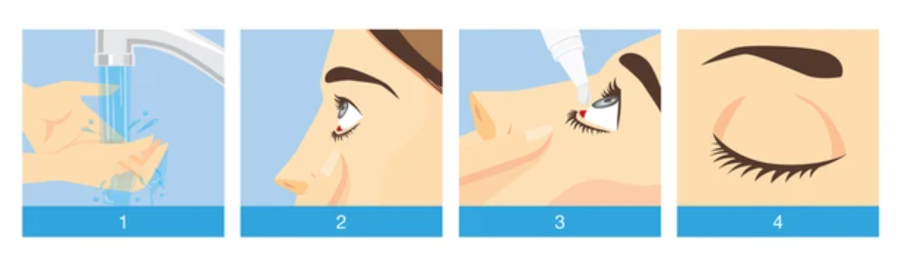
Ensure you leave 5 minutes between drops.
Checklist before your first visit
- I have read this information
- Bring a list of medications, eye drops and any drug allergies
- Bring my most recent glasses prescription
- If I wear contact lenses, I have left them out for the correct time
- If I have had laser refractive surgery, I am bringing all the original paperwork
- I understand I need to clean my eyelashes in the week before surgery
Contact details for postoperative concerns
If you have any concerns in the first month after your operation, please contact the staff in the Eye Treatment Centre on the following:
| From 9am to 5pm Monday to Friday: | 0300 373 5884 |
| From 5pm to 9am and at weekends: | 0300 614 5000 and ask for the Eye Doctor on call |
Contact us
If you have any queries relating to this information, please contact the Ophthalmology service.
About this information
Service:
Ophthalmology
Reference:
QQ/005
Approval date:
25 June 2026
Review date:
1 June 2029
Click ‘show accessibility tools’ at the bottom of the page

Then click ‘select language’

Alternative formats
You can use the accessibility toolbar at the bottom of your screen to:
-
Change the text size
-
Adjust the font
-
Modify the colour contrast
-
Use the translate function
If you would like this information in another format, such as Braille, audio, or easy read, please speak to a member of staff.
You can also print as well as download as PDF using the “Print this page” button at the end of the page.
Staff will print a copy for you on request
Important note
This page provides general information only. It is developed by clinical staff and is reviewed regularly every 3 years for accuracy. For personal advice about your health, or if you have any concerns, please speak to your doctor.