

Advice after your nerve block for surgery
On this page…
Introduction
As part of your recent rectal cancer surgery (Low Anterior Resection), you required a temporary loop ileostomy. The join (anastomosis) in your bowel has now healed, and the ileostomy can be reversed. This is a less complicated surgical procedure than your initial surgery and your surgeon will discuss this surgery with you. You should expect to be in hospital for two to three days, usually until your bowels open normally.
Following the reversal operation, it can take some time for your bowels to settle down, and they may never return to exactly how they were before. This leaflet will hopefully help you to manage any symptoms you have after stoma reversal. It also gives some advice on things you can do to prevent future functional problems.
Some of the symptoms you may experience are due to the altered layout of your bowel following surgery, and some are simply due to the inactivity of the bowel for a period of time. A collection of bowel-related symptoms that can occur after surgery to remove part or all of the rectum are known as Low Anterior Resection Syndrome (LARS).
Bowel Function
Even without surgery bowel function varies widely from person to person, and there is no ‘right’ or ‘wrong’ in this. However, it is important that your bowel function is acceptable to you and allows you to carry on with your usual activities without too much inconvenience.
The operations that will affect bowel function more commonly are those where all or most of the rectum is removed (anterior resection). This changes the structure and function of the large bowel. This can alter bowel function in the first few months after surgery in several ways and you will need to be open to the concept of a ‘new normal’ bowel habit.
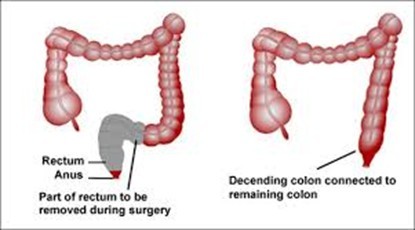
The loss of rectum that acted as a storage chamber (holding the stool until you were able to go to the toilet) may result in some or all of the following symptoms.
- Changes in bowel habits: Increased frequency of bowel movements, urgency, difficulty controlling bowel movements, and changes in stool consistency (e.g., loose stools, constipation).
- Incontinence: Leakage of stool or flatus.
- Difficulty emptying the bowels: Feeling like the bowel isn't completely emptied after a bowel movement.
- Clustering: Experiencing multiple bowel movements close together.
- Tenesmus: A feeling of needing to pass stool even when the bowel is empty.
- Painful bowel movements: Dyschezia.
- Soiling: Accidental soiling of clothes due to leakage or urgency.
Occasionally, the anastomosis (the join in the bowel that was made at the time of surgery) can become narrow as it heals. This narrowing can cause symptoms such as a feeling of permanently wanting to open your bowels although only passing a small amount each time, discomfort when opening your bowels, or bloating caused by hold-up of the stool.
These symptoms generally settle as the bowel starts working again. Not all patients experience every symptom, and patients find that their symptoms improve and resolve over time. Improvement is usually gradual, with the most dramatic improvement occurring in the first six to nine months. Factors such as tumor height, radiotherapy and type of surgical reconstruction can influence the severity of symptoms. Below are some suggestions that may help manage these symptoms.
Diet
There is no restrictive diet you need to follow since the reversal of your ileostomy. Our bodies need a whole range of different food types for recovery and health, and you should therefore eat and drink a varied diet as tolerated.
- Chew foods thoroughly.
- Try small, frequent meals (5-6 per day). Skipping meals may worsen watery stools and cause increased gas.
- Add new foods one at a time to determine the effect it has on your bowel movements.
- Drink plenty of fluids 2-3litres per day. Sip fluids slowly and drink either between meals or at the end of a meal.
- Avoid caffeine and/or alcohol. This can worsen stool output.
- Eat foods high in soluble fiber and use fiber supplements. Psyllium-based products improve stool consistency by absorbing water but not reducing the volume. This may help slow and thicken the stool.
Medication
Common medications that can be used to help with the management of LARS symptoms include loperamide (Imodium®) to reduce diarrhea and firm stools, and fiber supplements such as fybogel® or normacol® to help bulk and bind loose stools.
Your Specialist Nurse or General Practitioner can provide advice if you have any queries regarding medications.
Anal sphincter exercises
During the period of having a temporary ileostomy, the muscles around your back passage (anal sphincter) were inactive. Participating in regular exercises to strengthen these muscles can improve your control, and are simple to do:
- Squeeze (tighten and pull) the sphincter muscles as tightly as you can. Hold tightened for at least five seconds, then relax for about 4 seconds.
Repeat five times ~This will work on the strength of your muscles.
2. Next, pull the muscles up to about half of their maximum squeeze. See how long you can hold this for. Then relax for at least 10 seconds.
Repeat twice ~ This will work on the endurance or staying power of your muscles.
3. Pull up the muscles as quickly and tightly as you can and then relax and then pull up again and see how many times you can do this before you get tired.
Do these exercises – five as hard as you can, two as long as you can and five quick pull-ups – four to six times every day
As the muscles get stronger, you will find that you can hold for longer, and that you can do more pull-ups each time without the muscle getting tired. It takes time for exercise to make muscle stronger. You may need to exercise regularly for several months before the muscles gain their full strength.
Perianal Care
Stool after the reversal can first be watery initially, and you may see some blood-stained mucus on the toilet paper after you wipe, this is to be expected.
You may also feel some soreness around your anus where LARS symptoms have irritated the perianal skin. Make sure you clean and dry the area carefully after each bowel action. Moist toilet tissue or toilet wipes with Aloe Vera can be soothing, Sudocrem® or barrier creams can also be helpful to alleviate any discomfort.
Further information
If you have been registered with a Dispensing Appliance Contractor for your stoma supplies, please contact the company to discontinue your registration.
Following discharge home an appointment will be arranged for you to attend the LARS clinic; this will be around a month following your surgery to allow time for your bowel function to settle. The clinic is available to help support you and improve any symptoms you may be suffering following the reversal of your ileostomy.
If you have any problems or queries, please contact your Stoma Care Nurses.
Frimley Park Team: 03006136301 / fhft.
Wexham Park Team: 03006153734 / fhft.
Contact us
If you have any queries relating to this information, please contact the Stoma care service.
About this information
Service:
Stoma care
Reference:
H/106
Approval date:
30 January 2026
Review date:
1 June 2028
Click ‘show accessibility tools’ at the bottom of the page

Then click ‘select language’

Alternative formats
You can use the accessibility toolbar at the bottom of your screen to:
-
Change the text size
-
Adjust the font
-
Modify the colour contrast
-
Use the translate function
If you would like this information in another format, such as Braille, audio, or easy read, please speak to a member of staff.
You can also print as well as download as PDF using the “Print this page” button at the end of the page.
Staff will print a copy for you on request
Important note
This page provides general information only. It is developed by clinical staff and is reviewed regularly every 3 years for accuracy. For personal advice about your health, or if you have any concerns, please speak to your doctor.