

Advice after your nerve block for surgery
On this page…
Introduction
Dupuytrens contracture is when one or more fingers and thumb bend in towards the palm. This happens because thickening and tightening of tissue in the palm. It normally affects the ring and little fingers in one or both hands and often affects men more than women. It tends to get worse slowly over months or years.
The aim of the surgery is to allow your finger(s) to be straighter. Sometimes a splint is needed to keep your finger(s) straight after the surgery. This will be decided by your therapist. Most of the time your finger(s) will stay straight without a splint.
The most important things after surgery are:
- To get the swelling down as quickly as possible
- To keep the fingers and hand moving as much as possible
- To keep your shoulder and elbow moving fully
- To avoid heavy or gripping tasks until your wound is fully healed
Swelling
Your hand and fingers may be swollen after your surgery. It is important to get your swelling down as quickly as possible. To do this, you should elevate your hand above your heart as much as possible.
- Reach your arm in the air or above your head regularly during the day
- Rest your hand on your shoulder
- Rest your hand on cushions
Activities
You should avoid tight grip or gripping tasks until your wound is fully healed. This includes driving and heavy activities. The wound will usually be healed two weeks after surgery but can be up to six weeks if you have a skin graft.
Scar
Scars can become raised, thick/stuck and a deep red/purple colour. They can be uncomfortable to touch and stop you moving your fingers easily.
After your stitches are out your therapist will teach you to massage your scar. Massage will help the scar to become soft, flat, paler and give the scar more movement.
Your scar may take up to two years to fully mature. Massage for the first few months after surgery will make the biggest difference to your scar.
Use a thick unscented cream like E45, Nivea, Aqueous or similar.
Massage needs to be firm and deep, not like putting on hand cream.
Support your hand and massage firmly/with pressure in circles across the scar.
Exercise
Exercises are very important to stop the fingers getting stiff, to help reduce the swelling, and to prevent the scar getting stuck.
Your fingers may feel uncomfortable when you are doing the exercises, but they should not be painful. If your hands aches for more than 30 minutes after your exercises, you should try to do less next time. You should tell your therapist this at your next appointment.
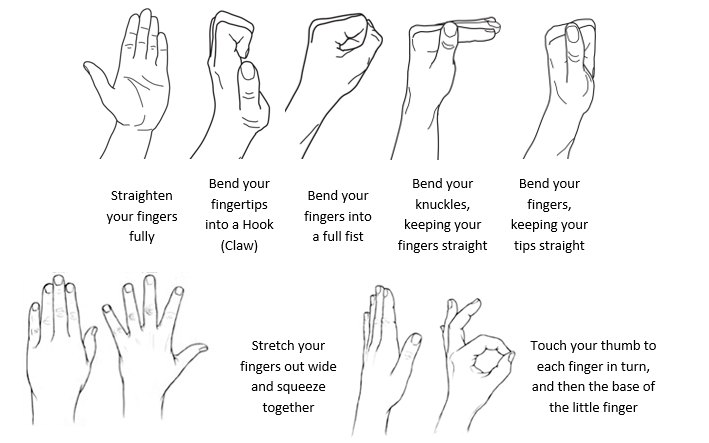
Try to follow the pictures one after the other to move your fingers fully.
Try to keep your wrist still and focus on just moving your fingers.
If your fingers are stiff, you may also be asked to push your fingers in these exercises.
Splint
If you have been given a splint, this should be worn for sleeping.
- You can wash your splint by taking off the soft Velcro straps and washing the plastic in cool soapy water or wipe down with a damp cloth/wipe.
- Do not let your splint get hot or leave it in a hot place.
- Bring your splint with you to every appointment so it can be adjusted.
Contact details
Hand therapy departments:
0300 6133396 for Frimley
0300 6140540 then Option 2 Wexham or Option 3 for Heatherwood
Plastic Dressing Clinic - 0300 6153031
Contact us
If you have any queries relating to this information, please contact the Hand therapy service.
About this information
Service:
Hand therapy
Reference:
UU/027
Approval date:
19 February 2026
Review date:
1 February 2029
Click ‘show accessibility tools’ at the bottom of the page

Then click ‘select language’

Alternative formats
You can use the accessibility toolbar at the bottom of your screen to:
-
Change the text size
-
Adjust the font
-
Modify the colour contrast
-
Use the translate function
If you would like this information in another format, such as Braille, audio, or easy read, please speak to a member of staff.
You can also print as well as download as PDF using the “Print this page” button at the end of the page.
Staff will print a copy for you on request
Important note
This page provides general information only. It is developed by clinical staff and is reviewed regularly every 3 years for accuracy. For personal advice about your health, or if you have any concerns, please speak to your doctor.