

Advice after your nerve block for surgery
On this page…
Categories:
Preparations Before Clinic
Medications:
Please let us know if you are taking any medications listed below or if you had recently been treated for Pulmonary Embolism (PE) or Deep Vein Thrombosis (DVT).
- Aspirin: Do not take on the day of the procedure.
- Clopidogrel, Ticagrelor, Dipyridamole: Stop 7 days prior (inform us if recent heart issues or recent stroke prevent you from stopping).
- Apixaban, Edoxaban, Dabigatran: Stop 2 days prior.
- Warfarin or Acenocoumarol: Stop 5 days prior. Please inform us if you have a metallic valve replacement which will prevent you from stopping this medication.
- Fondaparinux, Dalteparin or Enoxaparin: Stop 1 day before.
Escort Required
Please arrange for someone to accompany you home after the procedure.
What happens on the day of the Procedure?
- A thoracic ultrasound will determine the appropriate action: diagnostic pleural aspirate, therapeutic aspirate, chest drain, or no procedure.
- We will discuss the risks, complications, and benefits with you, and address any questions.
- Consent for the procedure will be obtained once a decision is made.
- The procedure typically takes 20-30 minutes.
- If complications arise, you may need hospital admission.
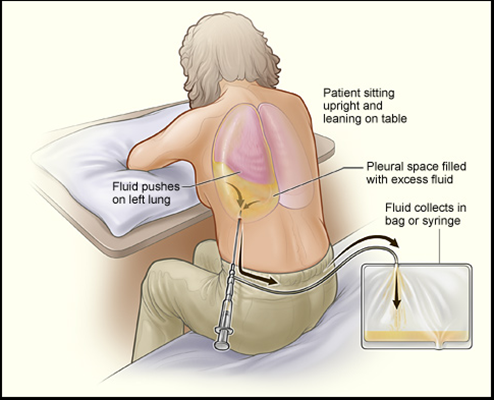
What is a Pleural Aspiration?
A pleural aspiration involves the insertion of a small plastic tube between your chest wall and lung to remove accumulated fluid. An ultrasound machine will be used to identify a safe insertion site to drain the fluid.
Other Pleural Procedures
- Thoracic Ultrasound: A quick, non-invasive scan to assess fluid in the pleural space.
- Chest Drain: A small tube may be inserted to continuously drain fluid for several days if indicated by ultrasound results.
Risk of the Procedure
- Pain: Local anaesthetic will be used to minimise discomfort.
- Bleeding: Blood tests and cessation of anticoagulants help mitigate this risk.
- Infection: Sterile techniques will be employed throughout.
- Damage to Surrounding Structures: Ultrasound guidance reduces the risk of injury to organs such as the kidney, spleen, and liver.
- Pneumothorax: Rarely occurs; symptoms may include difficulty breathing. Further monitoring or intervention may be required.
- Death: This is extremely rare, but a potential risk associated with any procedure.
- Procedure Failure: Various factors may lead to an unsuccessful procedure. Please communicate any discomfort, feeling dizzy or collapsing during the procedure.
Post Procedure Expectations
- A repeat chest X-ray may be conducted.
- You must have someone pick you up; do not use public transport alone.
- A small dressing will be applied at the insertion site; monitor for bleeding and keep it on for 24 hours.
- We will conduct observations to ensure stability post-procedure and will need to stay for 30 minutes.
- Fluid samples will be sent for analysis, and a follow-up appointment will be scheduled to discuss results.
If you have any questions or concerns, please do not hesitate to ask the medical team. Your comfort and understanding are important to us.
Contact us
If you have any queries relating to this information, please contact the Respiratory medicine service.
About this information
Service:
Respiratory medicine
Reference:
W/050
Approval date:
25 November 2024
Review date:
1 November 2027
Click ‘show accessibility tools’ at the bottom of the page

Then click ‘select language’

Alternative formats
You can use the accessibility toolbar at the bottom of your screen to:
-
Change the text size
-
Adjust the font
-
Modify the colour contrast
-
Use the translate function
If you would like this information in another format, such as Braille, audio, or easy read, please speak to a member of staff.
You can also print as well as download as PDF using the “Print this page” button at the end of the page.
Staff will print a copy for you on request
Important note
This page provides general information only. It is developed by clinical staff and is reviewed regularly every 3 years for accuracy. For personal advice about your health, or if you have any concerns, please speak to your doctor.