

Advice after your nerve block for surgery
On this page…
What is EBUS?
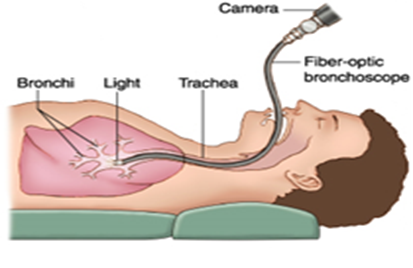
An EBUS is an EndoBronchial UltraSound and is a procedure that allows the doctor to look into your lungs, and take samples of the glands (lymph nodes) in the centre of your chest (mediastinum). A flexible tube, called a bronchoscope, approximately the size of a pencil, is passed into your lungs, via your mouth (see diagram). You will have a mouth-guard on and will be lying as flat as possible for the procedure.
The bronchoscope has a small camera at the end of it, so the doctor can look clearly at the windpipe (trachea) and breathing tubes (bronchi). You would have had a CT scan of your chest prior to the procedure, which the doctor will use to guide the location of the lymph nodes that they will take samples from. The ultrasound probe at the end of the camera is used to locate these glands and take samples with a small needle, under direct vision. This is called TBNA – Trans Bronchial Needle Aspiration. In 9 out of 10 cases we would expect this test to give a helpful answer to the problem but, occasionally, another test may be needed.
Alternative to EBUS
This should have been discussed with you at the time of appointment. The only other means of directly sampling lymph nodes like this requires general anaesthetic and is more invasive.
What should I do before the test?
- Because you will be having sedation, you will need to arrange transport to and from the hospital and have someone at home with you afterwards.
- You should not eat for 4 hours before the test but may have sips of clear fluid up until 2 hours beforehand.
- There is no need to pack an overnight bag unless you have been told otherwise. Just wear comfortable clothing and you will usually be asked to remove jewellery (except wedding bands), so leave valuables at home if possible.
- Please remove any nail varnish
- If you are taking clopidogrel, warfarin or any type of anti-coagulation, please read the medication section of this leaflet.
- Please inform a member of the team if you could be pregnant and, where possible, please check a pregnancy test before the procedure. Please also inform us if you are breast-feeding.
On the day before the procedure
- All patients needs to go to the WPH OLD ED unit in the purple zone near the diuretic lounge.
- You will be admitted by one of the nursing team, who will check your blood pressure, heart rate and oxygen saturations (observations).
- You will be asked to change into a hospital gown and have a cannula inserted, usually into your hand/arm.
- Relatives are not permitted in the procedure room.
The procedure
• We will administer anaesthetic throat spray, and give sedation through the cannula
• We will check your observations throughout the procedure so you will be attached to a monitor
• The procedure normally takes around 45 minutes depending on how many samples are taken.,
After the procedure
- You will be monitored for a few hours in hospital.
- You will not be able to eat or drink for at least 2 hours post procedure as you will have had anaesthetic throat spray and sedation.
- It is recommended that you do not drive or operate heavy machinery for the next 24 hours. Also, try to avoid alcohol, sign legal or important documents or take sleeping tablets
- If you experience any worsening chest pain, shortness of breath or coughing up large amounts of blood please seek medical attention.
Risks
EBUS is a very safe and effective technique with very few serious or life threatening complications. The main side effects are summarized below and your doctor will discuss and go through these with you prior to the procedure.
Contact us
If you have any queries relating to this information, please contact the Respiratory medicine service.
About this information
Service:
Respiratory medicine
Reference:
W/031
Approval date:
20 December 2024
Review date:
1 November 2027
Click ‘show accessibility tools’ at the bottom of the page

Then click ‘select language’

Alternative formats
You can use the accessibility toolbar at the bottom of your screen to:
-
Change the text size
-
Adjust the font
-
Modify the colour contrast
-
Use the translate function
If you would like this information in another format, such as Braille, audio, or easy read, please speak to a member of staff.
You can also print as well as download as PDF using the “Print this page” button at the end of the page.
Staff will print a copy for you on request
Important note
This page provides general information only. It is developed by clinical staff and is reviewed regularly every 3 years for accuracy. For personal advice about your health, or if you have any concerns, please speak to your doctor.