

Advice after your nerve block for surgery
On this page…
Diagram showing the Parathyroid Glands
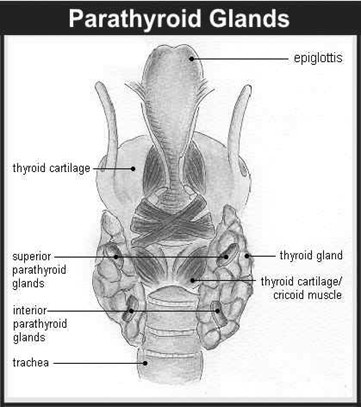
The Parathyroid Glands
The thyroid gland is a small dumbbell shaped gland that sits low down in the front of the neck. It is just in front of the windpipe. Its main function is to produce the hormone Thyroxine, which controls your body’s metabolism. It is shown in the diagram opposite.
Attached to the thyroid gland, and just behind it, are 4 little parathyroid glands, which control the calcium level in the blood. Also running just behind the thyroid gland are 2 nerves called the recurrent laryngeal nerves. These control the movement of vocal cords within the voice box of each side.
Problems with the Parathyroid Glands that require surgery
Sometimes one of the 4 parathyroid glands can become enlarged and overactive. It then produces too much parathyroid hormone. The effect of this is to cause calcium to leak from the bones into the blood stream. Your calcium level is then too high. This can lead to general aches and pains, problems with your bowls and things like kidney stones.
It can also lead to weakening of the skeleton if it goes on for long enough. The problem is usually due to one gland being overactive, but can sometimes be a result of all 4 glands becoming overactive.
The problem is normally detected with a simple blood test. Once the bloods tests confirm the problem, then an ultrasound scan and a special isotope scan are normally done to try and find the affected parathyroid gland. If it is possible to identify a single gland as the culprit, this makes the operation much easier. Normally, removal of the overactive gland cures the problem.
About the operation
You will attend the hospital about 1 to 2 weeks before the operation for a preoperative assessment. You should not have suffered from a common cold for at least 2 weeks before the operation. If you have had a cold, please ring the Consultant’s Secretary.
Please advise us if you take the oral contraceptive pill, as this may need to be stopped temporarily.
You will be admitted to hospital on the morning of the surgery.
Operations to remove the parathyroid glands are nearly always performed under a general anaesthetic (fast asleep). An incision is made in the front of the neck, often along a skin crease if one is present. This incision will leave a scar.
Exploration down the side of, and behind the thyroid gland, to find the suspect parathyroid gland is performed next. Once the parathyroid gland is identified, it is removed and sent to the Pathology Department for what is called a “frozen section.” This means that the Pathologist will have a look at the specimen immediately and let us know whether we have found the right thing. Once the Pathologist confirms the findings, the operation is finished. If the Pathologist says that we have not found the right thing, then we will explore the other side of the neck.
Typically, the operation therefore takes anything from 45 minutes to 90 minutes.
At the end of the operation, a drain is not required. The incision is then closed (often with special staples). If all is well, you should be fit for discharge home the same day or next day depending on time of surgery.
What to expect afterwards
After leaving hospital, the main problem is normally related to the length of the operation and anaesthetic. People often feel tired and worn out for a few days afterwards until things get back to normal.
The front of the neck may feel a little bruised and swollen for some time afterwards. Often the voice will be a little husky for a few days afterwards. This may be related to some bruising of the recurrent laryngeal nerves, but is more often related to having a tube in the throat for the anaesthetic.
The stitches or skin staples that have been used to close the incision should be removed about 1 week after the surgery. This can normally be arranged at your doctor’s surgery.
A follow up appointment will be made for about 4 weeks after the surgery.
Finally, we would recommend you allow at least 2 weeks for convalescence before getting back to normal activities. A Medical Certificate can be supplied if needed.
Risks
As with all operations there is a risk of bleeding or infection, although these are uncommon in this operation.
The main specific risk is damage to the recurrent laryngeal nerve. This can result in a husky voice for some time after the operation.
The other risk after the operation is that the calcium level in the blood might drop. This is because it takes a little while for the other parathyroid glands to start working properly again and also because the skeleton starts to suck back in lost calcium from the bloodstream. If the calcium level does drop, calcium supplements may be required for a period of time until the parathyroid glands recover.
If any of these problems arise after you have gone home please contact the wards:
Frimley Park Hospital: Short Stay Surgery ward Direct No: 0300 613[3216] or 0300 613[3950]
F1 (children’s ward) 0300 613 4252
Sources of Additional Information:
British Association of Otorhinolaryngologists: www.
National Institute for Health and Clinical Excellence (NICE) www.
Contact us
If you have any queries relating to this information, please contact the Ear or nose and throat (ENT) service.
About this information
Service:
Ear, nose and throat (ENT)
Reference:
G/026
Approval date:
23 February 2026
Review date:
1 February 2029
Click ‘show accessibility tools’ at the bottom of the page

Then click ‘select language’

Alternative formats
You can use the accessibility toolbar at the bottom of your screen to:
-
Change the text size
-
Adjust the font
-
Modify the colour contrast
-
Use the translate function
If you would like this information in another format, such as Braille, audio, or easy read, please speak to a member of staff.
You can also print as well as download as PDF using the “Print this page” button at the end of the page.
Staff will print a copy for you on request
Important note
This page provides general information only. It is developed by clinical staff and is reviewed regularly every 3 years for accuracy. For personal advice about your health, or if you have any concerns, please speak to your doctor.