

Advice after your nerve block for surgery
On this page…
|
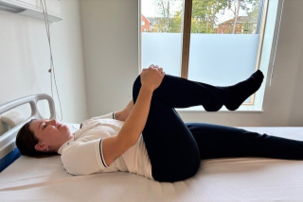
1. Knee hugs Lie on your back with both legs straight, then gently bring one knee towards your chest, using your hands on your shin to guide the movement. Hold the position where you feel a comfortable stretch, then slowly return to the starting position and repeat on the other side. 10 reps x3 a day |
 |
|
2. Knee drops Lie on your back with your knees bent and feet flat on the bed. Keeping your shoulders relaxed and in contact with the bed, gently roll both knees to one side until you feel a stretch in your hips or lower back. Hold the position briefly, then bring your knees back to the centre and repeat on the other side. 10 reps x3 a day |
 |
|
3. Pelvic tilts Lie on your back with your knees bent and feet flat on the bed. Gently draw in your lower tummy and pelvic floor muscles, then tilt your pelvis backwards so your lower back flattens against the floor. Hold for 5 seconds. 10 reps x3 a day |
 |
|
4. Core Activation To strengthen your deep tummy muscles, use only a gentle contraction—about one-third of your maximum effort—as a strong squeeze will activate the outer muscles instead. Lie on your back with your knees bent and place your thumbs just above the bony parts of your pelvis to feel for the correct muscles. Imagine gently drawing your navel in towards your spine without holding your breath; you should feel the muscles tighten under your thumbs. Hold this contraction for 10 seconds, then relax. 10 reps x3 a day |
 |
Contact us
If you have any queries relating to this information, please contact the Physiotherapy service.
About this information
Service:
Physiotherapy
Reference:
BB/070
Approval date:
30 April 2026
Review date:
1 April 2029
Click ‘show accessibility tools’ at the bottom of the page

Then click ‘select language’

Alternative formats
You can use the accessibility toolbar at the bottom of your screen to:
-
Change the text size
-
Adjust the font
-
Modify the colour contrast
-
Use the translate function
If you would like this information in another format, such as Braille, audio, or easy read, please speak to a member of staff.
You can also print as well as download as PDF using the “Print this page” button at the end of the page.
Staff will print a copy for you on request
Important note
This page provides general information only. It is developed by clinical staff and is reviewed regularly every 3 years for accuracy. For personal advice about your health, or if you have any concerns, please speak to your doctor.