

Advice after your nerve block for surgery
On this page…
Hello and welcome to the Frimley Trust
My name is Karolina and I am SACT Matron at Frimley Healthcare NHS Trust. My name is Param Pangali and I am the SACT Educator at Frimley Healthcare NHS Trust.
You've been sent this video because you've been referred by your oncologist or haematologist to commence the systemic anti-cancer therapy, (in short SACT) such as Chemotherapy or immunotherapy.
To help you understand what to expect on your first treatment, we have created this short video. We will describe the location of the treatment units as there is one on the Frimley site and one on the Wexham site.
The Chemo day unit at Frimley is situated at the end of blue and red corridor, next to G1 ward. Please come via the main entrance of the hospital. The Frimley site map is added in this video for further direction.
The unit is open Monday to Friday, 08:30 to 18:00.
In next section, we will explain what you can expect during your treatment.
On your first day of treatment, please arrive to your appointment on time and check in at the front desk. Please do let the ward clerk know if you require the parking concessions throughout your cancer treatment and this will be arranged for you.
On arrival on the Day Unit you will be checked in by the Receptionist and given a wrist band for your ID checks during treatment.
One of the staff members will then give you a tour of the unit, such as tea/coffee/toilet facilities. You will then have your weight and height checked, to make sure we have the correct details.
We will then check your blood pressure, oxygen level, heart rate, respiration, and temperature.
The allocated nurse will review your care such as full assessment, re-checking your signed consent, recent clinical review, and routine blood tests on our hospital electronic record system prior to commencing your treatment.
During this assessment they will ask you how you are feeling today, this gives you an opportunity to let them know about any problems which you may be experiencing or if there is anything you are concerned about.
In chemo units, we are using recliner chairs for our patients, so you remain comfortable during the treatment. You are welcome to bring reading books or iPad as some treatments may take several hours. There are television screens which could be helpful to keep you distracted. You are very welcome to bring in food with you and we also provide hot and cold drinks; snacks and sandwiches during your treatment.
It could be anxious experience for you or your family, we will accommodate one family member to stay during your treatment. On your treatment day, please take all your regular medications, unless advised by clinicians not to do so. Some drugs could counteract with your chemotherapy or immunotherapy. If not sure about which medications you need to avoid, please do let the team knows during your pre-treatment assessment.
We usually advise patients to bring any medications you may need during the day, for example painkillers or insulin. Depending on your chemotherapy regime, you may be given medicines to take home with, to help manage side effects, which will be explained by your key nurse.
Please make sure you drink plenty of fluids beforehand as this helps with cannulation and eat breakfast as normal. Usually, the treatment is provided intravenously via a cannula, a thin tube that sits in your arm, which is removed after your chemotherapy. Some patients may receive the treatment via central line (PICC or implanted Port), which usually organised with the IVAS team. These central devices are used for both giving IV medications as well as for taking regular bloods. The chemo unit will be able support you about who will look after these devises in the community. We will be linking with the District nursing team via regular online referrals for regular pre-treatment bloods and central line care.
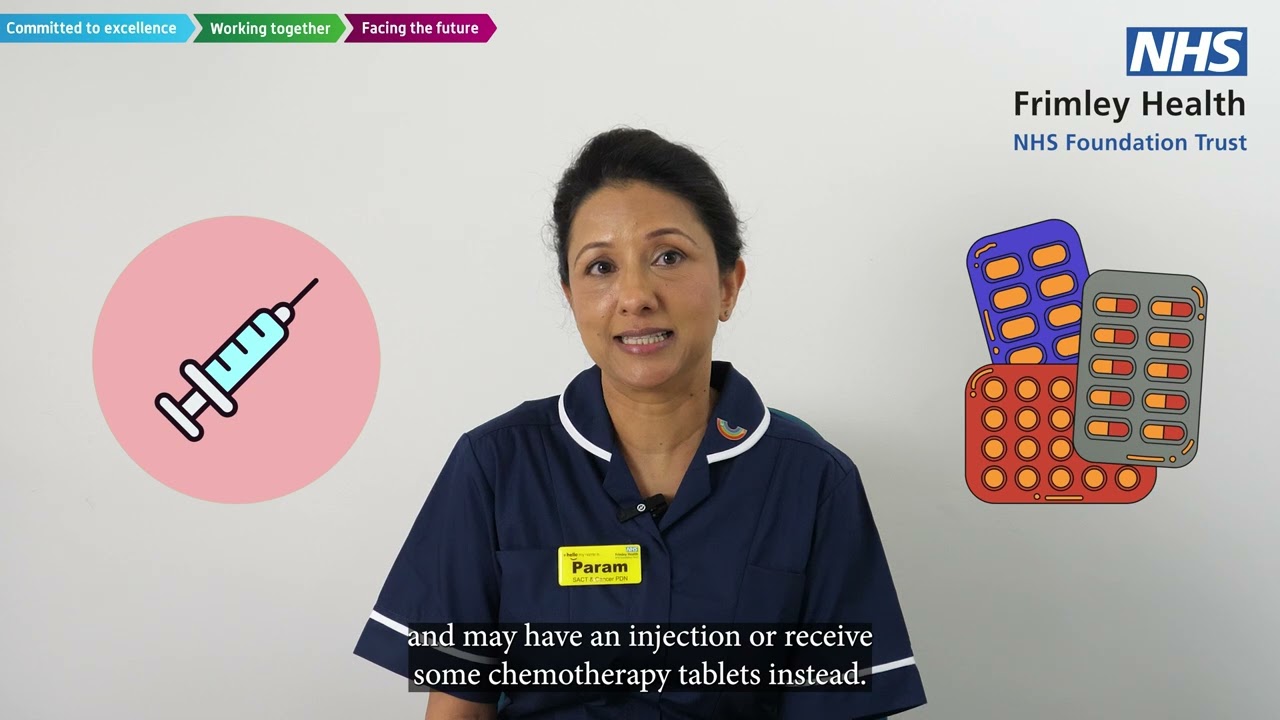
Some people do not have intravenous chemotherapy or immunotherapy and may have an injection or receive some chemotherapy tablets instead. At your pre-treatment chat, a specialist nurse will explain about how long your treatment will take on the day, so that you can plan your day.
As with any drug there is a risk of an allergic reaction with both chemotherapy and immunotherapy. Depending on the treatment you are having, we may then give you medicine that could help manage symptoms, make the chemotherapy work better or reduce the risk of an allergic reaction before starting the treatment. Following the pre-medication, your treatment will commence.
It is very sensible to get a lift home after your first treatment, as you are not going to know how you feel afterwards.
We also advice to have a thermometer to keep monitoring your temperature at home if you feel unwell, so that we could support you via hotline if you are at risk of developing an infection. During the winter months we encourage our patients to get a flu jab.
You should feel well during the administration of your treatment. If at any point, you don't, please let the nurse know immediately.
You will be provided with a treatment record booklet which will include your details i.e., your name, date of birth, hospital/NHS numbers, diagnosis, treatment regimen plan details, information about warning signs, and information about treatment delivery area.
In this record booklet, the treatment nurse will document the details of next cycle treatment information and date of next blood test with the printed copies of blood forms, so that you are safe and ready for the next treatment.
In case if you required to go to emergency department, please do show this record booklet so that the team could prioritise your case.
We will also provide a Macmillan alert card along with your record booklet, which contain brief guidance on symptoms that would require urgent assessment and an emergency 24-hours chemo hotline contact numbers. The Alert card will provide list of side effects to look out for and what to do if you develop them.
If you are feeling unwell or have any concerns about side effects due to your treatment, please find the chemo hotline numbers below
07769365369 - Wexham
03006131620 - Frimley
Please do keep the alert card in your purse or your wallet, so if you're out and about and you feel unwell, you can ring the hotline.
If your concern is not urgent such as general queries of scheduling or prescriptions or booking blood test, please do contact the chemo coordinators. The phone numbers for Wexham chemo coordinator is 03006154868 and for Frimley 03006134483.
If you would like to contact your cancer nurse specialist or treating team, please do ring cancer navigators on 03006133536.
We know this is an anxious period, but we are all here to support you and we will try to make the process as stress-free as possible. You are also able to access our support services and point of contact following treatment.
We hope you found this video helpful, and we wish you all the best with your treatment.
Contact us
If you have any queries relating to this information, please contact the Cancer care service.
About this information
Service:
Cancer care
Reference:
HH/026
Approval date:
29 October 2025
Review date:
29 October 2027
Click ‘show accessibility tools’ at the bottom of the page

Then click ‘select language’

Alternative formats
You can use the accessibility toolbar at the bottom of your screen to:
-
Change the text size
-
Adjust the font
-
Modify the colour contrast
-
Use the translate function
If you would like this information in another format, such as Braille, audio, or easy read, please speak to a member of staff.
You can also print as well as download as PDF using the “Print this page” button at the end of the page.
Staff will print a copy for you on request
Important note
This page provides general information only. It is developed by clinical staff and is reviewed regularly every 3 years for accuracy. For personal advice about your health, or if you have any concerns, please speak to your doctor.