

Advice after your nerve block for surgery
On this page…
What is joint replacement surgery?
Joint replacement (also called arthroplasty) is used in the hand for many different reasons.
This surgery can help to reduce pain, correct deformities and provide increased movement and function.
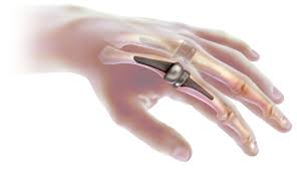
Metacarpal phalangeal (MCP) joint replacement refers to the replacement of joints between the metacarpal bones (which form the base of the hands) and the phalanges (the bones in the fingers). No joint replacement is ever going to be as effective as an original healthy joint; however with good surgery and hard work after your operation, you can achieve a good result.
You will need to consider that the disease process of osteoarthritis/rheumatoid arthritis is still ongoing, even with your new joints, so it is essential to protect your joint replacements as much as possible.
What happens during surgery?
When the joint is replaced, the bone is smoothed back and a hole is drilled down the centre of each of the bones.
An implant is inserted and used to provide a space between each bone, which creates a new joint surface
The Hand Therapy Process
A new joint takes around 12 weeks to fully heal. Within this time, you must try to achieve the maximum amount of movement possible, especially in bending. Your hand therapist will monitor your treatment and adapt your rehabilitation programme according to your needs.
- You will be provided with two splints to protect your joints from sideways forces. One splint will hold your fingers out straight and one splint will hold your fingers in a bent position.
- You need to wear the splint that holds your fingers bent when not exercising, and the other splint at night.
- Your splints may require regular adjustments by your therapist, so please bring both of them with you to each therapy session.
- Your splint must be worn at all times for the first four weeks and then at night and protection outdoors for a further four weeks unless advised by your therapist.
- You may be required to wear the straight splint at night for a little longer if there are problems with straightening your fingers on their own.
Scar
- After your stitches are out your therapist will teach you to massage your scar. Massage will help the scar to become soft, flat, more pale and will give the scar more movement.
- Your scar may take up to two years to fully mature. Massage for the first few months after surgery will make the biggest difference to your scar.
- Use a thick unscented cream like E45, Nivea, Aqueous or similar.
- Massage needs to be firm and deep, not like putting on handcream. Support your hand and massage firmly/with pressure in circles across the scar.
- Aim to massage your scar for a few minutes at a time, 4-5 x day.
Exercises
- Keeping your fingers straight, bend and straighten your knuckles.
- Bend the middle and end joints of your fingers whilst keeping your knuckles straight.
- Bend your fingers and knuckles to make a full fist.
- Fully straighten your fingers and knuckles.
- Using your other hand, push your fingers straight and try to keep them there.
- Bend and straighten your wrist.
- As if you were drumming your fingers, walk your fingers one at a time towards your thumb. Lift your hand off the table to reset your position - (never walk the fingers back towards your little finger).
Do
- Keep your arm and hand elevated to reduce swelling
- Alternate your splints day and night
- Lift your arm above your head regularly to keep your shoulder and elbow moving.
Don’t
- Use your hand for the first eight weeks following surgery
- Move your fingers towards your little finger (this is called ulnar drift).
Driving
You may drive when you feel confident to control the car, even in an emergency.
If all four MCPJs are replaced it is usually at least two months before you should consider driving again.
Single joint replacements in patients with osteoarthritis will usually be back to driving six weeks after the surgery and occasionally a little earlier if good progress is made.
You should discuss it with your insurer if you are considering driving with a splint in place.
Time off work
This will vary depending on the nature of your job and the exact nature of your surgery.
Sick notes can be provided on the day of your operation, at your clinic visits and by your own GP.
Joint Protection
Going forward, it is important to think about the way you use your hand to avoid forces that may push your fingers towards the little finger. Here are a few pointers for you to consider:
- Do not lean on your knuckles to assist getting out of a chair
- Avoid holding things for long periods – e.g. phone, book, especially in a puppet beak position
- Use both hands to hold a cup/mug or hold the mug close to your palm (instead of by the handle)
- Use assistive gadgets to help you to open jars and cans
- Use levered taps – this will reduce sideways forces on your fingers
- Widen handles to reduce the force on the knuckles
- Spread the load – e.g. use pans with two handles
Your therapist will be able to advise you on how you may adapt a particular activity.
Contact details
Hand therapy departments:
0300 6133396 for Frimley
0300 6140540 then Option 2 Wexham or Option 3 for Heatherwood
Contact us
If you have any queries relating to this information, please contact the Hand therapy service.
About this information
Service:
Hand therapy
Reference:
UU/085
Approval date:
1 August 2025
Review date:
1 August 2028
Click ‘show accessibility tools’ at the bottom of the page

Then click ‘select language’

Alternative formats
You can use the accessibility toolbar at the bottom of your screen to:
-
Change the text size
-
Adjust the font
-
Modify the colour contrast
-
Use the translate function
If you would like this information in another format, such as Braille, audio, or easy read, please speak to a member of staff.
You can also print as well as download as PDF using the “Print this page” button at the end of the page.
Staff will print a copy for you on request
Important note
This page provides general information only. It is developed by clinical staff and is reviewed regularly every 3 years for accuracy. For personal advice about your health, or if you have any concerns, please speak to your doctor.