

Advice after your nerve block for surgery
On this page…
Introduction
An epiretinal membrane is a condition which affects the macula. The macula is the central part of the retina. The retina is the light sensitive layer in the back of the eye. In many ways, it is similar to the film in a non-digital camera.
The macula is the part of the retina with which you are using to read. It is the part of the retina that provides you with the most sensitive vision. An epiretinal membrane occurs when a layer of scar tissue develops on the surface of the macula. This scar tissue then contracts. In contracting it wrinkles up the retina.
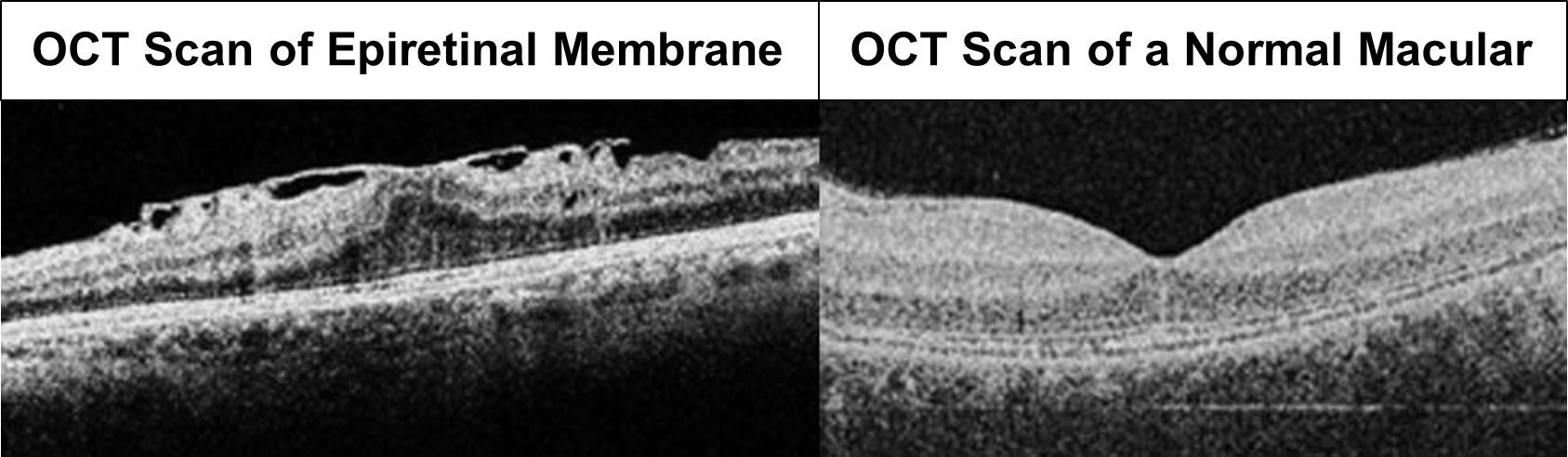
Who gets epiretinal membranes?
Most epiretinal membranes arise as a consequence of a little bit of ageing and bad luck. They may also arise as a result of inflammation (uveitis) within the eye or laser / freezing treatment to the eye used in order to prevent a retinal detachment. In a small proportion of cases it is a complication of otherwise successful retinal detachment surgery.
How does an epiretinal membrane affect your vision?
Firstly, the quality of the image can be very poor. Secondly, straight lines tend to become distorted with a bowing appearance. Thirdly, it is not unusual for patients to develop a central missing patch in their vision. Fourthly, both colours and the brightness of an image tend to be reduced in patients with an epiretinal membrane.
In many ways, this could be compared to turning down the colour and brightness on your television. Epiretinal membranes tend to affect one eye at a time. Many people with an epiretinal membrane are very aware that the poorer eye interferes with or gets in the way of the better eye.
As a result, even though the epiretinal membrane only affects one eye, the vision with both eyes open can be very unsettled. Some people will cover or close one eye in order to get over this effect.
What happens to an epiretinal membrane if it is not treated?
Most epiretinal membranes do not resolve on their own. The good news is that in most cases the problem is stable. About 1 in 10 people will have progressive deterioration in their vision as a consequence of epiretinal membrane. Epiretinal membranes only affect the central part of vision and as such, patients suffering from them do not go blind.
Can I get an epiretinal membrane in my other eye?
Yes, this is possible. There are some circumstances in which we are able to say that development of an epiretinal membrane is very unlikely to occur in the other eye.
What happens to an epiretinal membrane if it is treated?
Most patients with an epiretinal membrane can be successfully treated with an operation. Success means that the patient is pleased with the improvement in vision after the operation. About 70% of patients who undergo a successful epiretinal membrane operation are able to read 2 or 3 more lines on the standard vision test chart.
A major benefit in addition to improvement of vision is that the distortion tends to be much less after surgery. The eye with the epiretinal membrane tends to interfere much less with the other eye, preventing the need to close one eye to read or see clearly.
Possible complications
- Infection
- It occurs in less than 1 in 1000 patients who undergo an epiretinal membrane operation. This tends to occur within 2-5 days after the operation. If caught early enough, then most infections within the eye can be treated successfully. Unfortunately, infection can be a devastating complication of surgery. Overall, less than 1 in 500 could expect to end up worse after surgery.
- Glaucoma
- Raised pressure may occur in an eye that has undergone epiretinal membrane surgery. In most cases, this is transient and can be successfully treated with just eye drops. In less than 1 in 100 patients who undergo vitrectomy may have damage to the optic nerve as a consequence of high pressure. The severity varies greatly from person to person. Once you are discharged you should visit your optician yearly.
- Retinal detachment
- It may occur in about 1 in 100 people undergoing an epiretinal membrane operation. The vast majority of retinal detachments are repairable, but this can potentially be a blinding complication and surgery is needed to repair the detachment.
- Bleeding
- In rare cases (1 in 1000), there may be bleeding in the eye. In severe cases, this can lead to blindness.
- Recurrence
- A reappearance of epiretinal membranes can occur after surgery in about 5 – 10 % of cases. This is rare, but if this occurs, reoperation is possible.
- Cataract
- Progression of cataract can be quite rapid and may need a further operation to remove it. However, combined cataract surgery with epiretinal membrane surgery is sometimes performed.
Options of anaesthetic
You may choose to either have a local anaesthetic which will involve an injection at the start of the operation, a general anaesthetic, or a local anaesthetic with something to calm your anxiety.
Things avoid to do after the operation
Your surgeon will advise you on what to do after your surgery. There is no need to be concerned about going out for a walk, and travel by road, rail, or sea. We do ask patients not to swim for 2 months to prevent any unnecessary infection from occurring.
Most activities are fine to do as long as there is no gas bubble in the eye. If there is a gas bubble, then the patient cannot fly and drive for a period of time. Also it's important to tell the anaesthetic doctor if the patient is having another operation under general anaesthetic while the gas is still in the eye.
How long do I spend in hospital?
Most patients will have the operation as a day case - No overnight stay. However, if there is no escort to take the patient home or if the patient is unfit to go home, stay overnight to ensure safety will be necessary.
Post-op appointments
Usually the first visit will be the day 1, then 2 weeks after the surgery and then three months later. However, there're many variations to this.
Eye drops after the operation
Most patients will have a combination of an antibiotic and a steroid eye drops for 4 weeks. Occasionally, the pressure within the eye can be raised after surgery. If this occurs, pressure lowering drops will be prescribed as well.
Will I have to get my glasses changed?
Most people have a change of glasses after the surgery. We usually recommend that people think about changing their glasses after their 3-month follow up.
If you have any concerns after your operation, please contact the staff in the eye treatment centre on the following numbers
| From 9am to 5pm Monday to Friday: | 0300 373 5884 |
| From 5pm to 9am and at weekends: | 0300 614 5000 and ask for the Eye Doctor on call |
Contact us
If you have any queries relating to this information, please contact the Ophthalmology service.
About this information
Service:
Ophthalmology
Reference:
QQ/030
Approval date:
5 August 2024
Review date:
1 July 2027
Click ‘show accessibility tools’ at the bottom of the page

Then click ‘select language’

Alternative formats
You can use the accessibility toolbar at the bottom of your screen to:
-
Change the text size
-
Adjust the font
-
Modify the colour contrast
-
Use the translate function
If you would like this information in another format, such as Braille, audio, or easy read, please speak to a member of staff.
You can also print as well as download as PDF using the “Print this page” button at the end of the page.
Staff will print a copy for you on request
Important note
This page provides general information only. It is developed by clinical staff and is reviewed regularly every 3 years for accuracy. For personal advice about your health, or if you have any concerns, please speak to your doctor.