

Advice after your nerve block for surgery
On this page…
Introduction
Babies who are born early or are small at birth are at risk of developing an eye condition called retinopathy of prematurity (ROP). When these babies are born, the blood vessels at the retina (the back of the eye) are not full developed. As a result, in the first few weeks after birth, their eye may grow new, disorganized, blood vessels. This can lead to problems with the baby’s eyesight.
Retinopathy of prematurity (ROP) is one of the few causes of childhood visual disability that is largely preventable. All babies at risk of developing ROP have their eyes examined regularly to make sure ROP can be identified early and they can receive prompt treatment.
Who needs ROP screening?
All babies who are born less than 31 weeks or weigh less than 1,501g require ROP screening.
When does ROP screening happen?
If your baby was born less than 27 weeks, then they will have their first eye examination when they reach 30 - 31 weeks gestation. If your baby was born at 27 or more, they will have their first eye examination 4 - 5 weeks after birth. After their first eye examination, your baby will be examined again every 1 - 2 weeks (sometimes longer) until they reach around 37 weeks gestation.
Why does ROP occur?
Being born early is thought to be the most common cause of ROP, as the retinal blood vessels are not fully developed. However, other contributing factors include the amount of oxygen your baby has received and the baby’s overall general condition (infection / anaemia / nutrition).
How Common is ROP?
ROP is found in 60% of babies weighing less that 1501g at birth. In most of these babies, the ROP is only mild.
What does ROP screening involve?
ROP screening involves an eye examination by an ophthalmologist. Before the eye examination, your baby will be given dilating eye drops to make their pupils bigger as well anaesthetic eye drops which numb the eyes. Traditionally the ophthalmologist examines the retina using an ophthalmoscope to allow them to look closely at your baby’s eye. They also use a speculum (to hold the eyelid open) and an indenter (to move the eye) to get a better view of the retina.
Due to advances in imaging, we are now able to take pictures of the back of your baby’s eyes. We do this using the NeoCam (Frimley and Wexham) or the Optos Camera (Frimley). This allows us to document your baby’s eye health better as well as enables us to share images with clinicians to ensure the best care is given.
Babies can find the eye examination unpleasant, but the examination is safe and takes a short time. The clinical team will endeavor to keep you baby as comfortable as possible during the procedure. You are welcome to sit in during the examination, but most parents prefer to wait outside till the examination is over.
You may notice that your baby’s eyes may be red and puffy follow the examination, but this should improve after a few hours. If you have any concerns, please speak to the nurse or doctor looking after your baby.
Stages of ROP
The diagram below describes the stages of ROP. Stage 1 is the mildest and stage 5 is the most severe form of ROP.
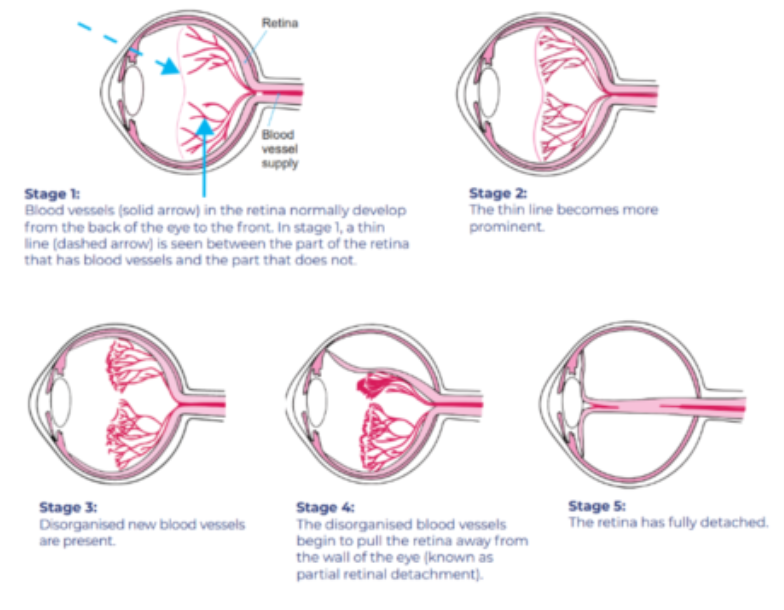
The doctor caring for your baby will explain to you if your baby has developed ROP and which stage they are at. It is important to note that having ROP doesn’t mean your baby will need treatment.
How is ROP treated?
Mild ROP (Stage 1 and 2) normally doesn’t need to be treated and should resolve by itself. Treatment may be recommended for stages 3, 4 and 5.
Treatments can include:
- photocoagulation (laser therapy) - It's the most common treatment to target the new disorganised blood vessels in the retina and stop them from growing.
- Eye Injections - to stop new blood vessels from growing and bleeding.
- Eye Surgery - to stop the retina from detaching further or to attempt to reattach a detached retina.
If your baby requires treatment, the doctor will explain which treatment is preferred, including the risks and benefits.
What is my baby is discharged home or transferred to another hospital?
ROP examinations are usually completed while your baby is in hospital. However, when your baby is discharged from hospital, we may continue to have eye examinations in an outpatient clinic. If transferred, the new hospital will receive a record of any ROP examinations that have taken place, and when your baby will be due the next one.
For further information and support
- Bliss: For babies born premature or sick
- Bliss’s vision is for every baby born premature or sick to have the best chance of survival and quality of life. They offer a wide range of services to support parents and families who have experienced neonatal care.
- Email: hello
@bliss.org.uk - Website: www.
bliss.org.uk
- RNIB (Royal National Institute of Blind People)
- Helpline Tel: 0303 123 9999
- Email: helpline
@rnib.org.uk - Website: www.
rnib.org.uk/ children
- The Royal College of Paediatrics and Child Health
- Website: www.
rcpch.ac.uk/ ROP
- Website: www.
- The Royal College of Ophthalmologists
- Website: www.
rcophth.ac.uk
- Website: www.
References
- Royal College of Paediatric and Child Health (2022) - Screening for Retinopathy of Prematurity.
- Prof Rebeccah Slater and Ms Sarah Chamberlain, Paediatric Neuroimaging Group, Department of Paediatrics and National Perinatal Epidemiology Unit (NPEU), University of Oxford who provided the stages diagrams to RCPCH.
Contact us
If you have any queries relating to this information, please contact the Ophthalmology service.
About this information
Service:
Ophthalmology
Reference:
QQ/059
Approval date:
1 July 2024
Review date:
1 July 2027
Click ‘show accessibility tools’ at the bottom of the page

Then click ‘select language’

Alternative formats
You can use the accessibility toolbar at the bottom of your screen to:
-
Change the text size
-
Adjust the font
-
Modify the colour contrast
-
Use the translate function
If you would like this information in another format, such as Braille, audio, or easy read, please speak to a member of staff.
You can also print as well as download as PDF using the “Print this page” button at the end of the page.
Staff will print a copy for you on request
Important note
This page provides general information only. It is developed by clinical staff and is reviewed regularly every 3 years for accuracy. For personal advice about your health, or if you have any concerns, please speak to your doctor.