

Advice after your nerve block for surgery
On this page…
Introduction
Keratoconus literally means “cone-shaped cornea”. Keratoconus affects the cornea, the clear window at the front of our eyes through which the coloured iris can be seen. The cornea acts as a powerful lens and does the majority of the focusing of the eye. To function properly it must be clear and have a very precise shape.
Keratoconus causes the cornea to become weak and thin, and this leads to an abnormal change in its shape. This causes the eye to have increased and irregular astigmatism, and often to become more short-sighted. This results in distorted or blurred vision, with increased “ghosting” of images, or glare from lights.
Keratoconus typically starts in the teens or early twenties. This is when it tends to progress most. Once you reach your thirties, the risk of progression reduces but is still possible. After age 40 progression is possible but unusual.
What is the cause?
There seem to be several genetic factors; about 5% of cases run in families. It may be from a small genetic change in several genes that code for corneal protein. It is more common in people with significant allergy such as eczema and asthma. Allergies or hayfever mean itchy eyes, and that often means eye rubbing. We now know that eye rubbing is bad news for keratoconus and can lead to worsening of the problem. Don’t rub your eyes if at all possible!
Keratoconus affects about 1 person in 2000 in the UK. It is more common in people of South Asian origin where the incidence is 1:450.
Often both eyes are affected, but one eye may remain only mildly affected and never need treatment. In its early stages the cornea looks normal, and we make the diagnosis with a map of the corneal shape known as corneal tomography.
Can you make my vision better?
If you haven’t used glasses or contact lenses, they are worth a try. If your vision is bad enough we can refer you to a local contact lens expert who understands the difficulties of keratoconus. In early keratoconus specialty soft contact lenses may be possible. Sometimes hard “GP” (gas-permeable) contact lenses are needed.
These are sometime “piggybacked” on top of a soft lens for better comfort. Hybrid lenses are a central gas-permeable portion with a soft skirt, and scleral or mini-scleral lenses are larger gas-permeable lenses. Many keratoconus patients who can’t see well with glasses, because of corneal distortion, have very good vision with contact lenses. These can be fitted a month or two after crosslinking.
Treatment
- Corneal Collagen Crosslinking, or simply Crosslinking
- It is a treatment to stop keratoconus progression by strengthening the cornea with a chemical reaction. If your keratoconus has become worse in an eye in the past year or two, you may benefit from crosslinking to prevent further deterioration. We have used crosslinking at Frimley Park since 2011, and have treated over 500 eyes, with low complication rates. We use "epithelium-off” crosslinking. The national institute for clinical excellence (NICE) has said that "epithelium-off" crosslinking is safe enough and works well enough to use in the NHS.
- Almost all patients are awake for the procedure, which takes 25 minutes. After the surface cells (the epithelium) of the cornea are wiped off, the cornea is soaked in a yellow dye called riboflavin (Vitamin B2) for 10 minutes. Then an ultraviolet light shone on the cornea for 8 minutes reacts with the yellow dye to make new crosslinks between collagen fibres within the cornea which increases corneal strength.
- At the end of the procedure a protective soft contact lens is placed on the eye for 2 days to encourage healing and reduce pain. This is removed at your first postoperative check after 2 days.
- The operation itself does not hurt although it can give you a slight headache. The eye will usually be painful for 48 hours after the procedure. We will give you painkillers including morphine to take home. Some people experience only moderate discomfort but others will report quite severe pain for 2 days afterwards.
- The vision is much worse for the week following the treatment in most cases. The vision begins to return to pre-operative levels after 2 weeks. We advise a week off work, or two if both eyes are treated.
- The cornea often becomes a little hazy after the treatment. This haze can affect the vision for a few weeks and rarely for several months, especially with bright lights and glare. This can make night driving difficult. Patients often complain the eye feels tired for a few weeks after crosslinking.
- There is a small risk (2%) of the vision being made permanently worse, because of corneal scarring, which cannot be corrected with glasses or contact lenses. In rare circumstances this might need corneal grafting to get vision back.
- In about 3% of patients crosslinking will not halt the progression of keratoconus. It can be repeated but this is rarely necessary. It is possible for crosslinking to improve your vision, but this takes months or years. In many cases it simply stops the vision getting worse without actually improving it.
- CAIRS (corneal allogenic intrastromal ring segments
- Strips of sterilized donor human cornea are inserted into corneal pockets made by a femtosecond laser. They flatten the central area of the cornea to make it more regular. The strips can be easily removed if they don’t work. CAIRS can be considered if contact lenses are too uncomfortable. You will probably still need glasses to see afterwards but vision may be improved a little with and without glasses.
- We wouldn’t normally consider CAIRS if you can see well with contact lenses and can wear them comfortably for as long as you need to.
- Risks of CAIRS surgery include:
- No improvement in vision.
- Infection of the ring with associated scarring and discomfort.
- In the case of most complications, removing the ring in the operating theatre will improve the symptoms.
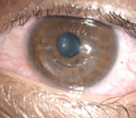
- Excimer laser surgery
- This requires a corneal laser refractive surgery excimer laser usually used for LASIK. For most of the UK this is a treatment only available privately. This is sometimes combined with crosslinking as “crosslinking plus”. We don’t yet have this laser at Frimley Health Trust. The combination of laser and crosslinking sometimes gives better vision than crosslinking alone.
- Corneal graft surgery
- This can improve the vision in advanced cases of keratoconus. It is only undertaken in more severe cases after ruling out other treatment options.
If you have any concerns after your operation, please contact the staff in the eye treatment centre on the following numbers:
| From 9am to 5pm Monday to Friday: | 0300 373 5884 |
| From 5pm to 9am and at weekends: | 0300 614 5000 and ask for the Eye Doctor on call |
Useful websites
https://
Contact us
If you have any queries relating to this information, please contact the Ophthalmology service.
About this information
Service:
Ophthalmology
Reference:
QQ/037
Approval date:
6 May 2025
Review date:
1 May 2028
Click ‘show accessibility tools’ at the bottom of the page

Then click ‘select language’

Alternative formats
You can use the accessibility toolbar at the bottom of your screen to:
-
Change the text size
-
Adjust the font
-
Modify the colour contrast
-
Use the translate function
If you would like this information in another format, such as Braille, audio, or easy read, please speak to a member of staff.
You can also print as well as download as PDF using the “Print this page” button at the end of the page.
Staff will print a copy for you on request
Important note
This page provides general information only. It is developed by clinical staff and is reviewed regularly every 3 years for accuracy. For personal advice about your health, or if you have any concerns, please speak to your doctor.