

Overall summary and benefits of the proposed approach
The proposed site is large enough to allow a modern new hospital to be designed in line with the national programme requirements. This allows for an optimised layout and masterplan configuration.
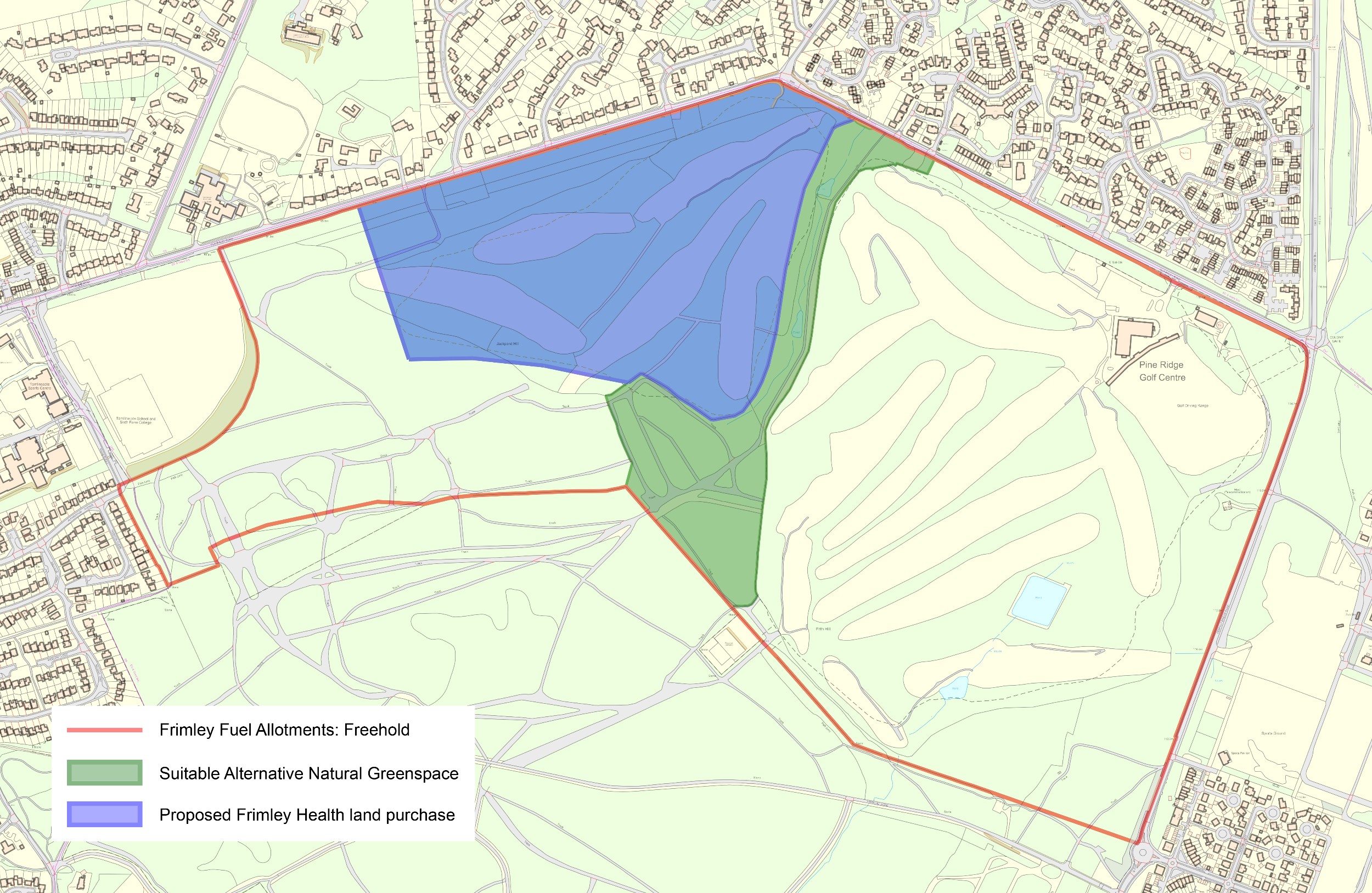
Development would be focused within a defined part of the site, carefully positioned away from the Thames Basin Heaths Special Protection Area, enabling significant areas of open and landscaped space to be retained around it.
This approach would limit the amount of land used, allow the hospital to function efficiently, and create opportunities to protect and enhance the wider landscape and natural environment, including sensitive natural habitats.
Reduced risk and stronger preparation
Extensive technical work and early design development have helped build a clear understanding of risks and opportunities associated with the site. This places the NHS in a strong position as plans move into the next stages of design, assessment and engagement.
The site selection process showed that the proposed site would offer the best opportunity to deliver a high‑quality new hospital that meets national requirements and benefits patients, staff and the wider community.
Distance from current site
It was identified as the only viable option that meets the full set of programme requirements needed to deliver a new hospital, within a five-mile radius of the existing site, helping to maintain local access for patients, staff and communities.
A modern hospital in the right place
The size of the land allows for a clear, safe and well‑planned hospital - designed to national Hospital 2.0 standards - that improves patient flow and efficiency. The site could be designed with clear entrances, good transport links and simple navigation, making it easier to access and less confusing to use.
It would offer space needed to create a welcoming environment with flexibility to adapt as healthcare needs change.
Supporting wellbeing through design and setting
The site’s natural surroundings create opportunities to design a hospital that supports recovery and wellbeing. This could include patient rooms with views across the landscape, outdoor spaces that offer calm and respite, and a more pleasant working environment for staff and volunteers.
No sale or acquisition barriers
We do not expect any acquisition barriers that would prevent us from vacating the existing RAAC affected hospital estate before the government deadline of 2035.
In summary
Taken together, these factors show that the site can support a modern hospital that can be delivered safely, with opportunities to improve care while managing risks and impacts as plans continue to develop.
While our proposed approach would offer benefits, it would also present challenges to be carefully considered as plans develop. Being open about these issues is an important part of meaningful engagement.
Challenges are expected for developments of this scale. Steps have already been taken to understand the potential challenges of the proposed location for a new Frimley Park Hospital acute hospital. This includes early pre application engagement with the local planning authority and ongoing discussions with key partners such as Surrey County Council and their highways department. As plans develop, transport, access, infrastructure and environmental considerations would be fully integrated into the overall design of the proposed site, supported by robust technical assessment.
Planning
A new acute hospital is a large and complex development. Modern hospitals are typically larger and taller than many other types of building because of the space required for clinical equipment, digital systems and essential infrastructure. As a result, potential visual and landscape impacts would need to be considered alongside the design of buildings, open space and site boundaries. This is common for large scale developments and is addressed through detailed master-planning, environmental assessment and engagement as part of the planning process.
During the next stage of the design we will build upon the formation design work we developed during the site selection process and feasibility due diligence. We will develop a level of technical information to allow a planning application to be submitted. Alongside the design of the new hospital there are two key areas that we will focus on;
- Transport / traffic / parking
- Environmental Impact Assessment
Transport and access
Transport and access are key considerations for patients, staff, visitors and local communities. Early work has focused on understanding possible access arrangements and the potential impact of the proposed new hospital on the local road network, rather than designing final solutions.
Initial desktop transport appraisals have been carried out for the shortlisted options, including the existing Frimley Park Hospital site. This work drew on publicly available information, site observations, historic traffic survey data, early modelling and professional judgement from specialist transport consultants.
The appraisals considered:
- the suitability of each site for road access and the surrounding highway network
- accessibility by public transport, including whether public transport access would be comparable to the existing hospital
- opportunities for walking and cycling
- measures that might be required to support safe and convenient access
If plans progress, more detailed traffic and transport surveys and modelling would be undertaken in partnership with local highways authorities and councils to help inform access arrangements and identify where improvements or mitigations may be required. This would include new traffic surveys at selected junctions in the Frimley, Frimley Green and Camberley areas, undertaken over representative periods (i.e. outside school holidays) to provide a reliable picture of traffic conditions. Any proposals would be subject to further assessment, engagement and the statutory planning process.
From our engagement with the local highways authority, we recognise that our traffic modelling must focus on the re-distribution of traffic within the transport network that has the capacity for growth e.g. the hospital is moving location rather than a new development adding extra traffic to the network. The proposed model of care at our new hospital will differ from the current model at Frimley Park Hospital, the new hospital will focus on acute services, with elements of outpatient services and diagnostic facilities being retained at Frimley Park and elements of elective services being moved to our elective powerhouse hub at Heatherwood Hospital. This all means a different distribution of traffic across our sites, and less traffic at our new hospital site.
Green travel plan
The profiling of traffic movements at across our sites will allow us to develop a green travel plan. The green travel plan will build on those active travel opportunities already identified and will seek to;
- Develop proposals to ensure routes to the new hospital are safe for all active travel modes.
- Ensure the design of the new hospital has the provision to support active travel modes for staff, carers and patients.
- Explore and develop attractive opportunities to reduce staff on-site parking via off site solutions.
- Develop design proposals to maximise electric vehicle charging provision to encourage and support usage.
- Ensure our travel plan proposals evidence how pollution can be reduced or offset
- Build upon our existing public transport modelling to establish viable proposals to support the new hospital location.
The green travel plan will be developed in consultation with all of our system partners e.g. primary care, ambulance services etc. There is also a wide-ranging stakeholder group that we will need to engage with as we develop the green travel plan. The development of the green travel plan will support the wider traffic network model that we will develop during the next stage of the design.
Traffic network model
We will implement a wide array of traffic surveys in the local vicinity during the next few months, these will be executed on our behalf and under licence from the local highways authority. These will be automated surveys using a mixture of road surface counters, pole mounted trip counters.
We will ensure that the data collection models the real time traffic profile for a number of weeks ensuring an accurate record traffic movements both in the vicinity of our current Frimley Park Hospital and our proposed new hospital location.
The results from the traffic surveys will then be built into a wider model. We will also engage with the local authority and highways authority to ensure any other future development / population growth assumptions in the locality are considered within our model.
The traffic network model (known within the industry as macroscopic modelling using software models such as VISUM). The model outputs will accurately define the traffic algorithm, identifying ‘pinch points’ congestion bottle necks. We will use the data to engage with the local authority and highways authority to identify and develop interventions, improvements and mitigations to ensure safety, accessibility and continued movement across the transport network in the locality.
Infrastructure
As with any major development, a new hospital would require investment in supporting infrastructure. This includes understanding ground conditions, utilities capacity, drainage and any enabling works needed to prepare the site for construction.
Environment
Ecology and biodiversity have been assessed alongside hospital design, rather than being considered as an afterthought. This has informed where development could be located and how the remaining land - including the woodland edges, habitat corridors, water features and less intensively managed areas where biodiversity is often strongest - could be managed to support nature and improve biodiversity over the long term. Improvements could include improving woodland quality, removing invasive species and creating more diverse habitats over time.
For the proposed site, careful consideration has been given to how it would be used, including specialist ecological surveys to understand the habitats present and the relationship to the wider Thames Basin Heaths area. Nearby designated sites have also been carefully considered, and this early work has informed how potential impacts could be avoided or managed. The proposed build area avoids the designated Suitable Alternative Natural Green Space (SANG), the areas identified as Sites of Nature Conservation Importance and remains outside the 400 metre buffer zone for the Thames Basin Heaths Special Protection Area.
We will also commit to delivering biodiversity net gain.