

Why we need to change
Through the work outlined above, a range of potential locations for a new Frimley Park Hospital were explored. A key principle was to remain within five miles of the existing hospital, helping to maintain local access for patients, staff and communities. Each site was assessed against a consistent set of clinical, technical, operational and delivery criteria.
As a result of this work, one site was identified as viable, that can feasibly deliver a modern acute hospital as set out in our criteria, and meet the national timeframes to replace existing NHS hospitals that have RAAC.
In particular, it:
- is close to the existing Frimley Park Hospital, helping to reduce disruption if services were to move there
- provides sufficient space and a suitable layout to support modern Hospital 2.0 design, including efficient services and smooth patient movement
- has fewer physical, planning and infrastructure constraints than other options, with access to utilities and no identified public rights of way
- supports a more straightforward and lower-risk construction approach to building on the existing site.
- offers opportunities to incorporate design features that support patient recovery and staff wellbeing, including access to green space
Importantly, the site also provides a realistic opportunity to deliver a new hospital within programme requirements and national timescales, including the need to replace RAAC-affected buildings.
The Trust has followed a rigorous, structured and fully compliant site selection process in line with HM Treasury Green Book requirements, Cabinet Office guidance and national NHS estate code guidance. Our process has been discussed widely with the Joint Health Overview and Scrutiny Committee (JHOSC) for the new Frimley Park Hospital, and has also been independently reviewed and assured by the national New Hospital Programme.
We have engaged with local MPs, councillors, planning authorities and system partners throughout this process and will continue to do so as our proposal progresses.
Identifying a proposed location does not mean decisions are final. The Trust has not purchased the land, and an agreement is in place to allow further technical work and engagement to take place. Further planning assessment, regulatory approvals and public engagement are still required, and your feedback will help shape how plans continue to develop.
Where the new hospital could be built
The proposed site is part of the land at: Pine Ridge Golf Club, Frimley
- Around 55 acres would be used
- This is approximately one fifth of the total site
Why this site has been identified
This site:
- Is within five miles of the existing hospital
- Provides enough space for a modern hospital
- Allows a more straightforward construction process
- Has fewer environmental and planning constraints
Only viable option
A wide range of potential sites were carefully assessed using clear criteria, including:
- Size and capacity
- Availability and timescales
- Deliverability and risk
- Access and location
- Environmental impact
- Value for money
Only one site met all of these requirements.
Why not rebuild on the existing hospital site?
Constraints of the current site
The existing site is:
- Small and tightly constrained
- Surrounded by roads, housing and neighbouring land
- Fully occupied by current hospital services
Challenges of rebuilding on-site
Rebuilding on the same site would involve:
- A long and complex construction programme
- Significant disruption to services
- Higher costs and risks
It could also require a much taller building, which would be difficult to deliver and have a significant impact on the surrounding area.
Limited future flexibility
A rebuilt hospital on the same site would:
- Be harder to adapt in the future
- Limit opportunities to improve services
- Make it more difficult to meet modern standards
For these reasons, rebuilding on the existing site is not considered a viable option.
Every site was assessed against the same set of criteria. To be considered viable, a site had to meet all of the following:
-
Size and capacity:
- large enough to accommodate a modern acute hospital built to Hospital 2.0 standards, with room to adapt as needs change
-
Availability:
- able to be acquired within the timescales the programme requires, without reliance on lengthy or uncertain processes
-
Deliverability:
- capable of being built without construction risks or constraints that would prevent delivery within national timescales
-
Location and access:
- within five miles of the existing Frimley Park Hospital, with suitable transport access
-
Environmental and planning feasibility:
- free from environmental, heritage or planning constraints that could not be reasonably mitigated
-
Timescales:
- able to be delivered ahead of the national requirement to remove RAAC from hospital buildings by 2035 (originally 2030, before the 2025 Mott MacDonald report)
-
Value for money:
- deliverable at a cost that represents value for the public purse, in line with HM Treasury Green Book requirements
These criteria were informed by what people told us during our early engagement in 2023 and 2024, alongside clinical advice, technical assessment and planning considerations.
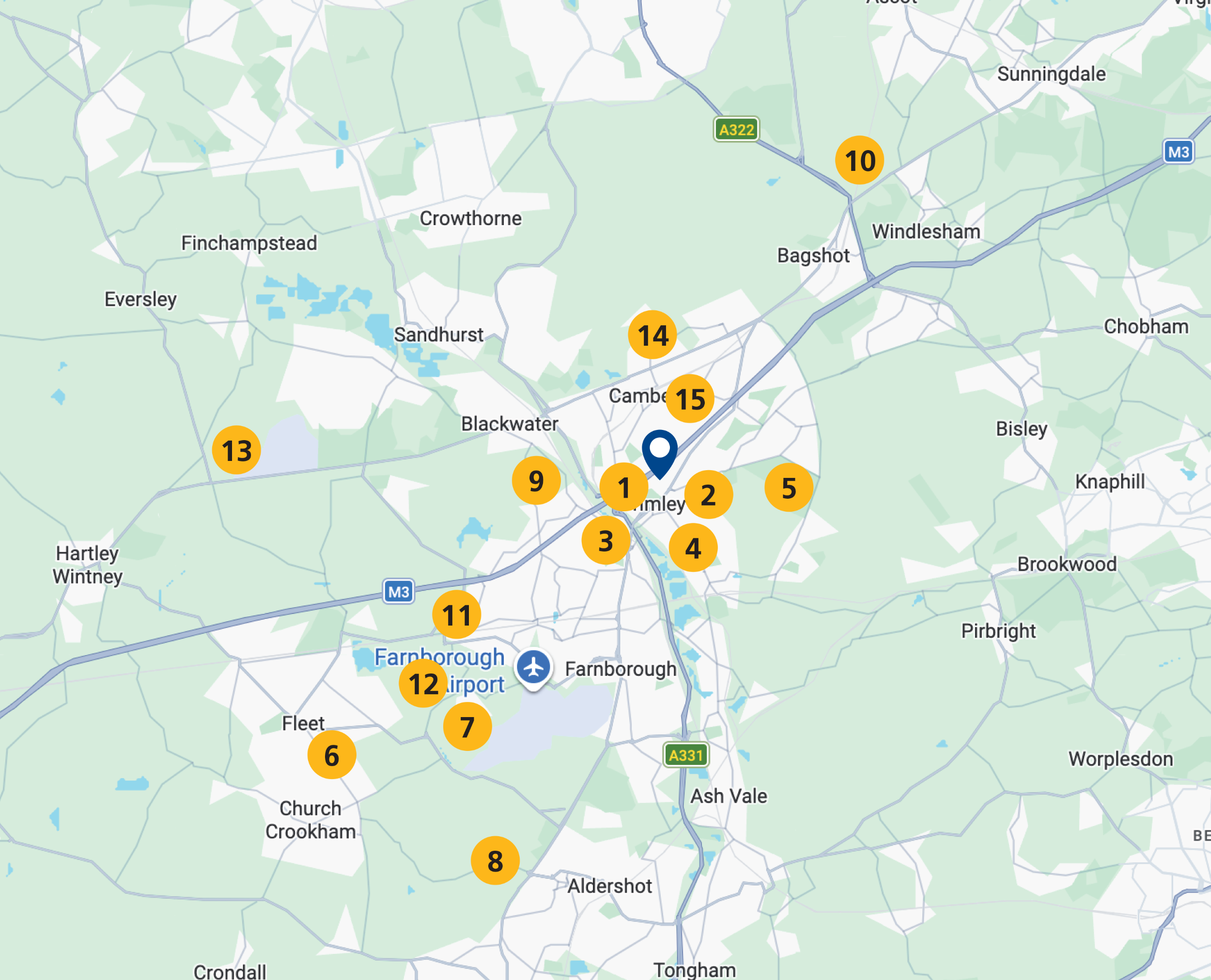
- Lyon Way / Frimley Road, Frimley
- Siemens Square, Frimley
- Frimley Business Park
- Frimley Green
- Pine Ridge Golf Club, Frimley
- Land west of Cody Tech Park
- Land east of Cody Tech Park
- Royal Pavilion Aldershot
- Hawley
- Longacres Garden Centre, Bagshot
- Discovery Place, Farnborough
- Southwood Golf Course, Farnborough
- Blackbushe Airport, Camberley
- London Road, Camberley
- Tekel's Park, Camberley
Why were sites ruled out?
There are several reasons that sites were ruled out, including:
- The site was too small
- The developable land was too small
- The site was not for sale
- The site was in a special protection area
- There were aviation constraints
- The site contained heritage assets
- The build was not operationally deliverable
Many sites were ruled out for a combination of reasons
Several sites were assessed in the vicinity of junction 4 of the M3, including sites in Hart, Rushmoor and Surrey Heath.
Two of these sites were directly within the Thames Basin Heaths Special Protection Area (SPA) and were ruled out because the environmental impacts could not be suitably mitigated.
Another site did not have a willing seller and was, in any event, too small for a new hospital.
A number of sites were identified in the vicinity of Farnborough Airport, all within Rushmoor Borough.
An aviation safeguarding study was commissioned to understand the impact of development on the airport's protected airspace.
The study concluded that a new hospital in this area would not be feasible, as it would create unacceptable impacts on airspace and airport operations.
In addition to these aviation constraints, all of these sites had their own technical and deliverability challenges.
The option of rebuilding on or next to the existing Frimley Park Hospital site relied on the use of neighbouring Ministry of Defence land for construction and logistical access, over a period of around seven years.
This land includes a Grade II listed building and a registered park and garden, both of which are designated heritage assets.
Development in this area would be likely to have a significant impact on these heritage assets, both during construction and in the long term.
While detailed heritage impact assessment work was not progressed, early discussions and planning considerations indicated that this approach would be unlikely to be supported by the local planning authority, given the scale of impact.
The Ministry of Defence also confirmed that it had no sites available.
A site not included within our Engagement Booklet but was looked at was the Broadmoor site, in Bracknell.
However this was ruled out as non-viable for the following reasons:
- Has a listed building of 150,000 sq ft in the middle of the site as well as listed curtilage buildings.
- Given the existing listed buildings there is not enough site to develop a new hospital.
- Is within the five mile radius but is a nine-mile drive from the existing site.
- The Broadmoor Estate including the original hospital complex is included on the Historic England Register of Park and Gardens of Special Historic Interest in England and designated as Grade II.
- Has a site of Special Scientific Interest (SSSI) allocation area and in part falls with the 400m Special Protection Area (SPA)
- There are a number of planning restrictions and legal obligations that would restrict the development of a new hospital.
- There is no nearby public transport network.
A number of other sites were assessed but cannot be named publicly, as their owners entered the process under a non-disclosure agreement. While the Trust is not able to disclose their locations, it is able to set out why each was found not to be a viable option for a new hospital:
One site had the potential to deliver a strong design solution but was located within the designated Green Belt, meaning any development would have required a ‘very special circumstances’ planning case. Of the shortlisted sites it lay furthest from the existing Frimley Park Hospital, and analysis showed it would have had the greatest impact on how patients, particularly the highest users of acute services, would access care. The landowner was also only willing to sell a substantially larger parcel than the hospital required, raising significant value-for-money considerations, and they ultimately chose to withdraw the site from the process.
Another site had a developable area below that needed for a new hospital and was further constrained by flood-risk areas and the need for significant utility diversions. The land was held under fragmented ownership, with parts of the site outside the seller's control and a number of existing tenancies with several years left to run. As a result, the site could not be assembled and delivered within the required timescales.
A third site scored well against several technical measures but was a comparatively confined site held across multiple ownerships and a large number of long-term leases, making land assembly highly complex. External operational safeguarding requirements also imposed height and development restrictions which, combined with the limited developable area, meant a hospital design compliant with the programme's standards could not be accommodated.
17 July 2026
To our patients, partners and all the communities we serve
Frimley Park Hospital needs to be replaced.
It contains reinforced autoclaved aerated concrete (RAAC), which means it cannot be kept safe indefinitely.
National backing means we have the chance to build a new hospital and transform the way services are delivered for hundreds of thousands of local people.
The current engagement work is focused on the wider changes to how services are provided – the model of care.
We are listening
I have heard loud and clear that you support the need for a new hospital.
And I have also heard a range of concerns about our proposal.
What people tell us will shape our plans in the months ahead and we will publish a report on our engagement work later this year.
Today, we set out why we propose to build on part of the land owned by Frimley Fuel Allotments in more detail.
The publication includes the criteria used to assess every site, the reasoning behind each decision, and the scores given.
This level of detail reflects the significance of the choices ahead, and I believe it’s important to build confidence in the process and not just the outcome.
Site selection
The Trust carried out a thorough site selection process with rigorous local and national governance.
Eighteen potential sites were assessed against a consistent set of criteria.
The Trust’s assessment has been tested and re-tested: by an independent peer review in 2024, by a joint reappraisal with the national programme in 2025 that deliberately reintroduced previously excluded sites, and by a further independent review.
Each process reached the same conclusion.
The opportunity
Ours is one of the largest schemes in the national New Hospital Programme and will support significant improvements to local healthcare, in line with the Government’s 10-Year Health Plan.
The new hospital is a key part of work already underway to transform the way health services are delivered – more care closer to people’s homes, better access to services and improving outcomes.
The potential positive impact of such a major investment in the Frimley area could have wide-ranging health, social and economic benefits for generations to come.
Missing out on the national funding to deliver all this could have an equally significant impact on health services for the population we serve and beyond.
Working together
I want us to work alongside our community to deliver the best possible hospital and services.
People have told us clearly that there are existing travel and transport issues in and around the proposed site.
Our proposal could help address long-standing concerns, like safer school access and congestion.
I very much welcome the constructive dialogue underway with local schools about how we can work together to make things better.
People also ask about the impact on the environment.
Although we haven’t done the design work yet, I can tell you that we want the hospital to be sympathetic to a much-loved green space.
I think that patients, visitors and staff will all benefit from retaining as much of the natural environment as possible.
More engagement and formal consultation to come
The current public engagement period that’s running until September will be extended so that we hear from as many people as possible while plans are still developing.
There will be more public engagement on traffic, transport and environmental issues starting later this year ahead of a planning application in autumn 2027.
Rightly, there will be a full public consultation on the proposed site through the local authority planning process.
We hope this report gives people the information they need to understand, and to challenge, the basis for our proposals and to provide us with the feedback we need.
I look forward to working with our patients, partners and communities over the months and years ahead.
Yours sincerely,
Lance McCarthy
Chief Executive
Frimley Health NHS Foundation Trust
New Frimley Park Hospital site selection report