Celebrating Allied Health Professions (AHP) Day


Date published: 20 October 2026
What started as an idea following a handful of complex trauma cases at Wexham Park Hospital has grown into a nationally recognised trauma education programme, attracting healthcare professionals from across the region while helping to strengthen emergency care for local communities.
In 2022, after treating a critically injured patient who was too unstable to transfer to a major trauma centre, Emergency Medicine Consultant Dr Anna Galley saw first-hand how much successful trauma care depends on teamwork.
"As these complex cases became more common, we wanted to ensure staff were prepared to deliver the highest standards of care in some of the most challenging situations in healthcare," says Anna.
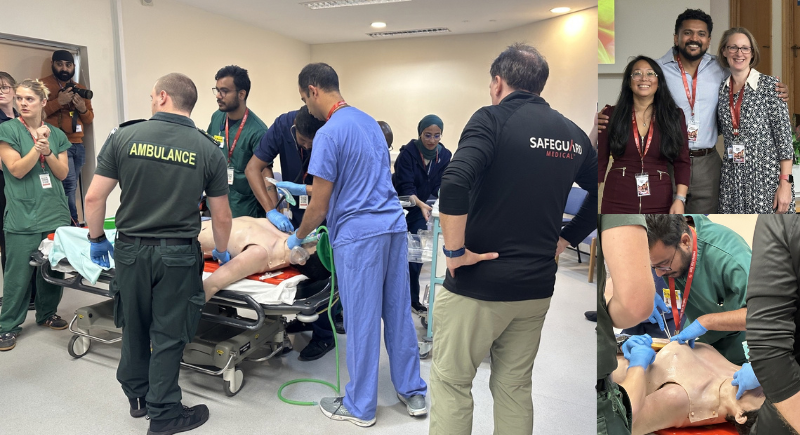
Today, Code Red brings together doctors, nurses, paramedics, pre-hospital clinicians, police and other emergency responders in highly realistic simulation environments where they can practise managing major trauma together.
Trauma is a team sport
Speaking last month on the first day of Code Red, Vasant Mohandas, who co-founded Code Red Trauma alongside Anna and Victoria Tay, explained that the programme's success came from focusing on how teams function under pressure, not just clinical expertise.
"Trauma is a team sport," says Vasant. "Healthcare professionals often train individual skills, but real-life trauma care depends on how people communicate, collaborate and make decisions together."
Using advanced simulation technology, life-like mannequins, cadaveric training together with realistic scenarios, participants experience the pressures of major trauma care in a safe learning environment.
"The clinical knowledge is already there," says Anna. "The challenge is bringing large multidisciplinary teams together, often made up of people who've never worked together before, and helping them perform under intense pressure."
To reflect real-world emergency care, the programme deliberately mixes professional groups, recognising that trauma patients are managed by multiple services working as one team.
Putting human factors centre stage
One of Code Red's most distinctive features is its focus on human factors, including communication, leadership, teamwork, decision-making, stress management and psychological safety.
Consultant Clinical Psychologists, Dr Zoe Chevalier and Dr Jane Birrell, help participants reflect not only on what happened during a scenario, but how they felt, communicated and worked together.
Zoe explained, "It's about understanding and managing ourselves and how we work together as a team in ever-changing fast-moving environments".
The programme teaches practical techniques including structured communication, controlled breathing, leadership skills and ways to safely raise concerns regardless of seniority. Clinical psychologists also deliver skills training on immediate debriefing after an event, helping teams learn from challenging situations and process their emotional impact.
"We can deal with incredibly difficult situations in the moment, but it's what happens afterwards that matters too," says Anna. "We're humans, not machines, and without time to reflect, those experiences can build up."
Alongside the training programme, the team is now researching confidence, cognitive workload and team performance to better understand the impact of simulation and human factors education on patient safety and workforce wellbeing.
Preparing teams for the rarest emergencies
Each year, the simulation service supports around 5,000 staff in simulation activity, equating to approximately 28,000 hours of simulation-based learning.
According to Dr Pete Woodford, Head of Simulation, Education TEL and School of Health, the goal is to prepare staff for rare but critical situations they may encounter only once in their careers.
"We're investing in more life-like mannequins and creating simulations for procedures that are incredibly rare but absolutely critical when they happen," he says. "The aim is that staff aren't experiencing them for the first time in real life."
Future plans include expanding in-situ simulations for Emergency Departments, allowing multidisciplinary teams to practise in their own clinical environments while testing systems, processes and teamwork.
The Trust is also developing new simulation resources, expanding faculty development programmes and launching an Actors Academy for staff willing to help create these incredibly realistic training scenarios.
Benefits for patients and the wider community
Ultimately, Code Red is about more than training healthcare professionals. By helping emergency teams build confidence, strengthen communication and practise life-saving procedures before they encounter them in real life, the programme aims to ensure patients receive the safest possible care when seconds matter most.
From 80 participants in its first year to more than 160 attendees over two days in 2026, Code Red has grown rapidly, attracting healthcare professionals from across the region.
Yet despite its growing reputation, its purpose remains unchanged.
"We know we are capable of delivering excellent trauma care," says Anna. "Code Red is about making sure we can do that consistently, every single time."